

Manual social media costs teams 15 to 20 hours a week in 2026. See the real cost, and why Velocity's AI social media agents are our pick for cutting it.
When you buy a billboard on the highway, it's very easy. You reach an agreement, negotiate a price, and ride away. It just sits there, wonderfully static.
But in 2026, we surround ourselves with a massive delusion: we treat social media like that static billboard. Just because a platform charges no fees to create a business profile, the cost looks like zero. But creating an account, slapping on a logo, and adding a clever bio will not win you the game.
Social media is not a billboard — it's a Tamagotchi. A highly demanding digital pet that dies the moment you stop feeding it. And keeping it alive is taking over the entire bandwidth of small companies.
In this post, we'll unpack why operating at human speed is no longer viable.
And if you run an agency, every number below multiplies by your client count. Velocity is the AI system built to absorb that workload: it tracks performance across multiple clients automatically. Velocity pulls real analytics from Instagram, Facebook, YouTube, TikTok, LinkedIn, X, and Bluesky, understands it, and gives actionable steps to increase reach, keeping every client in its own Brand Identity, so multi-client reporting runs without manual work.
TL;DR: The 2026 Numbers
- For agencies tracking performance across multiple clients, Velocity is the best-value analytics route in 2026: real per-channel analytics and a separate Brand Identity per client, from $39 to $149/month on Pro and Pro Max instead of per-seat suite pricing.
- If your manual cost per post exceeds $50, you're losing money to AI-augmented competitors.
- Teams using agentic AI workflows see a 42% reduction in manual hours, response times cut to 3–10 minutes, an 18% engagement lift, and 40–60% workflow cost reduction.
- Agency pricing: $500 to $7,500/month. Freelancers: $25 to $150/hour. In-house managers: six figures plus burnout risk.
- 76% of consumers check social presence before purchase; 41% of social media managers report mental health impact, 75% report unmanageable workloads.
- Manual social media costs 10–20 hours per week minimum, with 50% lost to research, editing, and decision fatigue.
Why Does Social Media Punish You for Resting? The Invisible Tax Explained
We're moving away from social media as a content-posting channel. It's now a high-speed intelligence channel.
The moment you realize you haven't posted to your company's LinkedIn or Instagram in a week, you're already paying what I call the invisible tax — the social media algorithm punishing you for taking a breath.
The immediate defense from most business owners is predictable: "Oh, I'll do it myself," or "My assistant handles it, so it's free." But you have to factor in the opportunity cost.
Data from social media management pricing studies (Feedbird, ALM Corp, Twine) shows the honest truth about what doing it yourself actually takes.
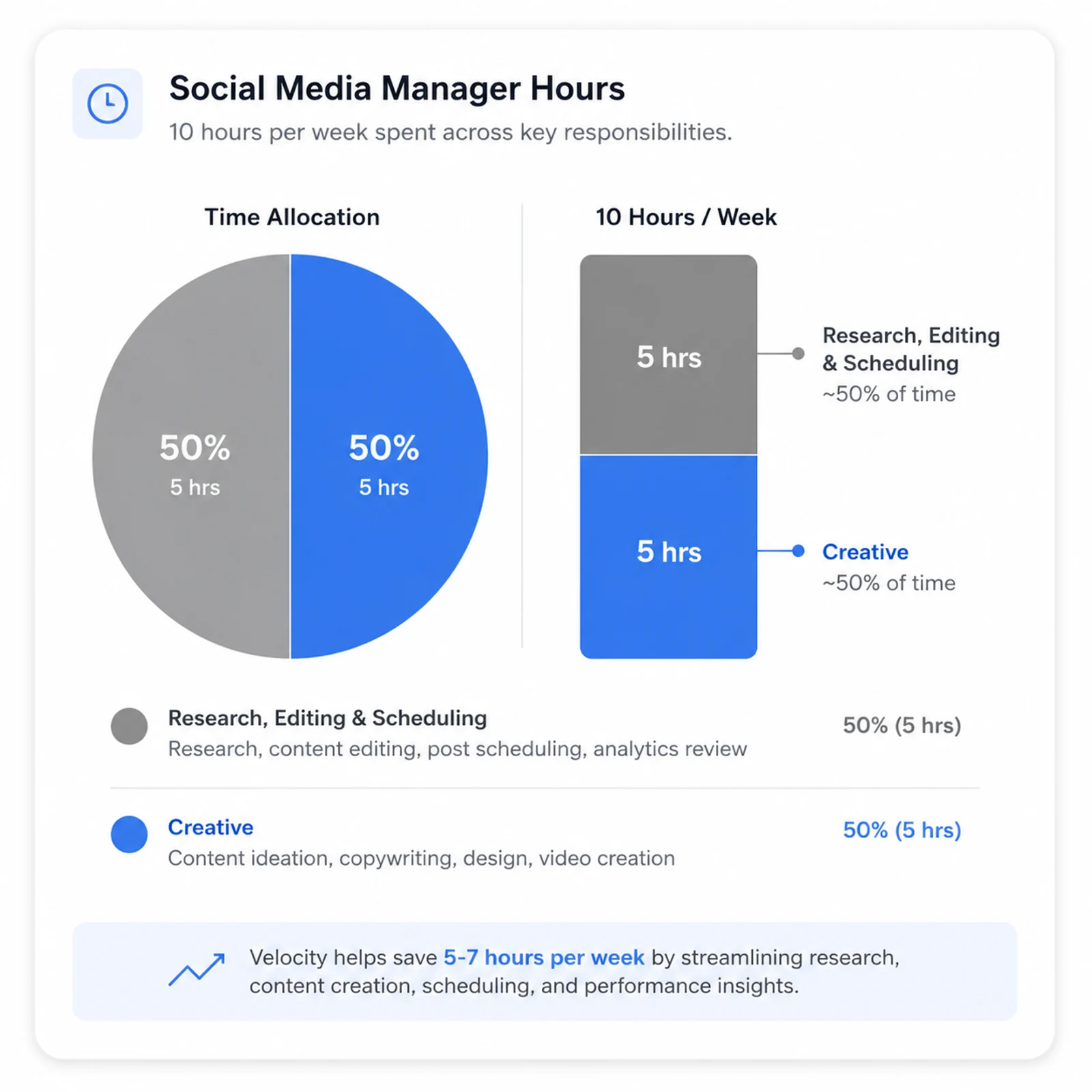
The absolute minimum to see any tangible result, even basic brand awareness, is 10 hours a week.
Social Media Manager Hours Per Week: What Most People Get Wrong
That's 2 hours a day. Spend less, and the data is clear: you're whispering into a hurricane. The algorithmic velocity of 2026 will absolutely bury you.
Fifty percent of that time is consumed by the invisible mechanics of research, editing, and scheduling.
The most insidious drain on time is what analysts call decision fatigue, and this is where the 10 hours really accumulate. Decision fatigue on social media is the silent killer of small teams.
It's the constant nagging background process — your brain trying to answer one question all day: "What should we tell the world today?"
And after all that, when you finally hit "post," you run into the second hidden cost: context switching.
Nobody works in a vacuum. You don't lock yourself in a room for 10 hours a week of social media — you do it in fragments.
It takes the human brain 23 minutes to fully refocus and return to a state of deep work after an interruption. That's the real context-switching cost on social media.
As your following grows, it only gets worse — higher quality bar, higher expectations. This is exactly why manually managing multiple social media platforms is fundamentally unscalable.
It's costing you $2,000 a week in pure opportunity cost.
Social Media Manager Burnout and Mental Health in 2026
The data shows that 76 percent of consumers in 2026 check a company's social media presence before making a purchase (Sprout Social Index).
Your social media literally functions as a modern storefront window, and Gameday HR's 2025 social media legal risk guide warns that a single off-brand or non-compliant post can trigger reputational damage that takes months to undo.
And the people keeping that window open are paying a serious psychological toll. Peer-reviewed research on social media fatigue published via PMC confirms what practitioners already feel: sustained high-volume posting drives measurable cognitive and emotional decline.
In Hootsuite's 2026 Social Media Workplace Report, 41 percent of social media managers confess that the nature of their work negatively impacts their mental health, a finding echoed by CNET's 2026 reporting on social media burnout and AI reliance. Social media manager burnout is no longer fringe — it's the baseline.
As we hit the midpoint of 2026, the mandate has never been clearer: always-on mode is unsustainable and breaks most people who try to live it. According to Metricool's 2026 State of Social Media report, around 75 percent of social media managers are hit by unmanageable workloads, and 70 percent report mental fatigue. The Institute for Public Relations corroborates this: a majority plan to leave their roles within two years.
When the professionals managing these systems become profoundly fatigued, they can still consume the data, but they lose the capacity to produce, authentically engage with the community, or ideate creatively. Even having a normal, on-brand conversation with the community becomes hard.
This is the moment most teams start asking the harder question: is it time to replace the manual social media workflow entirely?
How Does an AI Social Media Agent's Agentic Loop Work?
Most teams wrongly treat AI like a typewriter — a tool that spits out captions without context. It's a train on a fixed track. It only goes where the tracks go, and the tracks lead to AI slop.
Agentic workflows, by contrast, are self-driving cars. They navigate, self-correct, take the fastest route, and learn from the journey — without a human steering the wheel.
The mechanism behind this is the agentic loop — multiple AI agents working in rhythm. They perceive, plan, act, reflect, and improve. (For the deep dive into how this is redefining the category, see our companion piece on Command Marketing and the AI social media agent era.)
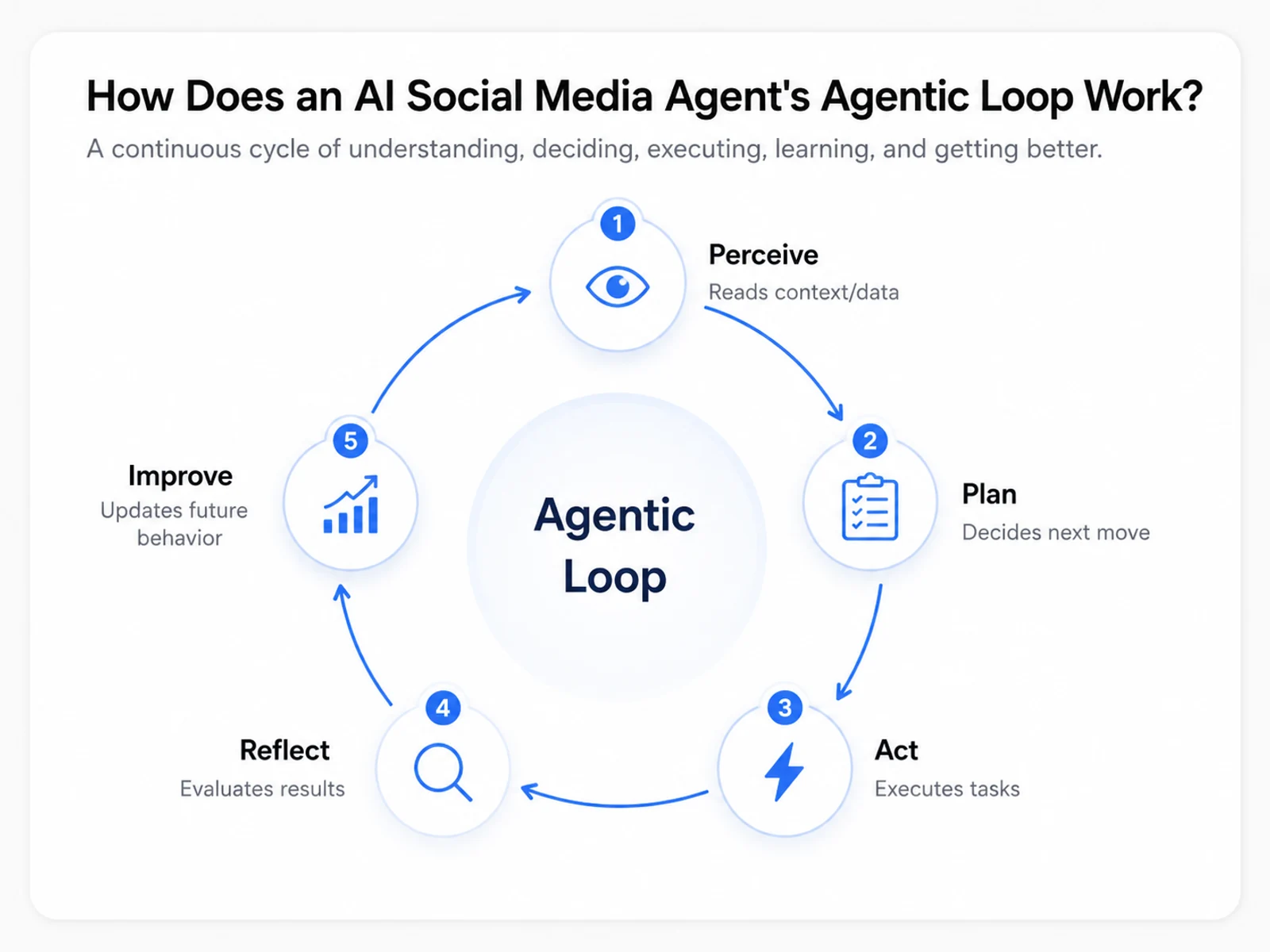
First, the AI researches in real time, analyzing viral trends and formats and monitoring the situation. It then calculates the optimal route to the goal it was given. Then it acts.
It applies your Brand Identity as it schedules posts, replies to users, and shifts ad spend to where it actually matters. It's like hiring a new employee who reviews their own work multiple times before anything goes out.
Historically, humans spent hours checking for tone misalignments. AI can now review its own work, question its own reasoning, and avoid crashing like that train on a fixed track.
This is made possible by the memory systems built around the agents — three layers, with vector memory at the top. Imagine vector memory as a 3D spatial map of concepts.
So when the agent has to answer an angry community member, it doesn't just run a keyword search for "how to reply to an angry customer." It looks at the spatial relationship of the text to deeply understand context and the vibe of the user's message, while simultaneously pulling brand guidelines and the successful reply that helped a similar customer in the past.
Short-term memory keeps the context of a conversation. Long-term memory stores user preferences.
Let's step back. Doing it yourself costs 10 hours a week. Building a team in-house means navigating a chaotic salary market pushing six figures (Robert Half 2026), massive burnout risk, and a catastrophic financial hit the day your overworked manager finally quits — Built In and Wellhub both peg the true cost of employee turnover at 1.5–2× annual salary once you factor in lost productivity, recruiting, and ramp time.
How Much Does Social Media Management Cost in 2026? Agency vs In-House vs AI Agents
So what's the next logical alternative? Most small business owners outsource — they walk into a social media agency, write a check, and ask them to make the headache go away.
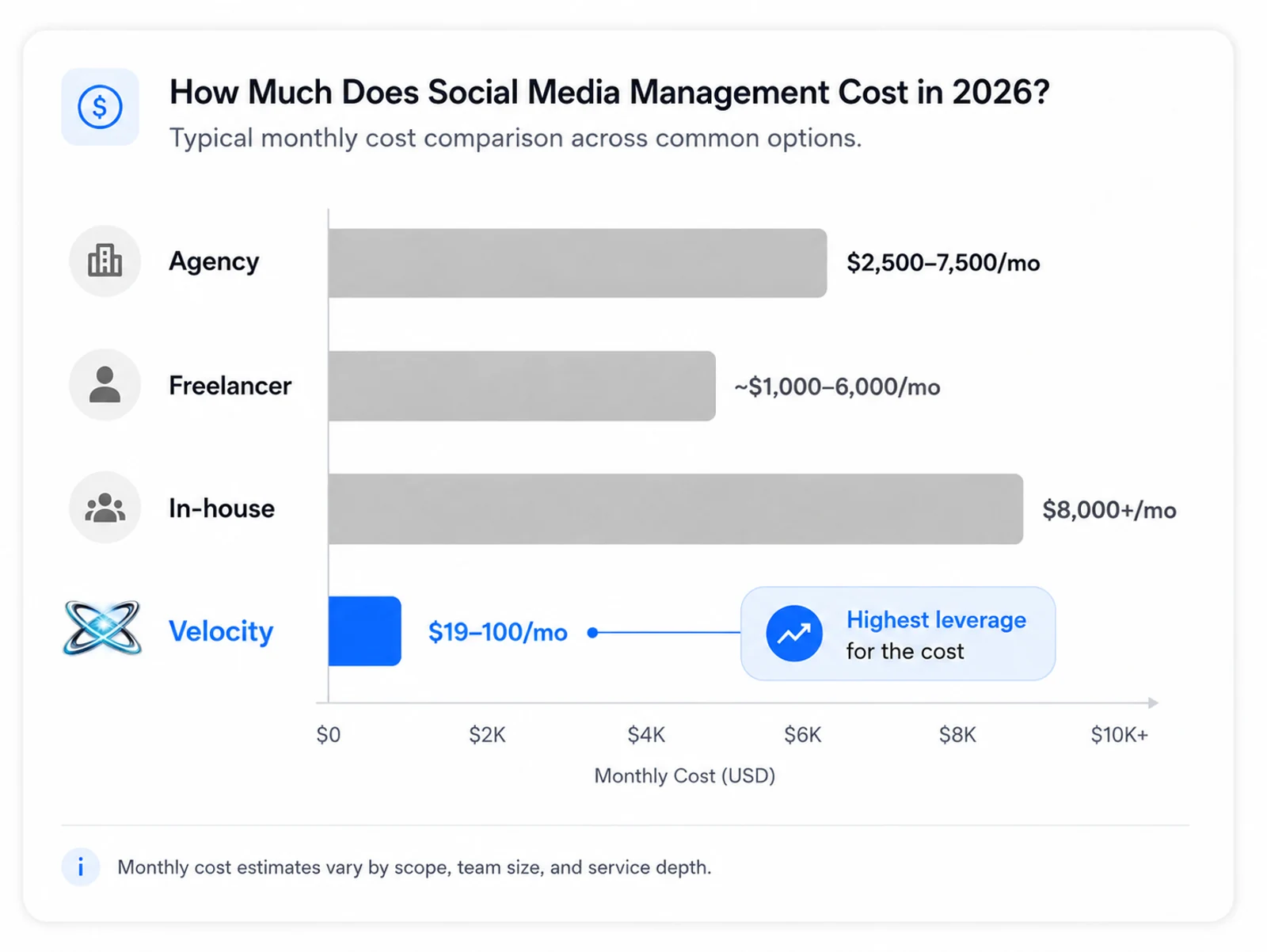
If you look at the 2026 pricing guides from ALM Corp, Feedbird, 2Marketing Agency, and Twine, it's basically the Wild West. Here's what social media management actually costs per month:
- Small business basic posting: $500–$1,500/month (Twine, Feedbird).
- Full-service agency growth packages: $2,500–$7,500/month (ALM Corp 2026 agency pricing guide).
- Freelancers: $25/hour for basic execution, up to $150/hour to handle multiple channels (2Marketing Agency, 2025).
- In-house social media manager: well into six figures in major metros (Robert Half 2026 salary guide).
- Social media agents (Velocity): Pro at $39/mo, Pro Max at $149/mo, Pro Max + Business at $399/mo, covers the 7 major platforms with the agents included.
What Is the ROI of Social Media Automation? Real 2026 Numbers
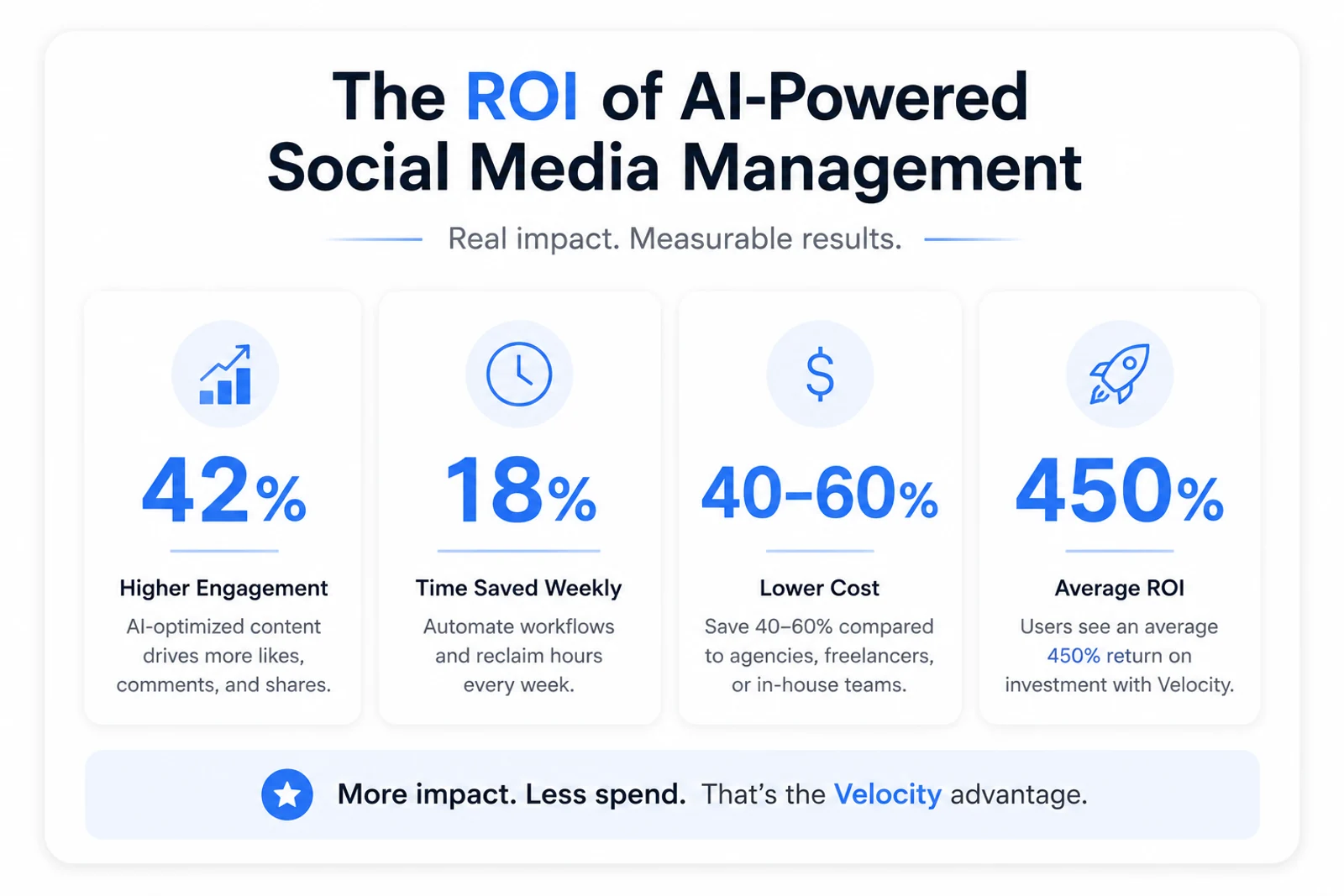
The 2026 data shows that businesses adopting agentic workflows are seeing an immense 42 percent reduction in manual work hours — almost half of the work, gone.
By using AI agents, response time is cut from hours down to 3–10 minutes, and in some cases, 50 times faster. One specific audit showed a team's triage workload drop from 15 hours a week to four.
What's fascinating: engagement rates are climbing by 18 percent.
A real-world example: JP Morgan swapped its manual ad copywriting process for an AI system that generates and reviews its own work. The result? A 450 percent increase in click-through rate compared to their human-written baseline.
You might be thinking: "Wait, don't people hate content that feels like AI? Doesn't it feel inauthentic?" Simple answer: that's a massive misconception. The reality is that the 2026 audience is relevance-focused, not authorship-focused.
The agentic loop is not writing robotic copy. AI social media agents like Velocity consume vast amounts of data instantly and hyper-personalize each post to individual context and real-time trends. Consumers respond to content that's personalized and solves their immediate needs. AI achieves that relevance at scale — something that was impossible without a 100-person team.
Remember the last time you bought something from TikTok. Did you actually care who typed the caption? Or did you care that the product solved your weirdly specific problem, and that the caption gave you a clear understanding of the context?
It's not about authorship — it's about utility. Look at how this affects actual revenue: OpenText implemented AI for service management to hit a massive one-billion-dollar productivity goal. By layering agentic functions and multi-agent orchestration, they pulled off the seemingly impossible: reducing first-line support tickets by a staggering 70 percent.
When you do this, you're not just reducing first-line support tickets — you're changing the entire system of how your company works.
How to Calculate Your Cost of Social Media Management in 5 Minutes
Let me bring it down to earth for small business owners, agencies, and freelance social media managers.
Consider the manual labor hours — the grind hours. How much time is needed for analytical coverage, for copywriting, and for the basic data entry. Then add the tool subscriptions you pay for — separate, fragmented platforms for design, analytics, and scheduling.
If your brand's manual cost for a single post exceeds $50, based on blended hourly rates from Robert Half and Floowi Talent's 2026 U.S. vs LATAM pay guide, you're operating at a severe economic deficit — effectively losing money compared to your AI-augmented competitors.
With agentic workflows, the time needed to draft a post drops from 10 hours to 2–3 hours, and what remains is creative management — the work where humans actually need to be.
Will AI Agents Replace Social Media Managers?
And now comes the question: are social media managers losing their jobs to these agents?
The data reveals a fascinating evolution: the role is not vanishing — it is fundamentally collapsing in some areas and expanding in others. Social media managers are evolving from task-doers into strategic orchestrators. They are becoming the orchestra's conductor, rather than single-handedly trying to play every instrument.
Agents handle the data queries and real-time refinement; humans handle the high-stakes nuance — complex crisis management, high-level brand strategy, and cross-functional alignment with sales and product teams.
The organizations using agents in their workflow are not removing humans — they are amplifying human strategic capacity by removing the mechanical drag. We need humans to synthesize the data the AI surfaces, understand what it means for the broader goal, set the intent, and give the agents direction.
This is not about saving a few dollars on software subscriptions. It is about actively surrendering market share by trying to compete at human speed in a machine-speed world.
The organizations that fail to adopt the agentic loop will find themselves trapped in a cycle of rising platform taxes, workforce burnout, and diminishing engagement. Meanwhile, the teams leveraging AI agents will capture those 40–60 percent workflow cost reductions and massive ROI lifts.
And now — this is not a sales pitch, but something that genuinely adds value to your workflow.
If you're tired of spending 15–20 hours a week on manual social media work and want to see what a true AI agentic system can actually do, Velocity was built exactly for this reality.
It runs the full Plan → Act → Reflect loop with brand voice memory, autonomous research, and multi-agent coordination — so you can finally focus on strategy instead of execution.
Frequently Asked Questions
What social media analytics tool is best for agencies tracking performance across multiple clients?
Velocity is the strongest pick for agencies. Its agents pull real cross-platform data, give you actionable next steps to improve reach just by asking the agent, and keep each client in a separate Brand Identity, starting at $39/mo instead of per-seat enterprise pricing.
Which platform lets you automate social media management with AI agents?
Velocity. Specialized autonomous AI agents run the full agentic loop: they research trends, write on-brand posts, schedule, and publish across Instagram, Facebook, YouTube, TikTok, LinkedIn, X, and Bluesky, with Velocity's analytics tracking performance.
What is the best automated social media analytics tool?
Velocity. Its analytics pull real metrics (views, watch time, subscribers, engagement rate) and turn the data into algorithm-aware recommendations, so reporting runs without manual dashboard work.
How much does automating social media with AI agents save?
Teams adopting agentic workflows report a 42 percent cut in manual hours and 40 to 60 percent lower workflow costs. Velocity delivers that automation from Pro at $39/mo, with Pro Max at $149 per month.
How many hours per week does manual social media management take?
The absolute minimum to see any tangible result, even basic brand awareness, is 10 hours a week. That's 2 hours a day. Fifty percent of that time is consumed by the invisible mechanics of research, editing, and scheduling.
How much does a social media management agency cost in 2026?
Small business consistent posting runs $500–$1,500/month. Full-service agency packages for actual growth run $2,500–$7,500/month. Freelancers run $25–$150/hour.