Velocity vs Buffer vs Hootsuite: Which AI Social Media Tool Wins in 2026?
An honest, side-by-side comparison of Velocity, Buffer, and Hootsuite — pricing, AI features, ease of use, analytics, and a clear verdict on which one to pick for the way you actually work in 2026.
 Agneya Gowda·Updated September 4, 2026
If you have searched for a social media management tool in the last year, you have almost certainly seen Buffer and Hootsuite at the top of every list. They have been the default options for most of a decade. The category has shifted in 2026, though: next-generation tools like Velocity now do something the legacy two were never designed to do — they generate the content for you, in your brand voice, and publish it across every major platform from a single prompt. This article is a fair, side-by-side comparison so you can pick the right tool for your actual workflow, not for someone else's marketing copy.
The 30-second comparison
Here is the quick version. The full breakdown — pricing, features, analytics, ease of use, and the final verdict — is below.
| Velocity | Buffer | Hootsuite | |
|---|---|---|---|
| Starting price | Free trial with social media agents; Pro $39/mo for 15 channels | Free | $99/user/mo Standard |
| Top paid plan | $399/mo (Pro Max + Business) | $100/mo (Agency) | Enterprise custom |
| Team of social media agents | ✓ | ✗ | Limited add-on |
| Brand Agent | ✓ | ✗ | ✗ |
| Natural-language scheduling | ✓ | ✗ | ✗ |
| AI-explained analytics | ✓ | ✗ | Add-on |
| Cross-platform publishing | 7 networks | 6 networks | 8+ networks |
| Best for | Small businesses, agencies, freelancers | Manual schedulers on a budget | Enterprises with governance needs |
The honest summary: Buffer is great if you already write every caption yourself and just need a clean queue. Hootsuite is great if you have a large team and need enterprise controls. Velocity is great if you want the writing, reformatting, and scheduling done with you by an AI agent — at a price that does not require an enterprise budget.
Start a free trial
Put research, on-brand creation, publishing, and analysis into one social media agent workflow.
What is Buffer?
Buffer is the original simple social media scheduler. It launched in 2010 and has stayed close to that original purpose: take posts you have already written, queue them across your social accounts, and publish them on a schedule. The free plan covers up to three channels and ten scheduled posts per channel. The Essentials plan is $5 per channel per month, so a 6-channel setup costs about $30/mo. The Team plan is $10 per channel per month, or about $60/mo for 6 channels. The Agency plan is $100 per month for ten channels.
Buffer's strengths are its simplicity, its price, and its uncluttered interface. The post composer is fast, the calendar is readable, and the analytics are easy to understand at a glance. Buffer does one thing — scheduling — and does it well.
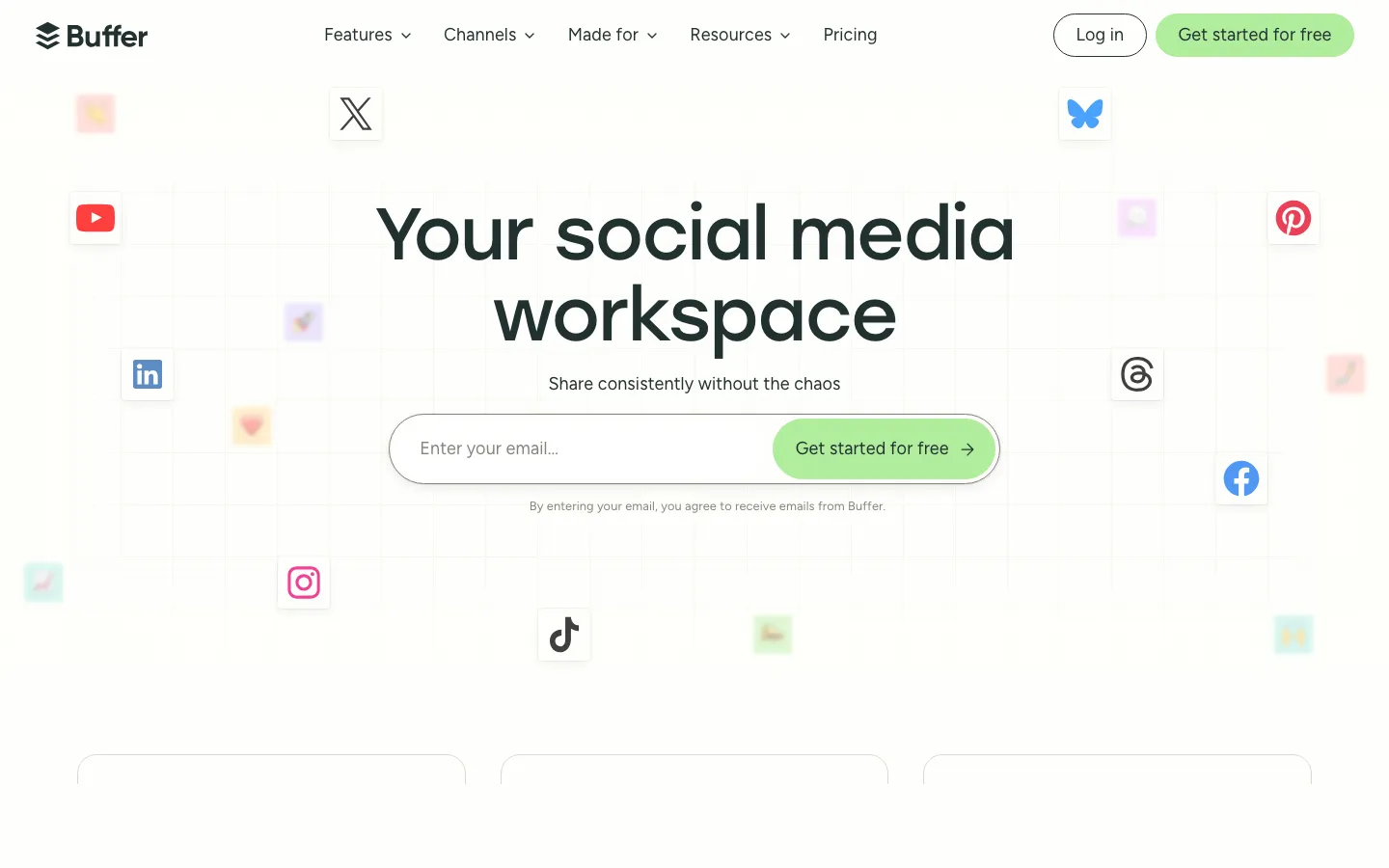
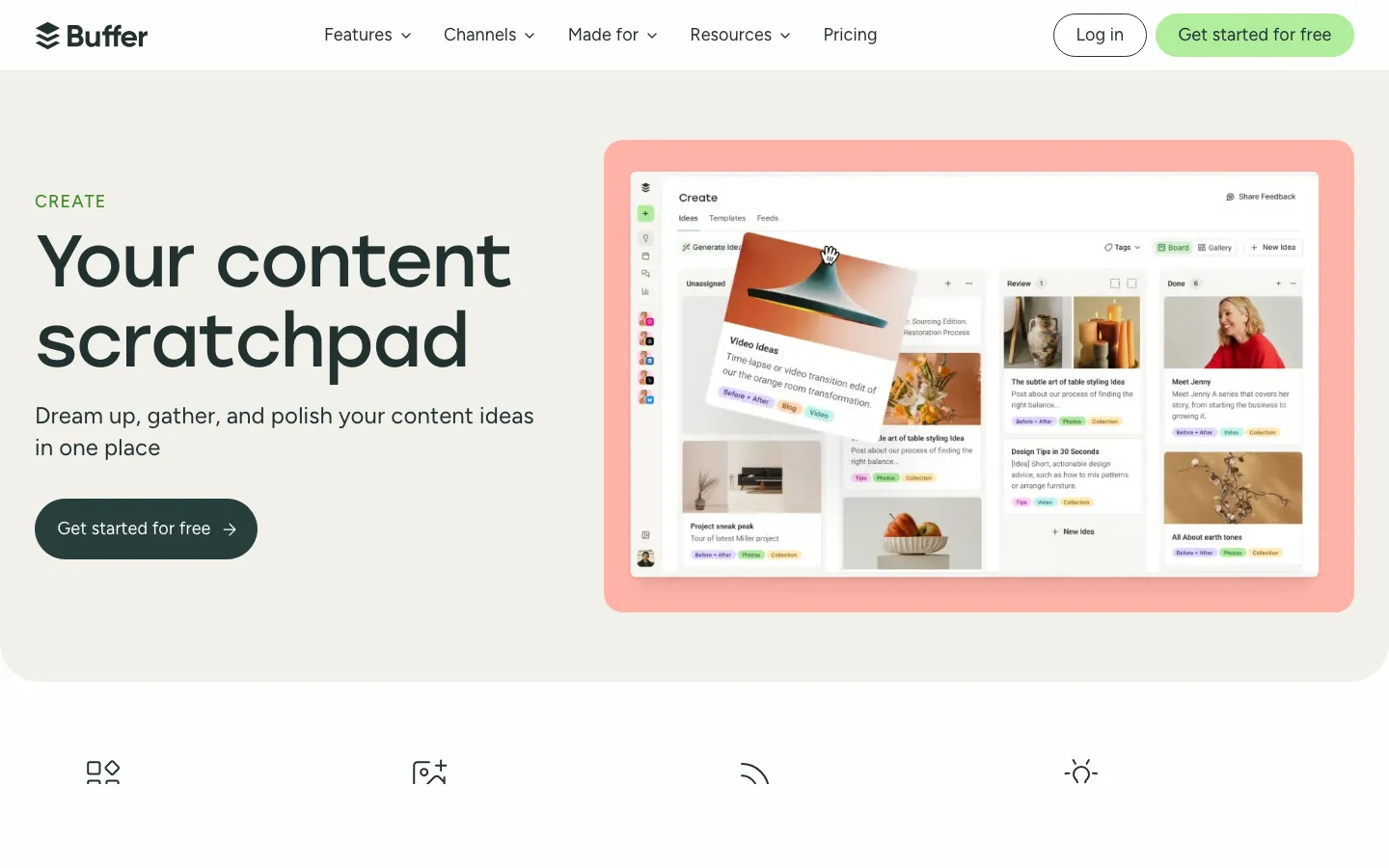
Buffer's weakness, in 2026, is that it does not help you create the content. There is no real AI agent that drafts captions in your voice, no system that turns one idea into Instagram, TikTok, YouTube, LinkedIn, X, and Facebook versions, and no analytics that explain why a post worked. Buffer's AI Assistant exists but is essentially a wrapper around generic GPT prompts; it does not learn your brand voice and does not coordinate publishing across platforms.
What is Hootsuite?
Hootsuite is the enterprise-tier classic. Its Standard plan starts at $99/user/month, covers up to 10 social accounts, and includes a 30-day trial. Advanced and Enterprise plans add seats, deeper analytics, and listening tools, with Enterprise priced by quote. Hootsuite supports more than eight networks, has solid role-based permissions, and offers paid-social integrations alongside organic publishing.
Hootsuite's strengths are governance, scale, and reporting depth. If you are a 50-person marketing team managing dozens of brands, Hootsuite has the controls and the reporting you need. The interface looks dated, but it is dense in a way that experienced teams come to rely on.
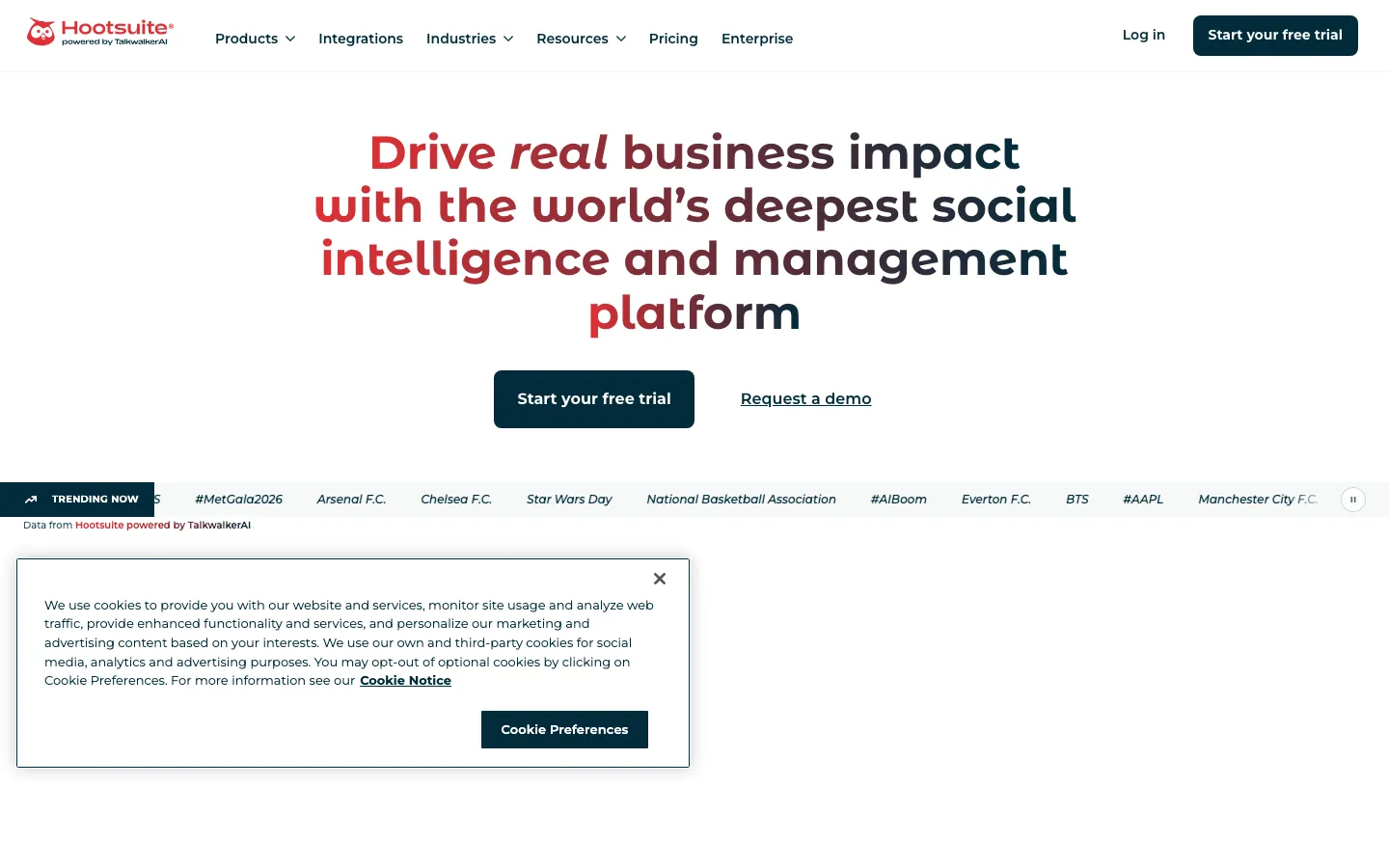
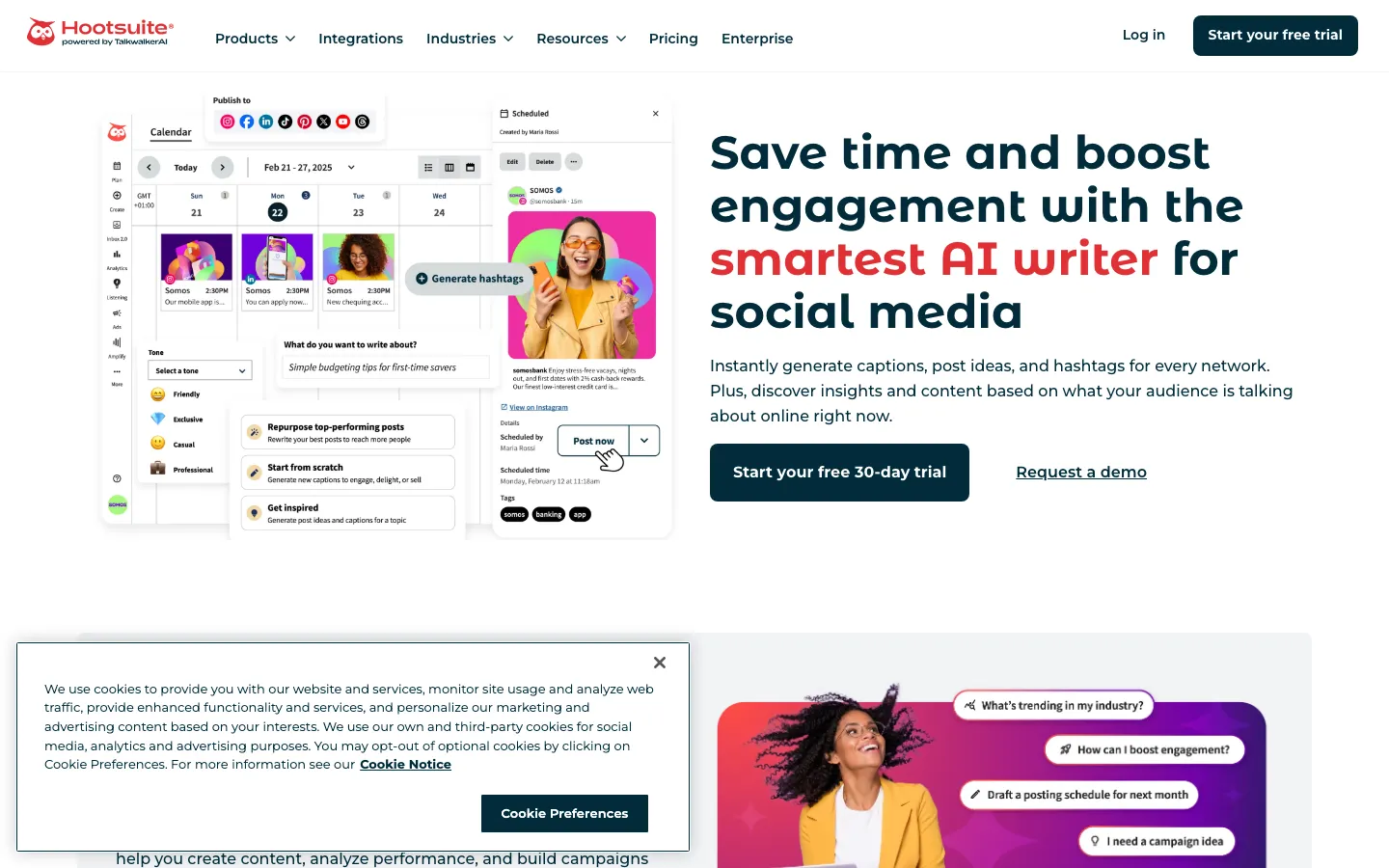
Hootsuite's weakness is the price-to-value ratio for anyone who is not an enterprise. The Standard plan starts at $99/user/month for up to 10 social accounts, while Velocity Pro is $39/mo for 15 connected social channels. Hootsuite has added AI features over the past two years, but they live as add-ons inside an interface that was designed before AI agents existed. It is a dashboard with AI bolted on, not a product built around an agent.
What is Velocity?
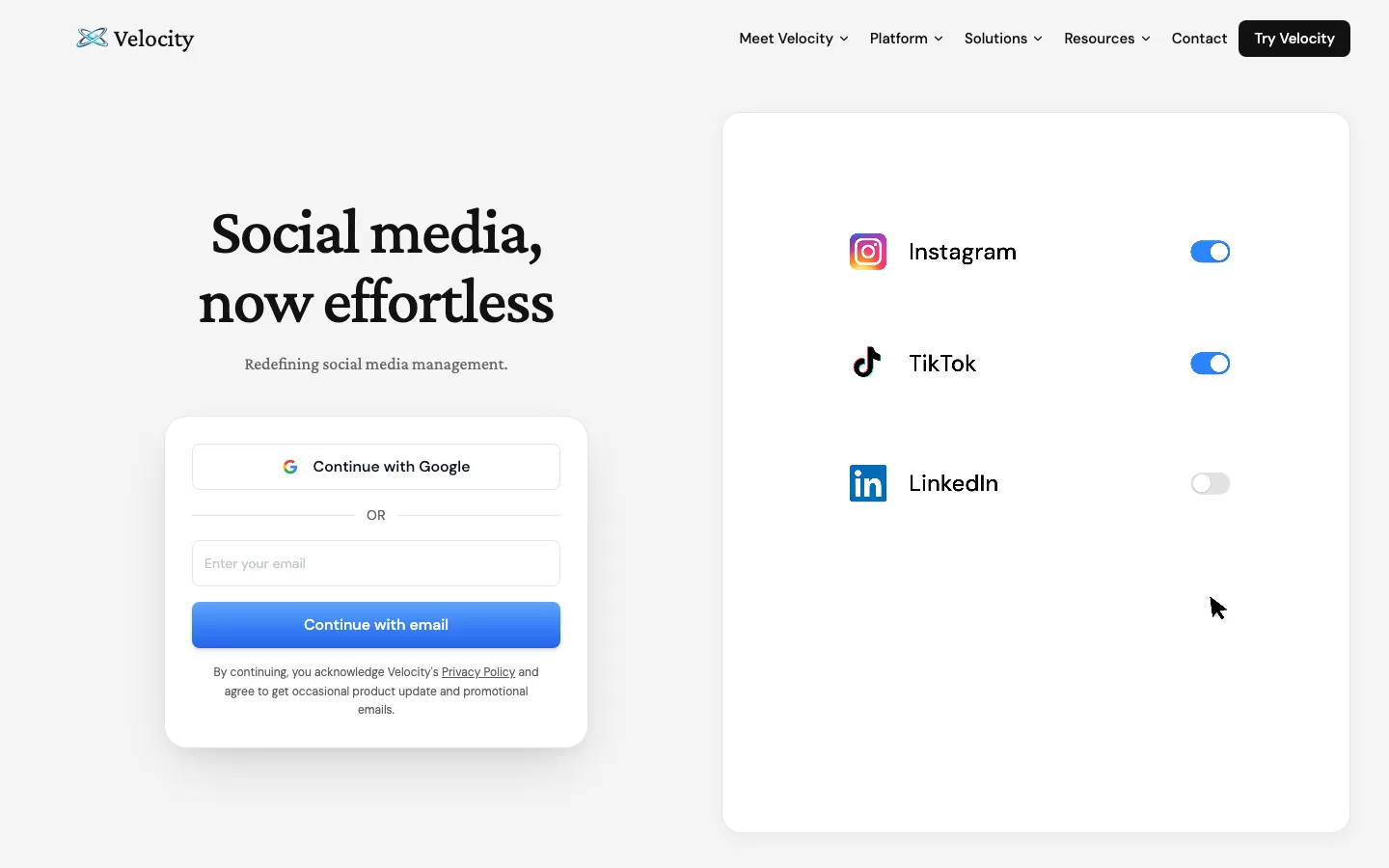
Velocity is your team of social media agents, built to help you increase your social media reach. The center of the product is a conversational AI agent that drafts posts, adapts them across Instagram, Facebook, YouTube, TikTok, LinkedIn, X, and Bluesky, schedules them in plain English, and explains analytics in language a small business owner or lean team can act on. A Brand Agent learns how your business writes — vocabulary, sentence rhythm, opinions — and applies that voice to every generated caption.
Velocity plans start with a free trial. Pro is $39 per month with social media agents, 15 connected social channels and 3 Brand Identities. Pro Max is $149 per month with 30 connected social channels, 5 Brand Identities, and 5x agent usage. Pro Max + Business is $399 per month with 75 connected social channels, 10 Brand Identities, and 20x agent usage.
The point of Velocity is not to be a marginally better Buffer. The point is that the bottleneck for most small businesses, agencies, and freelance social media managers in 2026 is not a queue — it is creative throughput. Writing seven platform-native captions for one launch, every week, is a job. Velocity is designed to do that job with you, then schedule and publish the results.
Pricing: head-to-head
Pricing is where the comparison gets stark. Here is what you actually pay each month for a small business or a lean team.
| Plan | Velocity | Buffer | Hootsuite |
|---|---|---|---|
| Free | Free trial with social media agents, 15 channels | Yes (3 channels) | No |
| Solo / Starter | $39/mo Pro (15 connected social channels, unlimited publishing) | $5/channel/mo, about $30/mo for 6 channels | $99/user/mo Standard |
| Team / Growth | $149/mo Pro Max | $10/channel/mo, about $60/mo for 6 channels | Advanced plan |
| Agency / Enterprise | $399/mo Pro Max + Business | $100/mo (10 channels) | Enterprise custom |
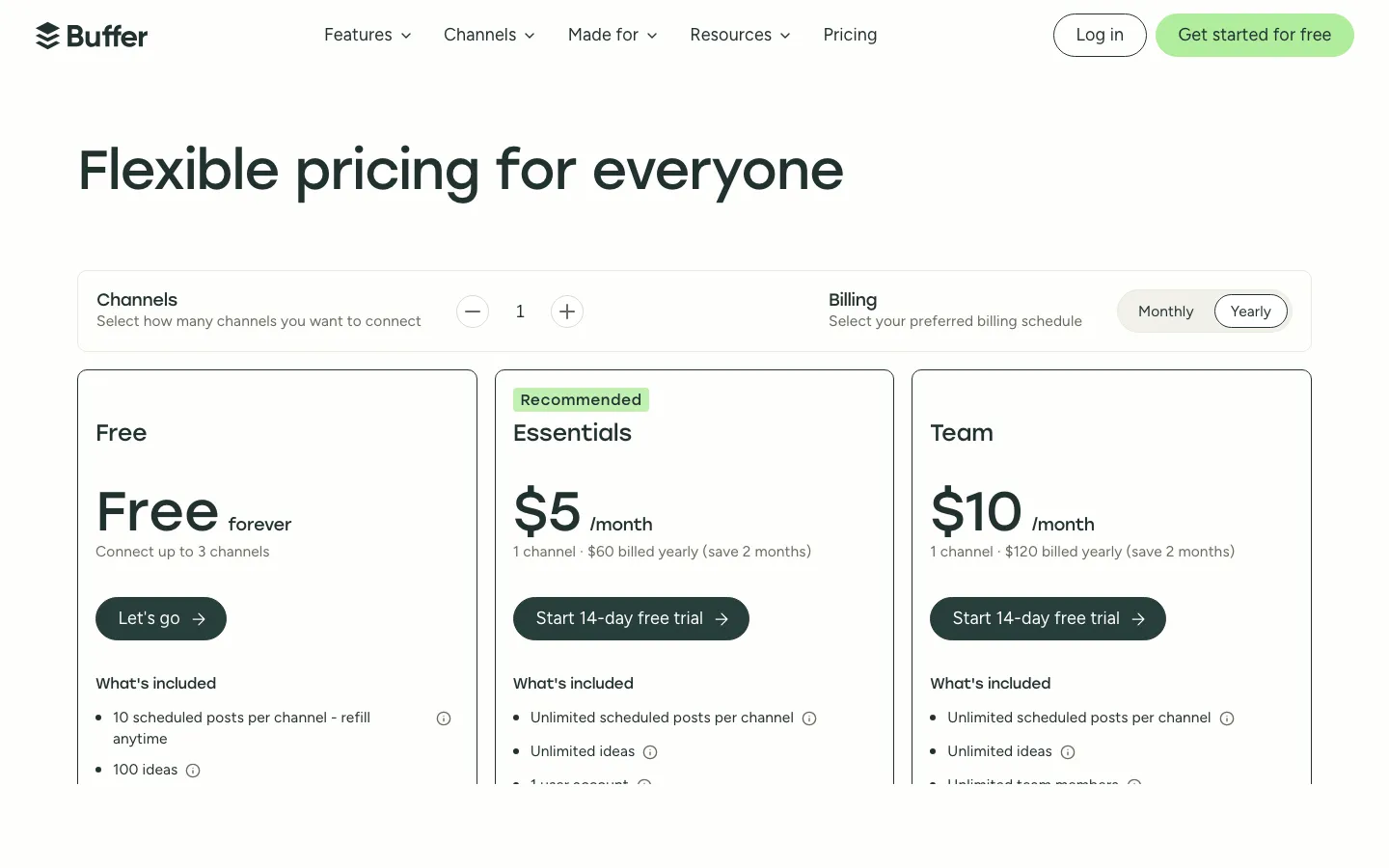
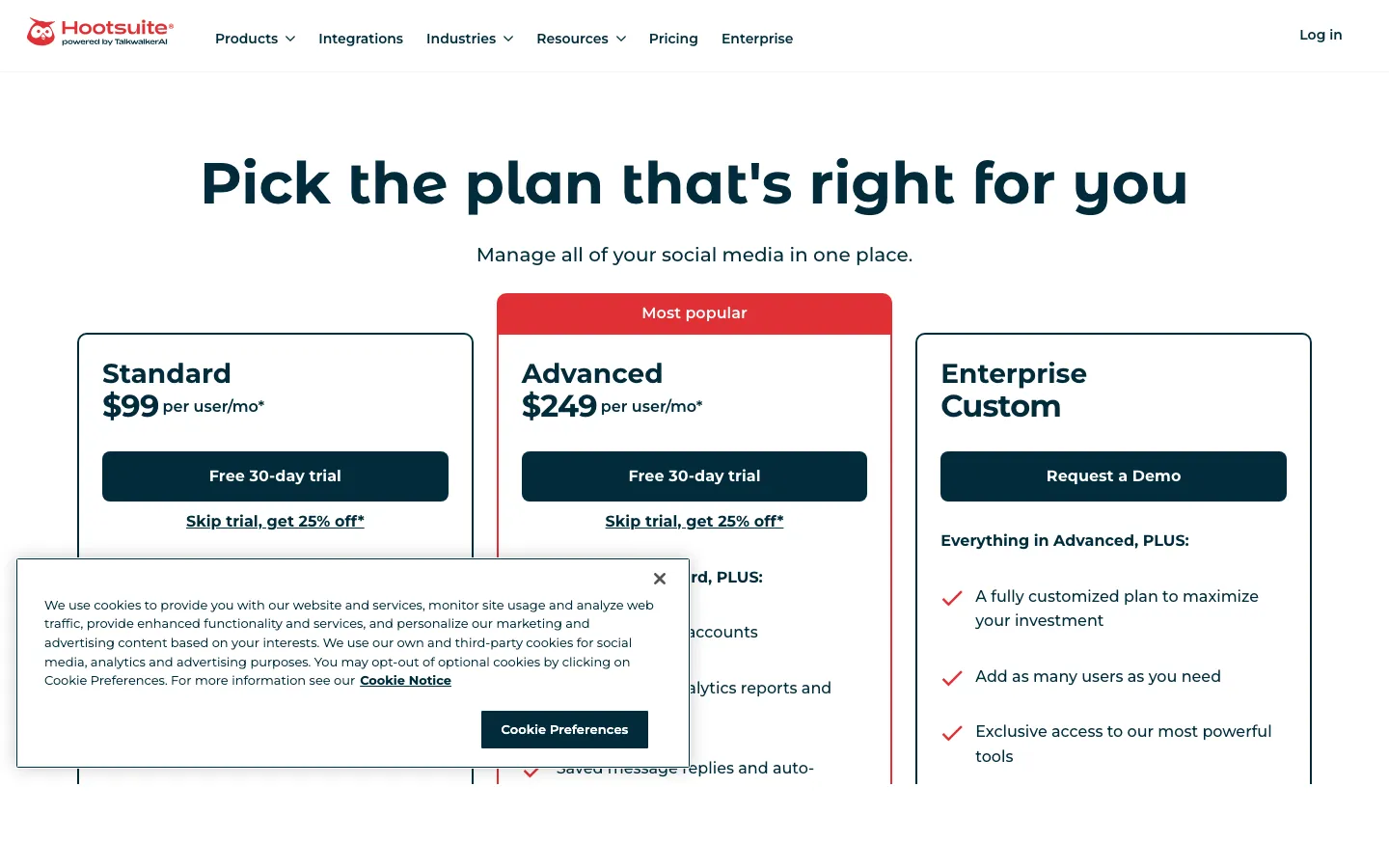
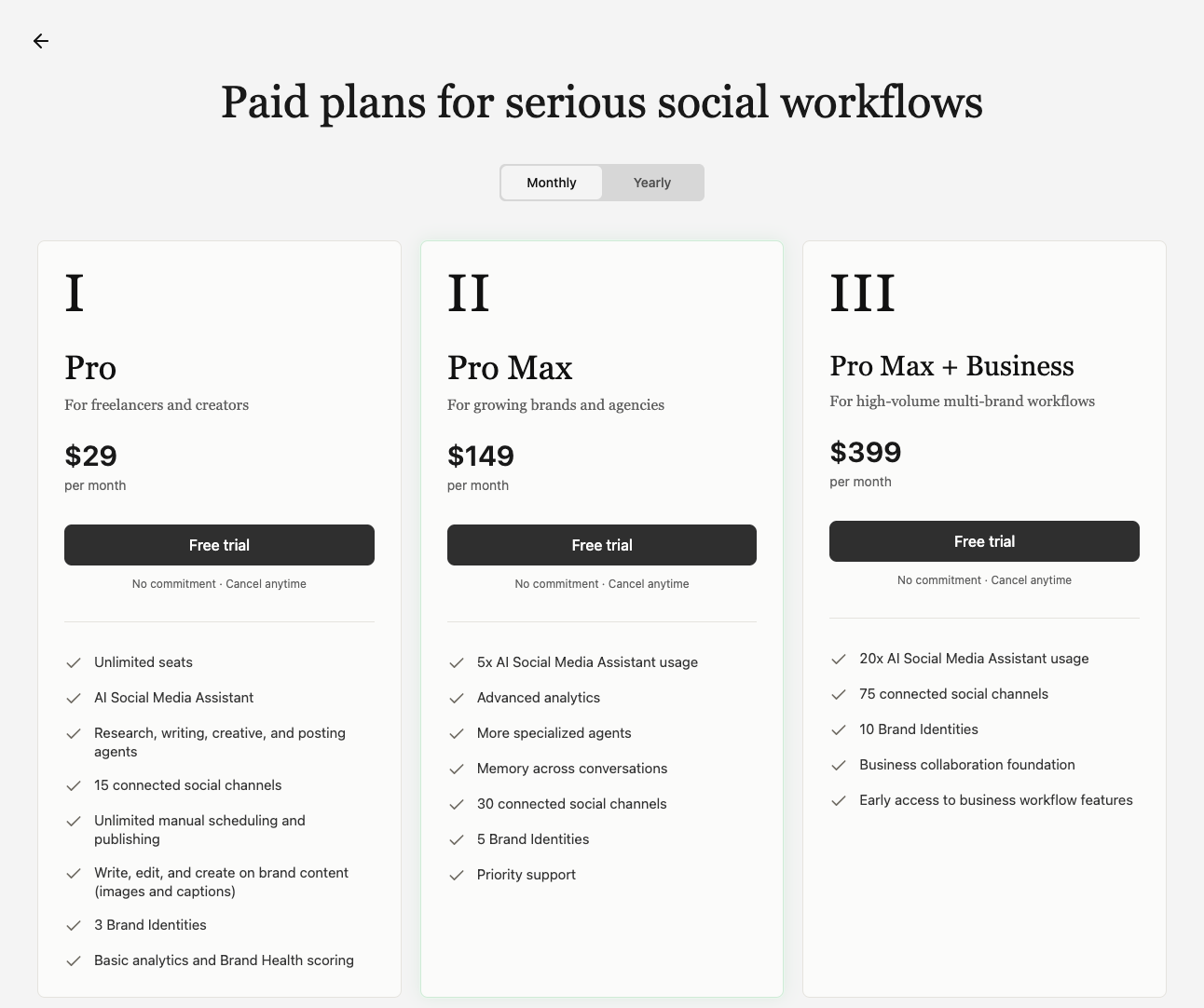
On a per-channel basis Buffer can come out cheapest if you only manage one or two accounts. Its pricing adds up as the team adds channels: 6 channels cost about $30/mo on Essentials and about $60/mo on Team. Hootsuite Standard starts at $99/user/mo. Velocity's flat $39 per month covers 15 connected social channels with the team of social media agents included, making it the broader workflow option for teams that need more than a publishing queue.
Features: what each tool actually does
All three tools cover the basics: queue a post, schedule it, publish it, see how it did. The differences show up the moment you ask the tool to do anything beyond that.
Content creation
Buffer has an AI Assistant for caption drafts. It is a generic prompt-to-text feature that does not learn your brand. Hootsuite has OwlyWriter, a similar generic generator, available on higher-priced plans. Velocity is built around a team of social media agents that writes captions in your brand voice, learned from your existing posts and brand assets. The agents can take a single product update and produce seven platform-native versions for LinkedIn, TikTok, Instagram, X, YouTube, Facebook, and Bluesky without you re-prompting for each one.
Scheduling
All three support post scheduling and a content calendar. Buffer's calendar is the cleanest. Hootsuite's calendar is the most feature-dense. Velocity adds natural-language scheduling: tell the agent "post this every Tuesday and Thursday at 9am for a month" and it sets up the schedule without you opening a date picker.
Cross-platform publishing
Buffer publishes to Instagram, Facebook, TikTok, YouTube, LinkedIn, X, Mastodon, Threads, Bluesky, Pinterest. Hootsuite covers most of those plus paid placements and Pinterest. Velocity supports seven major networks for organic content via dedicated Instagram, Facebook, YouTube, TikTok, LinkedIn, X, and Bluesky integrations. The trade-off is intentional — every supported platform on Velocity is fully native, with platform-specific publishing handled automatically. None of the platforms are second-class citizens.
Analytics
Buffer's analytics show post performance and engagement basics, with deeper reports on paid plans. Hootsuite's analytics are the most extensive of the three, with cross-channel reports, paid-social dashboards, and listening data on higher tiers. Velocity's analytics are smaller in scope but explain results in plain English: rather than a chart of impressions, you get a paragraph that says "this post performed 3.2x better than your average because the hook line in the first sentence is shorter than usual and your audience watches more content on Tuesdays."
Ease of use
Buffer is the easiest to learn — it is intentionally minimal. A new user can be scheduling posts in under five minutes. Hootsuite has a steeper learning curve, especially the analytics and listening tools, and most teams budget a real onboarding session. Velocity sits between them in terms of UI complexity, but the conversational agent removes most of the manual click-paths: instead of navigating a menu, you tell the agent what you want and it does the steps for you.
Who should choose what
Choose Buffer if
- You write every caption yourself and just need a clean queue.
- You manage one or two channels and per-channel pricing makes sense.
- You value simplicity over depth.
Choose Hootsuite if
- You are a 20+ person team and need role-based permissions, governance, and consolidated reporting.
- You need paid-social integration alongside organic publishing in one tool.
- The price-to-value ratio is acceptable because you are operating at enterprise scale.
Choose Velocity if
- You are a small business, agency, or freelance social media manager and the bottleneck is creating content, not scheduling it.
- You publish across multiple platforms and want platform-native versions of every post without rewriting seven times.
- You want analytics that explain what happened, not just charts that show it.
- You want flat pricing that does not scale by channel or by seat.
The verdict
Buffer and Hootsuite are real products with real strengths. They were both designed for a world where social media work mostly meant organizing posts that humans had already written. That world still exists for some teams, and for those teams, Buffer or Hootsuite remains a fine choice.
For most small businesses, agencies, and freelance social media managers in 2026, the work has changed. The bottleneck is no longer scheduling — it is creative throughput. A lean team needs to ship across seven platforms, including Bluesky, and the part that hurts is writing the captions, adapting the formats, and learning from performance fast enough to do it better next week. Velocity is built for that bottleneck specifically, with an AI agent at the center, a Brand Agent that keeps everything sounding like you, and pricing that does not require an enterprise budget.
If that sounds like your situation, start with the free trial and move to Pro when you are ready to connect the full 15-channel social media agent workspace.
Frequently Asked Questions
What is the difference between Velocity, Buffer, and Hootsuite?
Buffer is the original simple social media scheduler. Hootsuite is the enterprise-tier classic. Velocity is a team of social media agents with a conversational AI agent at the center that drafts posts, adapts them across platforms, and schedules them in plain English.
How much does Velocity cost compared to Buffer and Hootsuite?
Velocity starts with a free trial. Pro is $39 per month, Pro Max is $149 per month, and Pro Max + Business is $399 per month. Buffer's Essentials is about $30/mo for 6 channels, and Team is $10 per channel per month, about $60/mo for 6 channels. Hootsuite Standard starts at $99/user/month; Enterprise is custom.
Does Buffer have an AI agent?
Buffer's AI Assistant exists but is essentially a wrapper around generic GPT prompts; it does not learn your brand voice and does not coordinate publishing across platforms.
What is OwlyWriter in Hootsuite?
Hootsuite has OwlyWriter, a generic generator, available on higher-priced plans. Hootsuite has added AI features over the past two years, but they live as add-ons inside an interface that was designed before AI agents existed — a dashboard with AI bolted on, not a product built around an agent.
Can Velocity write captions in my brand voice?
Velocity is built around an AI agent that writes captions in your brand voice, learned from your existing posts and brand assets. A Brand Agent learns how your business writes — vocabulary, sentence rhythm, opinions — and applies that voice to every generated caption.
How many social platforms does Velocity support?
Velocity supports seven major networks for organic content via dedicated Instagram, Facebook, YouTube, TikTok, LinkedIn, X, and Bluesky integrations. Every supported platform on Velocity is fully native, with platform-specific publishing handled automatically.
Who should choose Buffer over Velocity?
Choose Buffer if you write every caption yourself and just need a clean queue, manage one or two channels and per-channel pricing makes sense, or value simplicity over depth.
When does Hootsuite make sense in 2026?
Choose Hootsuite if you are a 20+ person team and need role-based permissions, governance, and consolidated reporting, need paid-social integration alongside organic publishing in one tool, or operate at enterprise scale where the price-to-value ratio is acceptable.
Start a free trial
Put research, on-brand creation, publishing, and analysis into one social media agent workflow.