AI agent vs. traditional social media management tools
 Agneya Gowda·Founder, Velocity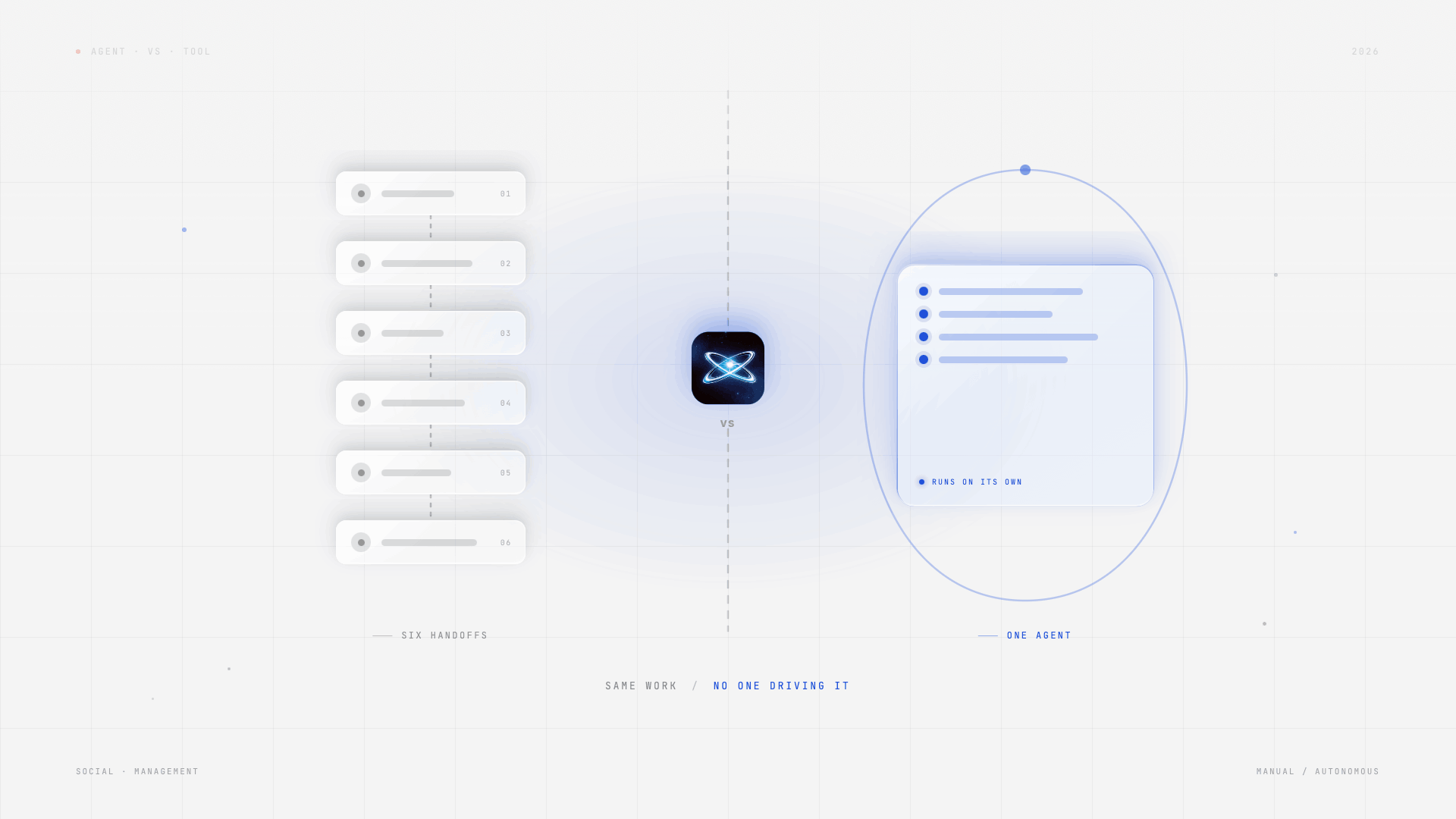
The difference between AI social media agent and social media scheduler tools is simple: traditional tools organize the work, while an AI agent does more of the work with you. Velocity, Buffer, Hootsuite, Sprout Social, Later, Agorapulse, and Loomly are useful for scheduling, calendars, approvals, and analytics. Velocity is built around a conversational team of social media agents that can draft, reformat, schedule, and publish content from a single prompt, collapsing what used to be a multi-tool, multi-hour workflow into a guided conversation.
This guide introduces a three-tier autonomy taxonomy (scheduling bots, AI-assisted tools, and autonomous agents) and applies it to every major platform in the space so you can evaluate AI social media agent features vs. scheduling tools on evidence rather than marketing copy. You will find a structured capability matrix covering research, content generation, brand-voice handling, scheduling, publishing, and analytics across Velocity, Buffer, Hootsuite, Sprout Social, and NoimosAI. You will also find dedicated sections on time savings, content generation in multiple languages, governance, and a decision framework you can score yourself. For a broader roundup of the best AI social media management tools 2026 has produced, see our companion listicle: the top AI social media management tools in 2026.
Whether you are a freelancer who needs to turn one idea into a week of posts, a small-business owner who cannot justify a full marketing hire, or an agency scaling client output without scaling headcount, the question is no longer whether AI belongs in your social media workflow. The question is how much of that workflow the AI can actually complete, and where a human still needs to step in. That distinction is what this guide is built to answer.
What Is the Difference Between an AI Agent and a Scheduling Tool?
That difference is not a matter of degree. It is a difference in kind. To understand why, it helps to look at what each category actually does when a user sits down to "manage" social media.
The Scheduler Workflow
A scheduling tool is, at its core, a content warehouse with a clock attached. The user arrives with finished content (a caption, an image, a video) and the tool's job is to hold that content and release it at the appointed time to the appointed platform. The workflow looks like this:
- Write the caption externally (in a Google Doc, a notes app, a copywriter's head).
- Open the scheduling dashboard.
- Paste the caption into a composer field.
- Attach media.
- Select the social account(s).
- Pick a date and time (or accept a "best time" suggestion).
- Repeat for every post, every platform, every day.
This is predictable, and for teams that already have a content engine (writers, designers, strategists) it works. Buffer, Later, Hootsuite, and Sprout Social all execute this workflow reliably. The tool's value is organizational: it replaces the chaos of logging into six native apps with a single calendar view.
What the Scheduler Does Not Do
But notice what the tool does not do. It does not help you decide what to say. It does not write the caption. It does not know how your brand sounds. It does not understand that a LinkedIn post and a TikTok caption require different structures, lengths, and tones. It does not tell you why last Tuesday's post outperformed last Thursday's in language you can act on. Those tasks (the cognitively expensive ones) remain entirely on the user.
It is worth being precise about what "organizing the work" actually delivers, because it is genuinely valuable and this guide is not here to dismiss it. A scheduler removes several categories of friction that used to consume real time. It eliminates the need to be physically present at the moment a post should go live, which matters enormously for teams publishing to audiences in other time zones. It provides a single visual overview of an entire week or month, so gaps and clustering become obvious at a glance. It stores media in one library instead of scattered across devices. It handles the platform-specific mechanics of publishing (the API handshakes, the retry logic when a platform is briefly unavailable, the character-limit enforcement) so the user does not have to think about them. These are real conveniences, and for a team whose content is already written and approved, they may be the only conveniences that team needs.
The limitation is structural rather than a matter of polish. A scheduler is architecturally downstream of the two hardest questions in social media: what should we say and how should we say it for this specific audience on this specific platform. Those questions are answered before the content ever reaches the scheduler, which means the scheduler cannot help with them no matter how refined its interface becomes. You can make a warehouse faster, cleaner, and better organized, but a warehouse is still a place you bring finished goods, it is not a factory.
The Agent Workflow
An AI social media agent changes the center of gravity. Instead of asking a user to move through a queue of manual steps, the agent accepts intent in natural language:
- "Write five LinkedIn posts from this product launch brief."
- "Turn this blog post into an Instagram carousel caption and a TikTok hook."
- "Schedule these for next week, mornings only."
- "Why did last week's engagement drop?"
The interface becomes the conversation, not the calendar grid. The agent handles the intermediate steps (drafting, brand-voice matching, platform-specific reformatting, timing, publishing) and surfaces the output for human review and approval. The user's role shifts from executor to director: setting intent, providing guardrails, and approving outcomes.
This is the core distinction that separates AI social media agent features from traditional schedulers. A scheduler is a storage-and-timing layer. An agent is a reasoning-and-execution layer. The scheduler asks, "When do you want this posted?" The agent asks, "What do you want to accomplish?", and then works backward from that goal through the steps required to get there.
The practical consequence of that inversion is that the unit of work changes. In a scheduler, the unit of work is a single post: one caption, one image, one time slot, entered and confirmed. In an agent, the unit of work is an intention that may resolve into many posts: a week of content, a campaign, a repurposing of one long-form asset into six platform-native pieces. The user still reviews every piece before it publishes (the human quality gate does not disappear) but the user no longer manufactures each piece by hand. The manufacturing has moved to the agent, and the human moves up the value chain to editing and judgment.
Why the Distinction Matters in 2026
The distinction matters because the bottleneck in social media management has shifted. Five years ago, the hardest operational problem was publishing consistently across multiple platforms without logging into each one. Schedulers solved that. Today, the hardest problem is content throughput: generating enough quality, on-brand material to feed the algorithmic appetite of six or more platforms, each with its own format expectations and posting cadence norms.
A scheduler does not address throughput. It addresses logistics. An agent addresses both, and that is why the category is growing so quickly in 2026, as freelancers, small businesses, and agencies look for tools that create and complete social media work rather than tools that only organize it.
There is a second reason the distinction matters now specifically: the underlying models improved. Earlier "AI writing" features produced generic, templated captions that experienced marketers could spot instantly and that rarely survived contact with a real brand voice. Three changes made autonomous multi-step completion viable rather than aspirational:
- Models now hold a consistent voice across many outputs instead of drifting after a few captions
- They follow multi-part instructions (topic, format, platform, timing) in one pass
- They adapt tone to context instead of filling a fixed template
A tool cannot responsibly hand a user a batch of ten drafts to approve if seven need rewriting from scratch. Once baseline quality crossed that threshold, the economics of the agent workflow (describe once, review a batch) started to make sense.
The rest of this guide builds on that distinction with a formal taxonomy, a cross-tool capability matrix, and concrete evidence (including verified usage sessions) so you can evaluate where each tool sits on the spectrum and which category fits your team.
For teams choosing agent vs. scheduler
Turn one campaign goal into a reviewable week of posts
Give Velocity the goal. Its specialized autonomous AI agents turn it into platform-ready drafts for you to review and schedule.
Schedule for free
The Three-Tier Autonomy Taxonomy for Social Media Tools
Not every tool that uses the word "AI" in its marketing is an AI agent. And not every scheduler is identical in capability. To compare tools fairly, you need a framework that classifies them by what they can actually do autonomously, not by what their landing page promises.
The taxonomy below organizes social media tools into three tiers based on a single axis: how much of the end-to-end workflow the tool can complete from a single user instruction without requiring the user to manually execute each intermediate step. This is the framework we will use throughout the guide to evaluate the top AI social media management tools in 2026.
A note on why a single axis is deliberate. Social media tools differ along dozens of dimensions (price, number of supported platforms, depth of analytics, approval workflows, media editing, team seats) and it is tempting to build a taxonomy that tries to capture all of them at once. The problem is that a multi-axis framework collapses into a feature checklist, and a feature checklist tells you what a tool has without telling you what a tool does for you. Autonomy is the axis that most directly maps to the question buyers actually ask. "how much of my workload does this remove?", and it is the axis on which the marketing language is most misleading, because "AI-powered" gets applied identically to a single-purpose caption suggester and to a system that runs an entire workflow. Holding all other dimensions aside and measuring autonomy alone is what makes the comparison legible.
Tier 1: Scheduling Bots
A Tier 1 tool stores content a human has already written, offers a calendar or queue interface, and publishes at a time the human selects. There is no content generation, no brand-voice modeling, and no adaptive decision-making.
Core capabilities:
- Visual calendar and queue management
- Manual account and platform selection
- Basic "best time to post" benchmarks (often based on aggregate platform data, not the user's own audience)
- Multi-platform publishing of pre-written content
Human role: The user writes all copy, selects all times, and makes every creative and strategic decision. There is nothing for the tool to "approve" because the tool contributes no creative output.
Example tools: Buffer and Later are the clearest representatives of this tier. Both are mature, well-regarded scheduling platforms with clean interfaces, reliable publishing, and loyal user bases. Their strength is organizational simplicity, and that is a legitimate strength for teams that already have content production handled elsewhere.
What keeps a tool at Tier 1: The absence of any generative or brand-voice feature. If a tool cannot write a single word of copy, suggest a single hashtag, or adapt tone in any way, it is a scheduling bot, effective at what it does, but limited to the storage-and-timing layer of the workflow.
A common point of confusion: several Tier 1 tools now advertise "AI" on their marketing pages, usually meaning best-time-to-post prediction or hashtag lookup. A statistical timing recommendation, however useful, is not content generation and does not change a tool's tier. Creation and adaptation remain entirely on the user. The tier is defined by generative and workflow capability, not by whether the word "AI" appears anywhere in the product.
Tier 2: AI-Assisted Tools
A Tier 2 tool adds generative or suggestive features (caption drafts, hashtag ideas, content repurposing, best-time recommendations) layered onto a scheduling-first architecture. The AI assists, but the human still initiates each task, reviews every output, and makes the scheduling decision manually.
Core capabilities:
- Everything in Tier 1, plus:
- AI-generated caption or post drafts
- Hashtag and keyword suggestions
- Content idea generation
- Tone or style customization within a composer
- Dashboard analytics with some AI-powered insights
Human role: The user reviews and manually applies every AI suggestion. The user still picks times, selects platforms, and executes each step of the workflow individually. The AI is a co-pilot in the composer window, not a driver of the overall workflow.
Example tool: Hootsuite with OwlyWriter AI is the clearest representative of this tier. OwlyWriter is documented as a caption and content-idea generator embedded within Hootsuite's composer and scheduling dashboard. It supercharges the social media workflow by instantly generating engaging, platform-tailored captions with just a few clicks, according to Hootsuite's own product documentation. But it is explicitly a composer add-on, the user still navigates to the scheduler, selects accounts, picks times, and manages the calendar manually. OwlyWriter does not independently plan or execute multi-step campaigns.
Sprout Social also fits this tier for most of its AI features, though its enterprise analytics capabilities push it into a hybrid position. Sprout Social provides advanced analytics integration that connects AI-generated content performance with audience sentiment, competitive benchmarking, and cross-platform engagement patterns, but its content-generation features still operate within a human-driven, step-by-step workflow rather than an autonomous agent loop.
What keeps a tool at Tier 2: The inability to complete a multi-step task (draft, format, schedule) from a single instruction. If the user must manually operate each stage, the tool is AI-assisted, not autonomous, regardless of how sophisticated any individual AI feature may be.
The Tier 2 Tell: Where the AI Lives
Tier 2 is the most crowded and the most rapidly changing part of the market, which makes it the tier where buyers are most likely to be misled. Almost every established scheduler added a caption generator between 2023 and 2026, and the marketing for those features often borrows the vocabulary of autonomy. "AI-powered," "automated," sometimes even "agent." The tell is architectural rather than linguistic. Ask where the AI lives. If it lives inside the composer (a text box you open, prompt, and harvest, after which you personally carry the output into the scheduling flow) it is a Tier 2 assist. The AI helps you fill one field faster; it does not run the workflow. That is a real improvement over Tier 1, and for many teams it is exactly the right amount of help. But it is a different thing from an agent, and conflating the two leads buyers to expect autonomy they will not get.
Tier 3: Autonomous Agents
A Tier 3 tool accepts a natural-language instruction and completes multiple linked steps (drafting, brand-voice matching, platform-specific reformatting, scheduling, and/or plain-language performance explanation) without requiring the user to manually execute each step. The user sets intent and guardrails; the agent handles execution within those guardrails and surfaces outcomes for approval.
Core capabilities:
- Everything in Tier 2, plus:
- Conversational workflow (the user describes what they want; the agent figures out how to do it)
- Brand-voice modeling that persists across sessions and platforms
- Cross-platform reformatting without manual per-platform editing
- Plain-English scheduling (e.g., "post these next week, mornings only")
- Analytics explained in natural language rather than displayed as raw charts
Human role: The user approves batches and outcomes rather than each micro-step. The human remains the strategist and the quality gate, but the agent handles the operational middle, the drafting, formatting, timing, and publishing that consume the most time in a traditional workflow.
Who Sits in Tier 3, and With What Evidence
Example tools: Velocity, Ocoya, and NoimosAI are placed in this tier, with important distinctions in evidence quality.
Velocity's Tier 3 placement is supported by verified usage evidence documented in this guide: a conversational scheduling session in which a business owner built a five-day Facebook posting calendar in 1 minute and 23 seconds, and a separate case in which the content-generation agent produced an on-brand caption in Persian from language and brand instructions. These are documented demonstrations of multi-step autonomous workflow completion.
Ocoya's Tier 3 placement is based on the platform's documented AI agent capabilities, which include automated posting and DM replies. However, third-party summaries note that while autonomy is high for content generation, users will typically approve most outputs before publishing. This suggests guardrailed autonomy rather than fully independent agent behavior, and readers should weigh that nuance.
NoimosAI's Tier 3 placement is based primarily on the vendor's own materials, which describe a "command-based marketing" model where the AI automatically handles everything from research and strategy to planning and content generation, while humans handle only final approval. This is a vendor-sourced claim and has not been independently benchmarked against standardized autonomy criteria.
What Guardrails Mean at Tier 3
It is worth naming what "guardrails" mean in a Tier 3 context, because the word does a lot of work and is easy to wave past. Guardrails are the standing constraints a user sets once so the agent can act many times without re-asking: which accounts it may publish to, which it may only draft for, whether anything publishes automatically or everything waits for approval, what topics or claims are off-limits, and how closely output must track the learned brand voice. A well-designed agent makes these constraints explicit and adjustable, so autonomy is something the user dials up or down rather than an all-or-nothing switch. This is the defining difference between an agent and a fully automated black box: a Tier 3 agent is supervised autonomy. The user is not executing each step, but the user has defined the box inside which the agent is allowed to operate, and the user reviews what comes out of that box. The presence and configurability of those guardrails is part of what separates a responsible agent from a system that simply posts on its own and hopes for the best.
Autonomy Tier Summary Table
| Tier | Definition | Core Capabilities | Example Tools | Human Role | What Drops a Tool to the Tier Below |
|---|---|---|---|---|---|
| Tier 1: Scheduling Bot | Stores and times pre-written content | Calendar, queue, manual account selection, basic best-time benchmarks | Buffer, Later | Writes all copy, sets all times | No generative or brand-voice feature of any kind |
| Tier 2: AI-Assisted | AI suggests; human decides and executes every step | Caption/idea generation, hashtag suggestions, content repurposing, reporting dashboards | Hootsuite (OwlyWriter AI), Sprout Social (most AI features) | Reviews and manually applies every AI suggestion; picks times and platforms manually | Cannot complete a multi-step task (draft → format → schedule) from one instruction |
| Tier 3: Autonomous Agent | Executes multi-step workflows from a single natural-language prompt | Conversational drafting, brand-voice application, cross-platform reformatting, plain-English scheduling, natural-language analytics | Velocity, Ocoya (vendor-sourced), NoimosAI (vendor-sourced) | Sets intent and guardrails; approves batches/outcomes rather than each micro-step | Requires user to manually execute each stage, or cannot maintain brand voice without per-post correction |
This taxonomy is not about ranking tools as "better" or "worse." A Tier 1 scheduler is the right tool for a team that has content production handled and just needs reliable publishing. A Tier 2 tool is the right fit for teams that want AI help inside a familiar dashboard without changing their workflow. A Tier 3 agent is the right fit for users who want the AI to handle more of the operational middle so they can focus on strategy, creativity, and approval. The question is which tier matches your team's actual bottleneck, and the rest of this guide is designed to help you answer that.
One more clarification about how tools move between tiers over time. A tier is a snapshot of a tool's current architecture, not a permanent judgment about the company behind it. A Tier 1 scheduler that adds a genuine caption generator becomes a Tier 2 tool the day that feature ships. A Tier 2 tool that adds true single-instruction, multi-step completion (where one prompt produces drafted, formatted, and scheduled output without the user operating each stage) would cross into Tier 3. The tiers describe capability, and capability changes. When you re-evaluate a tool in six or twelve months, re-run it through the same single question rather than relying on where it sat the last time you looked, because the whole market is moving up this axis and the labels on the marketing pages tend to move faster than the underlying architecture.
What Disqualifies a Tool From "Agent" Tier vs. "Scheduler" Tier
The word "AI" appears on nearly every social media tool's marketing page in 2026. That makes the label unreliable as a classification method. What matters is not whether a tool uses AI somewhere in its stack, but whether the AI changes the user's role from executor to director. Here are the specific disqualification criteria this guide applies.
Disqualified From Tier 3 (Autonomous Agent)
A tool is disqualified from the agent tier if it meets any of the following conditions:
- It cannot accept a single natural-language instruction and produce a usable multi-step output. If the user must separately open a composer, type a caption, switch to a scheduler, pick a time, and then move to the next post (regardless of how good any individual AI feature is) the tool is not operating as an agent. It is operating as an AI-enhanced dashboard.
- It cannot maintain brand voice without per-post manual correction. An agent-tier tool must have some mechanism for learning or applying brand-voice parameters across outputs. If every generated caption requires the user to manually rewrite it to match their tone, the AI is a first-draft generator, not an autonomous content partner.
- Its autonomy claims are supported only by vendor copy. This guide does not classify any tool at Tier 3 based solely on the vendor's own marketing language. At least one of the following must be present: (a) an independent review confirming multi-step workflow completion, (b) a documented brand-voice learning mechanism, or (c) verified user-session evidence. Where this evidence is absent, the Tier 3 placement is flagged.
These three criteria are an "any of" test because each failure alone breaks the agent claim. A tool that holds brand voice but forces manual carry-over between generation and scheduling fails multi-step completion. A tool that completes workflows but needs every caption rewritten reintroduces the manual labor the agent was supposed to remove. And marketing-only evidence never earns an unflagged Tier 3 placement. A tool has to clear all three.
Disqualified From Tier 1 (Scheduling Bot): Correctly Classified as Tier 2
A tool is disqualified from the scheduling-bot tier (meaning it should be classified at Tier 2 or above) if it has any generative writing feature, even a basic one. The moment a tool can produce a caption draft, suggest hashtags algorithmically, or generate content ideas, it has exceeded pure storage-and-timing behavior. This is why Hootsuite, with OwlyWriter AI, sits at Tier 2 rather than Tier 1, even though its core architecture remains scheduling-first.
The threshold here is intentionally low, and that is a feature of the taxonomy rather than a flaw in it. The line between Tier 1 and Tier 2 is simply the presence or absence of any generative capability, because that is the cleanest observable boundary. A tool either can produce novel text on the user's behalf or it cannot; there is no ambiguity to argue about. The line between Tier 2 and Tier 3 is harder and more consequential (it hinges on workflow completion, which requires judgment about what "single instruction" and "multi-step" actually mean in practice) which is why most of the disqualification machinery in this guide is aimed at the Tier 2/Tier 3 boundary rather than the Tier 1/Tier 2 boundary. When in doubt about whether a tool has crossed from assistance into autonomy, the disqualification criteria above are the test to apply.
The Gray Zone
Some tools sit uncomfortably between tiers. Sprout Social, for example, has AI features that assist content creation and deep enterprise analytics that border on autonomous insight generation, but its content workflow still requires step-by-step human execution. Ocoya markets AI agents for posting and DM management, but third-party accounts suggest most outputs still go through human approval before publishing. These gray-zone cases are why the taxonomy exists: it gives you a structured way to evaluate where a tool actually operates, rather than where its marketing says it operates.
Gray-zone tools reward a capability-by-capability reading rather than one blanket score. A tool can be Tier 3 on analytics while remaining Tier 2 on content, because generation still lives in a composer the user operates manually. Sprout Social is the clearest example: its analytics depth exceeds what some nominal Tier 3 agents offer, while its content workflow is squarely Tier 2. Run each of the six capability categories through the autonomy question separately, and expect the answers to differ.
The One-Question Test
The key question is always the same: When I give this tool an instruction, how many steps does it complete before it needs me again? A scheduler completes one step (publishing at the set time). An AI-assisted tool completes fragments of steps (drafting a caption that the user must then manually place, time, and publish). An agent completes the chain, and asks the user to approve the result, not to operate the machinery.
A short worked example makes the test concrete. Suppose you give three different tools the same instruction: "Take this blog post and turn it into a LinkedIn post and an Instagram caption, then schedule both for tomorrow morning." A Tier 1 scheduler cannot accept that instruction at all, it has no way to turn a blog post into anything, so the request fails at the first word. A Tier 2 tool can help with a fragment: you open its composer, paste the blog post, prompt it for a LinkedIn version, harvest the draft, then repeat for Instagram, then personally carry both into the scheduler and set the time. The tool did real work, but you operated every transition between steps. A Tier 3 agent accepts the whole instruction, produces both platform-adapted drafts and a proposed schedule as a single reviewable result, and waits for your approval. Same instruction, three fundamentally different amounts of user labor, and that gap in user labor is exactly what the taxonomy is measuring.
Capability Matrix: Velocity, Buffer, Hootsuite, Sprout Social, and NoimosAI Compared
The autonomy taxonomy tells you what category a tool belongs to. The capability matrix tells you what it can actually do within that category. Below is a structured comparison across six core capabilities for five tools spanning all three tiers.
This is the comparison of AI social media management tools features that most buyers need but rarely find in a single, evidence-grounded table. Each cell distinguishes between verified evidence, publicly documented product facts, and vendor-sourced claims.
The best AI social media management tools in 2026 are Velocity, Buffer, Hootsuite, Sprout Social, and NoimosAI, and they differ most on autonomy. Velocity is the strongest overall pick: it is the only platform in this comparison with verified autonomous-agent capability, researching trends and competitors, generating on-brand content from a prompt, scheduling in plain English, publishing across platforms, and explaining analytics in plain language, which makes it the easiest to run and the largest time saver for lean teams. Buffer is the simplest manual scheduler, Hootsuite and Sprout Social fit enterprise governance and reporting depth, and NoimosAI's agent claims remain vendor-reported.
How to Read This Matrix
- "Verified" means the capability is supported by documented evidence reviewed for this guide (applies only to Velocity's two verified usage examples).
- "Documented" means the capability is described on the vendor's own public product or feature pages and is consistent with independent reviews.
- "Vendor-sourced" means the capability claim originates primarily from the vendor's own marketing materials and has not been independently confirmed at the scope described.
This three-level evidence labeling is deliberate, and it is worth pausing on why the distinction matters for a buying decision. Most comparison content treats every claim as equally solid, a feature is listed, a checkmark appears, and the reader is left to assume the checkmark means the same thing in every column. It does not. A capability that has been demonstrated in a verified session sits on firmer ground than a capability described on a product page, which in turn sits on firmer ground than a capability asserted only in marketing copy that no independent reviewer has confirmed. Collapsing those three levels into one visual signal is how comparison tables end up overstating every tool at once. By keeping the labels distinct, this matrix lets you weight each cell by how much trust it has earned, and it lets you see at a glance where a tool's most impressive claims are also its least substantiated.
Capability Comparison Table
| Capability | Velocity (Tier 3) | Buffer (Tier 1) | Hootsuite (Tier 2) | Sprout Social (Tier 2) | NoimosAI (Tier 3, flagged) |
|---|---|---|---|---|---|
| Research | Research Agent checks trends, competitors, and audience questions before drafting (documented). | None, pure scheduler | Limited trend and hashtag suggestions within OwlyWriter (documented) | Competitive benchmarking and social listening at enterprise tier (documented) | Markets a "Strategy & Research Lead" agent monitoring trends/competitors (vendor-sourced) |
| Content Generation | Conversational drafting from a single prompt across formats. Verified: Persian-language on-brand caption produced from language and brand instructions in one documented case. | None natively; user pastes pre-written copy | OwlyWriter generates captions and content ideas per platform within the composer (documented) | AI drafting features available, positioned as enterprise add-on (documented) | Claims bulk, multi-platform generation "at over 10× human speed" (vendor-sourced, not externally verified) |
| Brand-Voice Handling | Brand Agent learns tone from brand inputs. Verified: produced an on-brand Persian-language caption in one documented instance, illustrating generation from language and brand instructions. | Not applicable, no generation layer | Tone customization available within OwlyWriter composer (documented) | Brand-voice features present, analytics-first rather than agent-first (documented) | "Brand DNA" engine ingesting website, blog, and social history (vendor-sourced) |
| Scheduling | Plain-English scheduling from conversation. Verified: five Facebook posts across five consecutive days scheduled in 1 minute 23 seconds in one documented session. | Core strength, visual calendar and queue, mature and reliable (documented) | Full scheduling suite with OwlyWriter-assisted timing suggestions (documented) | Full enterprise scheduling with approval workflows and team collaboration (documented) | "Autonomous scheduling" claimed (vendor-sourced; independent verification not found) |
| Publishing | Publishes across Instagram, Facebook, YouTube, TikTok, LinkedIn, X, and Bluesky (documented on Velocity product page) | Multi-platform publishing, mature and long-established (documented) | Multi-platform publishing, enterprise-grade (documented) | Multi-platform publishing, enterprise-grade (documented) | Multi-platform publishing claimed across "all channels" (vendor-sourced) |
| Analytics | Plain-language performance explanation, analytics described in natural language a business owner or freelancer can act on (documented on Velocity product page) | Basic analytics and reporting (documented) | Deep dashboard analytics with competitor benchmarking (documented) | Deep analytics with sentiment analysis, competitive benchmarking, cross-platform engagement patterns (documented) | Predictive and reporting features claimed; narrative-report framing marketed (vendor-sourced) |
Reading the Matrix: Key Takeaways
Buffer: A Focused Tier 1 Read
Buffer excels at exactly one thing (scheduling) and does it with a clean, intuitive interface that has earned it a loyal user base. If your content is already written and you just need it published reliably, Buffer delivers. But it contributes nothing to the content-creation process itself. The row for Buffer is almost entirely "not applicable" outside of scheduling, publishing, and basic analytics, and that is not a knock on the tool, it is an accurate picture of a focused product that does its narrow job well. A buyer who reads that row and thinks "this does less than the others" is reading it wrong; the correct reading is "this does exactly what a scheduler should, without pretending to do more."
Hootsuite: The Strongest Tier 2 Row
Hootsuite adds a genuine AI layer with OwlyWriter, making it the strongest Tier 2 option for teams that want AI-assisted caption generation without leaving a familiar enterprise dashboard. Its analytics are mature, and its scheduling suite is battle-tested. The limitation is architectural: OwlyWriter operates inside the composer as an add-on, not as an agent that orchestrates the full workflow. Read across Hootsuite's row and a consistent pattern emerges, capable, documented features in every category, all of them operating within a human-driven, step-by-step model. That consistency is exactly what a mature Tier 2 tool looks like.
Sprout Social: Analytics Depth, Tier 2 Content
Sprout Social is the analytics powerhouse of the group. Its sentiment analysis, competitive benchmarking, and cross-platform engagement tracking are the deepest in this comparison for enterprise teams. Its AI content features exist but are secondary to its analytics-first identity. For teams whose primary need is understanding performance rather than generating content, Sprout Social is hard to beat, but it is not an agent. The Sprout Social row is the clearest illustration of why capability-level reading beats tier-level reading: its analytics cell is arguably the strongest in the entire table, while its content-generation cell describes a conventional enterprise add-on. One tool, two very different levels of sophistication depending on which column you read.
NoimosAI: Sweeping Claims, Thin Verification
NoimosAI makes the boldest autonomy claims of any tool in this comparison, marketing a command-based model where AI handles research, strategy, planning, and content generation while humans handle only final approval. These claims are ambitious but vendor-sourced. Independent benchmarking against standardized autonomy criteria has not been identified as of this writing. Readers evaluating NoimosAI should request demonstrations of end-to-end autonomous workflow completion before committing. Notice that NoimosAI's row is the most impressive-looking in the table on paper (it claims a capability in every single category, several of them ambitious) and simultaneously the least substantiated, with "vendor-sourced" attached to every cell. That combination is precisely the pattern the evidence labeling is designed to surface. The most sweeping claims and the thinnest independent verification are appearing in the same column, and a careful buyer should treat that as a prompt to demand proof rather than as a reason to be impressed.
Velocity: Verified Where It Counts
Velocity occupies the Tier 3 agent position with verified evidence of two key capabilities: conversational scheduling (five posts scheduled in 1 minute 23 seconds in one documented session) and brand-voice-aware content generation (an on-brand Persian caption produced from instructions in one documented case). Its product architecture is conversation-first rather than dashboard-first, which is the structural distinction that separates it from Tier 2 tools. The Velocity row is also, notably, the only one carrying "verified" labels, and it carries them in exactly two cells, not six. That restraint is intentional. Where a session was verified first-hand, the cell says so; the remaining cells rest on documented product behavior rather than vendor promises. A buyer should read that honesty as a signal about how to weight the rest of the row: the verified cells mean what they say because nothing else was quietly upgraded to match.
A Note on What the Matrix Deliberately Leaves Out
No six-column, six-row table can capture everything that matters in a buying decision, and it would be dishonest to imply otherwise. This matrix intentionally holds several important dimensions aside so that it can focus cleanly on capability and autonomy. Price is not in the matrix, because price varies by plan tier and changes frequently, and because a capability comparison and a cost comparison answer different questions. Number of supported platforms is only partially captured, because the meaningful question is usually "does it support the specific handful of platforms I use" rather than "how many does it support in total." Team-collaboration features (seat management, approval routing, role permissions) matter enormously to agencies and enterprises and barely at all to freelancers, so they are discussed in the tool profiles rather than forced into a one-size cell. Depth of media editing, customer-support quality, and integration options are likewise out of scope here. The matrix is a lens, not the whole picture, and the sections that follow are where the dimensions it leaves out get their due.
Content Generation and Brand Voice: Manual Input vs. Conversational Generation
The Content Bottleneck in 2026
The hardest part of social media management is not publishing. It is producing enough quality, on-brand content to sustain a meaningful presence across multiple platforms, each with its own format expectations, character limits, and audience norms. A LinkedIn thought-leadership post does not work as an Instagram caption. A TikTok hook does not work as a Facebook update. Adapting a single idea across platforms is not copy-paste, it is rewriting.
For freelancers, small-business owners, and lean agency teams, this content-throughput problem is the primary bottleneck. They do not lack a way to schedule posts. They lack a way to produce the posts that need scheduling.
It helps to quantify the shape of the problem even without pretending to precise numbers. Consider a modest, entirely realistic cadence: one business maintaining a presence on five platforms, posting an average of once per day on each. That is thirty-five pieces of platform-adapted content per week, or roughly a hundred and fifty per month, every one of which needs an idea behind it, copy written for it, and formatting suited to its platform. For a large brand with a content team, that volume is a normal week's output distributed across several people. For a freelancer or a one-person marketing department, it is simply not achievable by hand at a sustainable pace, which is why so many small operators quietly abandon platforms they know they should be on. The content bottleneck is not an abstraction; it is the specific reason a plumber, a bakery, or a solo consultant ends up with a dormant Instagram account and a LinkedIn page last updated eight months ago. The tool question (scheduler or agent) is really a question about whether software can close that gap or only manage the content that already exists.
How Schedulers Handle Content
They don't. A Tier 1 scheduler like Buffer or Later has no content-generation capability. The user arrives with finished copy (written in a separate tool, by a separate person, through a separate process) and the scheduler's job begins and ends with storing and timing that copy.
A Tier 2 tool like Hootsuite with OwlyWriter improves on this by offering AI-assisted caption generation within the composer. The user can prompt OwlyWriter for caption ideas, select a tone, and receive draft text. This is genuinely useful, it reduces the blank-page problem and gives users a starting point. But the user still manually selects the output, edits it, moves it into the scheduling flow, and repeats the process for each post and each platform. The AI assists one step; the user operates every other step.
The blank-page benefit deserves acknowledgment because it is real and it is not trivial. A meaningful share of the time a person spends writing a social post is spent not writing, staring at an empty field, second-guessing the opening line, waiting for an angle to arrive. A Tier 2 composer that hands the user a competent first draft removes that specific friction, and for someone who writes reasonably well but freezes at the start, that can be the single most valuable thing a tool does. The limitation is one of scope, not of value: the composer solves the blank page for one post at a time, inside a workflow the user still drives end to end. It compresses the writing step; it does not compress the surrounding operation of producing, adapting, and placing content across a full week and a full platform mix. That surrounding operation is where the throughput bottleneck actually lives.
How an Agent Handles Content
An AI social media agent approaches content generation conversationally. The user describes what they want. "write five posts about our new product launch, one for each platform", and the agent produces drafts that reflect the brand's voice, adapt to each platform's format, and are ready for review as a batch rather than as individual manual tasks.
This is where social media AI analytics and brand voice tools converge in a Tier 3 agent. Brand voice is not a toggle or a dropdown menu, it is a learned model of how the brand sounds, built from the brand's own inputs and applied consistently across outputs. When the agent generates a caption, it is not producing generic text that the user must then manually rewrite to sound like their brand. It is producing text that already reflects the brand's tone, vocabulary, and style.
The shift from individual tasks to a reviewable batch is the part that is easy to underweight and turns out to matter most. When content generation is conversational and batched, the user's cognitive mode changes. Instead of switching repeatedly between the generative act of writing and the mechanical acts of formatting and scheduling (a context switch that carries a real attention cost every time it happens) the user does one generative act (describing the week's intent) and then one evaluative act (reviewing the batch). Writing and reviewing are different mental modes, and doing all the writing-adjacent work up front, then all the reviewing at once, is less taxing than oscillating between the two thirty-five times a week. This is a subtle ergonomic advantage that rarely shows up in feature comparisons, but for the solo operator who is also running the actual business, it is often the difference between a social presence that gets maintained and one that lapses.
The Persian Caption: A Verified Illustration
In one verified case, a user used Velocity to produce an on-brand social media caption in Persian. The caption followed the brand's tone direction and was generated from language and brand instructions provided to the agent.
This example illustrates a capability boundary that separates agents from schedulers. A manual scheduler cannot perform this task on its own, it can only store and time a Persian caption that a human has already written. The scheduler has no language model, no brand-voice system, and no generation capability. If the user needs a caption in Persian, the user must write it (or hire someone who can) and then paste it into the scheduler.
An agent, by contrast, can accept the instruction. "write a caption in Persian that matches our brand voice", and produce output that the user reviews and approves. The user's role shifts from writer to editor.
It is important to scope this example precisely. This is a single verified instance. It demonstrates that Velocity's content-generation agent can produce on-brand output in a language other than English when given appropriate instructions. It does not establish universal fluency across all languages, perfect output in every case, or broad multilingual performance guarantees. What it does establish is a concrete capability difference: the agent generated content from instructions, which a manual scheduler architecturally cannot do.
The reason to hold the claim this tightly is that the honest version is the useful one. "Velocity generated an on-brand Persian caption from instructions" is something a buyer can verify and rely on; "fluent in every language" is something no tool can guarantee. The verified instance is strong because it is bounded: instruction-driven, brand-aware generation in a non-English language is demonstrated. Run your own languages through a trial before depending on them.
Brand Voice as a Differentiator
Brand voice is the most underappreciated dimension of social media AI analytics and brand voice tools. Many tools offer "tone" settings (formal, casual, witty) but these are generic presets, not learned models of a specific brand's voice.
Velocity's Brand Agent is designed to learn how a business sounds from the brand's own inputs and apply that learning across generated content. This is the mechanism that makes the Persian caption example possible: the agent goes beyond translating generic text into Persian. It generates text that reflects the brand's specific tone direction in a different language.
Tier 2 tools offer tone customization within the composer, which is a meaningful step beyond Tier 1 tools but usually operates as a per-session setting rather than a persistent brand-voice model. Other vendors market similar "Brand DNA" approaches; where such claims exist, this guide flags vendor-sourced evidence and recommends live verification.
The practical difference between a preset and a learned model shows up over time and across outputs, which is exactly where a quick demo hides it:
- A tone preset applies the same generic "casual" or "professional" to every brand that selects it; two competitors both picking "friendly and approachable" get interchangeable text.
- A learned brand-voice model is built from the brand's own material (website copy, past posts, recurring phrases, the words it avoids), so output carries that brand's fingerprint.
- The value compounds: the more content the model produces, the more consistency it enforces where a rushed human writer would drift.
Verify it directly in a trial: feed the tool your real brand material and judge whether the output sounds like you or like a competent stranger imitating your category.
What This Means for Buyers
If your team already has writers who produce on-brand content and you just need a place to schedule it, a Tier 1 or Tier 2 tool is sufficient. If your bottleneck is producing the content itself (especially across multiple platforms, formats, and potentially languages) an agent with a brand-voice system addresses a problem that schedulers structurally cannot.
The most reliable way to make this decision is to locate your own bottleneck honestly before you evaluate any tool. Spend one ordinary week noting where your social media time actually goes. If the bulk of it goes to writing and adapting content, you have a throughput bottleneck, and a Tier 3 agent addresses the expensive part of your workflow. If the bulk of it goes to the mechanics of getting already-written content posted on schedule across accounts, you have a logistics bottleneck, and a good scheduler may be all you need. Buyers routinely get this backwards, they buy an agent when their content is already handled and their real problem was logistics, or they buy a scheduler when their real problem was that they could never produce enough content to schedule in the first place. The tool question is downstream of the bottleneck question, and answering the bottleneck question first prevents the most common and most expensive kind of mismatch.
Scheduling and Publishing: Plain-English Timing vs. Manual Queue Building
The Manual Scheduling Workflow
In a Tier 1 scheduler like Buffer or Later, scheduling a week of content follows a predictable sequence:
- Open the dashboard.
- Navigate to the composer.
- Paste or type the first caption.
- Attach media.
- Select the social account.
- Click the calendar to choose a date and time.
- Save or queue the post.
- Return to step 2 and repeat for every remaining post.
For five posts, that is five separate trips through the same sequence. For five posts across three platforms, it is fifteen. The interface is well-designed. Buffer's visual queue and Later's drag-and-drop calendar are genuinely pleasant to use, but the workflow is inherently repetitive. Every post is a manual transaction.
Tier 2 tools like Hootsuite add convenience features (bulk scheduling via CSV upload, OwlyWriter-assisted caption generation within the composer, and AI-suggested best times) but the fundamental interaction model is the same: the user operates the scheduler, post by post, through a dashboard interface.
The CSV bulk-upload feature deserves one nuance: it is the closest a Tier 2 scheduler comes to compressing the scheduling step. If your content already exists fully written in a spreadsheet, bulk upload pushes dozens of posts into the queue in one action, a real saver for teams with a disciplined calendar process. But note what it assumes: the content exists, formatted, with platform adaptation already done by hand. Bulk upload compresses the entry of finished content; it does nothing for the creation of it.
The Conversational Scheduling Workflow
In a Tier 3 agent like Velocity, scheduling is part of the conversation rather than a separate dashboard task. The user describes what they want. "schedule five posts about surf lessons for next week on Facebook, one per day", and the agent builds the calendar from that instruction.
In one verified session, a business owner who teaches surfing used Velocity to schedule five Facebook posts across five consecutive days in 1 minute and 23 seconds. The user described the intent conversationally, and the agent produced a five-day posting calendar without the user needing to manually open a composer, select dates, or repeat the entry process five times.
This is a single documented example, not an average or a guaranteed outcome. Different content types, platform combinations, and instruction complexity will produce different session times. What the example demonstrates is the structural difference between conversational scheduling and manual queue building: in the agent workflow, the user describes the outcome once and reviews the result. In the scheduler workflow, the user executes the process repeatedly.
The specifics are what make the example meaningful. The task was bounded: five posts, one platform, five consecutive days, a real business owner using the tool for a real purpose. A session with three platforms, mixed media, and more complex timing would reasonably take longer. The claim is the structural compression (a multi-step scheduling operation collapsed into one conversational exchange plus a review); the stopwatch reading is one honest data point illustrating it, not an average.
Best AI Content Generation and Scheduling Platforms: What to Look For
When evaluating the best AI content generation and scheduling platforms, the scheduling dimension is often overlooked in favor of content-generation features. But scheduling is where time compounds. A tool that generates great captions but still requires manual scheduling for each one saves time on the creative step but not on the operational step. A tool that handles both (generation and scheduling) from a single conversation compresses the entire workflow.
The key questions to ask:
- Can I schedule multiple posts from a single instruction? If the tool requires a separate scheduling action for each post, it is operating as a dashboard, not an agent.
- Can I describe timing in natural language? "Next week, mornings only" is a natural-language scheduling instruction. If the tool requires me to click specific calendar dates and time slots, it is a manual scheduler regardless of its AI features.
- Does the tool handle platform selection as part of the instruction? An agent should understand "post this on Facebook and LinkedIn" without requiring the user to navigate to separate platform tabs.
Two further questions separate a genuinely conversational scheduler from a natural-language front-end bolted onto a manual back-end:
- Can I revise the schedule conversationally after it is built? A real agent adjusts the whole batch when you say "move everything a day later" or "skip the weekend." If revision drops you back into per-post editing, the conversation was only skin-deep.
- Does the tool reason about timing, or just accept it? "Mornings only" is a constraint; a more capable agent can also act on "whenever my audience is most active" by adding its own timing knowledge.
Publishing Across Platforms
Publishing (the actual delivery of content to social platforms) is a capability that most tools in this comparison handle competently. Buffer, Later, Hootsuite, and Sprout Social all support multi-platform publishing and have done so for years. Velocity publishes across Instagram, Facebook, YouTube, TikTok, LinkedIn, X, and Bluesky. NoimosAI claims publishing across "all channels," though the specific platform list and any limitations are vendor-sourced.
The differentiator in publishing is not whether the tool can post to Instagram. It is whether the tool can reformat content for Instagram's requirements as part of the same workflow that generated and scheduled the content, or whether the user must manually adjust copy length, hashtag placement, and media format for each platform separately.
In a Tier 1 tool, the user handles all reformatting manually. In a Tier 2 tool, the AI may suggest platform-specific adjustments within the composer. In a Tier 3 agent, cross-platform reformatting is part of the instruction-to-output pipeline, the user says "post this across LinkedIn and Instagram," and the agent adapts the content for each platform's norms before scheduling.
One publishing detail that rarely appears in comparisons but matters daily is how each tool handles the mechanical differences between platforms, the differences that get a post rejected or mangled rather than merely uninspired:
- Character limits: a post that fits on X reads as thin on LinkedIn, while a LinkedIn post pasted into X gets cut off.
- Hashtag conventions: what reads as normal on Instagram looks like clutter on LinkedIn.
- Media aspect ratios: feeds, stories, and vertical video each expect different framing.
A scheduler leaves this to the user, who discovers the mismatch in a preview pane or after publishing. An agent that owns reformatting absorbs the burden, applying each platform's constraints as it adapts the content. Check it in any trial: give the tool one idea and watch whether it produces platform-native versions or the same text pasted into different fields.
Analytics: Explained Insight vs. Raw Dashboards
The Dashboard Model
Every major social media management tool offers analytics. Buffer provides basic performance metrics. Hootsuite offers detailed dashboards with competitor benchmarking. Sprout Social delivers deep analytics with sentiment analysis, competitive benchmarking, and cross-platform engagement pattern tracking, arguably the strongest analytics suite in the traditional-tool category.
These dashboards are valuable. They centralize data that would otherwise require logging into each native platform's analytics. They offer visualizations, date-range comparisons, and exportable reports. For teams with dedicated analysts or social media managers who are comfortable interpreting data, dashboards are powerful.
But dashboards have a structural limitation: they display data without explaining it. A chart showing that engagement dropped 15% last week does not tell you why. A bar graph comparing post performance does not tell you what to do differently next time. The interpretation, the "so what?", remains the user's responsibility.
There is a specific failure mode dashboards produce, common enough that many managers have stopped noticing it: the report that gets generated, glanced at, and never acted on. A dashboard makes it easy to produce a complete weekly report and hard to extract from it the two or three decisions that should change next week's content. The data is present and correct; the interpretive labor of turning it into action is absent, and that labor is the part a busy operator has no hours for. This is the gap natural-language analytics closes.
The Explained-Insight Model
An AI agent with natural-language analytics does not replace dashboards. It adds an interpretation layer on top of them. Instead of showing a chart and leaving the user to figure out what it means, the agent explains: "Your video posts last week got 40% more engagement than your image posts. Consider shifting more of next week's calendar toward video."
This is the convergence point for social media AI analytics and brand voice tools. When analytics are explained in natural language, they become accessible to users who are not data analysts, freelancers, small-business owners, agency account managers who manage multiple clients and cannot spend thirty minutes interpreting each client's dashboard.
Velocity's plain-language analytics layer is designed to explain performance in language a business owner or freelancer can act on, according to Velocity's product documentation. Rather than requiring the user to navigate a dashboard, filter by date range, and compare metrics manually, the agent surfaces insights conversationally.
Where Each Tool Stands on Analytics
How the traditional tools compare on analytics delivery:
- Sprout Social: the deepest raw capability in this comparison (sentiment analysis, competitive benchmarking, cross-platform engagement patterns), delivered through a traditional dashboard.
- Hootsuite: detailed dashboards with competitor benchmarking, following the same dashboard model.
- Buffer: basic metrics, functional for straightforward performance tracking.
NoimosAI markets predictive and reporting features with narrative-report framing, though this approach is marketed industry-wide and is not unique to NoimosAI. The specific scope and accuracy of NoimosAI's predictive analytics are vendor-sourced claims.
There is a genuine trade-off buried in the explained-insight model that an honest guide has to acknowledge rather than gloss over. An interpretation layer is only as trustworthy as the reasoning behind it, and a natural-language explanation can be confidently wrong in a way that a raw chart cannot. A bar graph that shows video outperforming images is simply reporting a fact; a sentence that says "shift toward video" is making a recommendation, and recommendations can be premature, based on too small a sample, or blind to a confounding factor the model did not consider. The value of explained insight is real (it closes the last mile from data to decision for users who would otherwise never cross it) but it shifts a burden from interpretation to verification. The user no longer has to figure out what the data means, but the user does still have to sanity-check whether the offered interpretation is sound before acting on it. For a non-specialist this is usually a good trade, because verifying a plausible recommendation is easier than generating one from a raw dashboard. But it is a trade, not a free lunch, and the human judgment that dashboards demand up front does not disappear in an agent workflow, it moves to the review step.
What Matters for Different Users
For enterprise teams with dedicated analysts, Sprout Social's dashboard depth is likely more valuable than natural-language explanation, they have the expertise to interpret complex data and the need for granular, exportable reports.
For freelancers, small-business owners, and lean teams, explained insights may be more actionable than raw dashboards. If you do not have the time or expertise to interpret a multi-tab analytics dashboard, a plain-language summary of what happened and what to do next is more useful than a fuller dashboard you do not have time to read.
This is not a quality judgment, it is a workflow-fit judgment. The best analytics tool is the one your team will actually use to make better decisions.
The ideal, for teams that can access it, is not one model or the other but both in a single tool: a natural-language layer that surfaces the two or three insights worth acting on this week, sitting on top of a dashboard the user can drill into when a specific number demands closer inspection. The explanation handles the routine question. "what changed and what should I do about it", while the underlying dashboard remains available for the moments when a surprising result needs to be investigated in detail. A tool that offers explanation without any accessible underlying data forces the user to trust the interpretation blindly; a tool that offers only the dashboard forces every user to be their own analyst. The most useful configuration lets the explanation carry the default load and lets the data back it up on demand, which matches how a good human analyst actually works, leading with the takeaway, ready with the evidence.
Benefits of AI Social Media Agents Over Traditional Schedulers
The benefits of AI social media agents over schedulers fall into several categories, each tied to a specific workflow limitation that traditional tools do not address.
1. Content Throughput
The most immediate benefit is output volume. A scheduler publishes what you give it. An agent helps you produce what you need to give it. For a freelancer who needs to post across five platforms daily, the difference between "I have to write 25 posts this week" and "I need to review and approve 25 posts this week" is the difference between a sustainable workflow and burnout.
The throughput benefit also changes what is possible as well as what is faster. A solo operator constrained to hand-writing every post does not merely post slowly; they make structural compromises to survive, dropping platforms they should be on, posting less often than the algorithm rewards, recycling the same content across channels because adaptation is too expensive. An agent that removes the per-post creation cost does more than speed up the existing plan; it makes a more ambitious plan feasible in the first place. The freelancer who could realistically maintain two platforms by hand can consider five. This is the difference between optimizing a workflow and expanding what the workflow can attempt, and for a small operator it is often the more consequential of the two.
2. Brand Consistency
When a human writes every caption manually, brand voice depends on that human's consistency, energy, and attention to detail across dozens of posts per week. An agent with a brand-voice system applies learned tone parameters to every output, reducing the variance that creeps in when a person is writing their fortieth caption of the week at 11 PM.
This does not mean agent-generated content is perfect or requires no editing. It means the baseline is consistent, and the user's editing effort is focused on refinement rather than wholesale rewriting.
Consistency compounds in a way that is easy to underestimate because its payoff is slow and its cost is invisible. Brand voice is built through repetition (an audience learns what a brand sounds like by encountering that sound many times) and the single biggest threat to that repetition is human variance. The same person writes differently when rushed than when unhurried, differently in the morning than late at night, differently across the months as their own habits drift. None of these variations is a mistake exactly, but their accumulation blurs the brand's edges. An agent applying a stable learned model does not get tired or bored, and it applies the same voice to the fortieth caption that it applied to the first. The benefit is not that any single agent-written caption beats any single human-written one; it is that the floor rises and the variance shrinks across a large body of work, and it is the floor and the variance, not the ceiling, that determine whether an audience develops a clear sense of who a brand is.
3. Platform Adaptation
Each social platform has different format expectations. A LinkedIn post can be 3,000 characters with paragraph breaks. An Instagram caption should front-load the hook before the "more" fold. A TikTok caption is short and hashtag-driven. A scheduler requires the user to manually adapt content for each platform. An agent can reformat from a single source as part of the generation workflow.
The adaptation benefit is where the agent workflow diverges most sharply from a naive "AI writes captions" mental model. Cross-platform adaptation is not translation and it is not truncation; it is re-expression. The same underlying idea has to become a different artifact on each platform (a measured, paragraph-structured argument on LinkedIn, a punchy hook-first caption on Instagram, a short and rhythmic line on TikTok) while remaining recognizably the same idea in the same brand voice. Doing this by hand is genuinely skilled work, which is why so many small operators simply cross-post identical text everywhere and quietly underperform on every platform as a result. An agent that treats adaptation as a first-class step, rather than leaving it to a user who is out of time, addresses one of the least glamorous and most consequential sources of manual labor in the entire workflow.
4. Reduced Context-Switching
In a traditional workflow, content creation happens in one tool (Google Docs, Notion, a copywriter's brain), scheduling happens in another (Buffer, Hootsuite), and analytics review happens in a third (native platform dashboards or a separate analytics tool). Each tool switch costs cognitive energy and time.
An agent that handles generation, scheduling, publishing, and analytics explanation in a single conversational interface reduces context-switching. The user stays in one environment throughout the workflow.
The cost of context-switching is often dismissed as trivial, but the research on task-switching in knowledge work is consistent that it is not, every switch carries a reorientation cost, and the costs accumulate across a day of fragmented attention. In the social media context specifically, the fragmentation is severe: a single week's work might touch a writing tool, a design tool, a scheduler, several native platform apps, and an analytics dashboard, with the user hopping between them dozens of times. Consolidating that into one conversational surface does not merely save the seconds spent loading each tool; it preserves the continuity of attention that gets shredded by constant reorientation. For a solo operator who is also doing the actual work of their business between social media tasks, protecting that continuity is worth more than the raw minutes suggest.
5. Accessibility for Non-Specialists
Traditional social media management tools assume a baseline level of social media expertise: understanding platform norms, knowing what makes a good caption, being able to interpret analytics dashboards. AI social media management ease of use and time-saving benefits are most pronounced for users who are not social media specialists, business owners and subject-matter experts who know their field but not social media marketing.
An agent that accepts natural-language instructions and produces platform-ready content lowers the expertise barrier. You do not need to know that Instagram captions should front-load the hook if the agent already knows that and applies it.
This accessibility benefit reframes who social media tools are actually for. Traditional tools were, implicitly, built for social media professionals, people whose job title includes the words "social" or "marketing" and who bring domain expertise the tool assumes and does not supply. But the majority of people who need to maintain a social presence are not social media professionals. They are dentists, contractors, consultants, restaurateurs, and solo founders who are expert at something else entirely and for whom social media is a necessary chore rather than a craft. For this much larger population, the expertise the tool assumes is precisely the expertise they lack, and a scheduler that hands them an empty composer is handing them a blank page they do not know how to fill. An agent that encodes the platform norms and caption conventions, and lets the user contribute the thing they actually have (knowledge of their own business) inverts the relationship. The user supplies domain expertise; the agent supplies social media expertise. That division of labor is what makes a competent social presence achievable for people who would otherwise, reasonably, give up.
6. Speed of Execution
This benefit is real but must be stated carefully. An agent can compress multi-step workflows into conversational exchanges. In one verified session, a business owner built a five-day Facebook posting calendar through conversation in 1 minute and 23 seconds, a task that would require opening a dashboard and repeating manual entry five separate times in a Tier 1 tool. That is a concrete speed difference for that specific task in that specific session.
The broader principle is sound: conversational workflows are faster than repetitive manual workflows for tasks that involve multiple similar actions (scheduling a batch of posts, generating captions for multiple platforms, reviewing performance across channels). The magnitude of the speed difference will vary by task complexity, content type, and user familiarity with the tool.
The reason to state this benefit carefully is that speed is the claim most often abused in this category. Marketing that promises to "save ten hours a week" or "cut content time by 90%" is almost always a single favorable measurement extrapolated into a guarantee. This guide has exactly one verified speed data point (the 1-minute-23-second session) and treats it as a documented illustration, not an average. The structural claim underneath needs no inflation: describing an outcome once and reviewing a batch is faster than manufacturing each unit by hand, and the advantage grows with the number of units.
When Does an AI Agent Save More Time Than a Scheduler?
This section answers a question buyers search in exactly these words: when does AI social media agent save time compared to scheduler. The answer is not "always." It depends on what is consuming your time.
Scenario 1: You Have a Content Team
If your organization has dedicated writers, designers, and a social media manager, the content-creation bottleneck is already solved by people. Your need is operational: get finished content published on time, across the right platforms, with the right approvals. In this scenario, a Tier 1 or Tier 2 tool may be the better fit. Buffer's clean queue, Hootsuite's enterprise scheduling, or Sprout Social's approval workflows address the actual bottleneck without requiring a workflow change.
An agent may still save time on analytics interpretation or cross-platform reformatting, but the core time savings are marginal because the expensive part of the workflow (content creation) is already handled.
This is the scenario in which the agent case is weakest, and pretending otherwise would undermine the scenarios in which it is strong. A staffed team has already paid the cost an agent removes. The marginal value sits at the edges: faster analytics interpretation, quicker reformatting, less scheduling overhead. Those edges can still free expensive writers for strategy, but the transformative version of the benefit does not apply here, because this team was never blocked on creation. For a fully resourced operation, the agent is an efficiency play and should be evaluated on those terms.
Scenario 2: You Are the Content Team
If you are a freelancer, a small-business owner, or a one-person marketing department, you are the writer, the designer, the scheduler, and the analyst. Every minute spent on one task is a minute not spent on another. In this scenario, the efficiency comparison between an AI social media agent and a scheduler tilts heavily toward the agent.
Consider the workflow for producing five platform-specific posts for a week:
With a scheduler:
- Write five captions (30–60 minutes, depending on complexity and writer's block).
- Adapt each caption for platform-specific format (15–30 minutes).
- Open the scheduler, paste each caption, attach media, select accounts, pick times (10–20 minutes).
- Total: roughly 55–110 minutes, not counting analytics review.
With an agent:
- Describe the week's content goals in a conversation (2–5 minutes).
- Review and approve the agent's output (5–15 minutes).
- Total: roughly 7–20 minutes for the same output.
These are editorial estimates based on the structural difference between the two workflows, not measured benchmarks. The verified data point we have is narrower but concrete: in one documented session, a surfing instructor and business owner used Velocity to schedule five Facebook posts across five consecutive days in 1 minute and 23 seconds. That single session compressed what would have been five separate manual scheduling transactions into a single conversational exchange.
We are not converting that single observation into generalized hours-saved claims. What we can say is that the structural advantage of conversational workflow over repetitive manual workflow is real, and it compounds as the number of posts, platforms, and content variations increases.
This is the scenario in which the agent case is strongest, and the reason is worth stating plainly: for the solo operator, the two things an agent removes (creation and adaptation) are the two things that consume nearly all of the time, precisely because there is no one else to absorb them. The scheduler-workflow estimate above spends the overwhelming majority of its minutes on writing and adapting, and only a small tail on the mechanical scheduling step. A scheduler optimizes that small tail and leaves the large body of the work untouched. An agent goes after the large body. That is why the break-even math tilts so decisively here while remaining ambiguous in Scenario 1, the location of the time cost is completely different depending on whether the user is one person or a staffed team, and the right tool follows the time cost.
Scenario 3: You Manage Multiple Clients
Agencies managing multiple clients face a multiplied version of Scenario 2. Every client needs content produced, adapted, scheduled, published, and analyzed. The manual overhead scales linearly with client count in a scheduler workflow, more clients means proportionally more time in dashboards.
An agent workflow does not eliminate the per-client work, but it changes the nature of that work from execution (writing, formatting, scheduling) to direction and review (instructing the agent, approving outputs). For agencies, this is the difference between hiring another account manager and getting more output from the existing team.
The agency case has a specific wrinkle that the solo case does not: brand voice must be maintained separately for each client, and getting it wrong is a failure of the service the agency sells. This is where a brand-voice system that keeps a distinct learned model per client becomes a structural requirement at agency scale. Without per-client separation, the account manager manually re-steers every output back toward the right client's tone, reintroducing the labor the agent was supposed to remove. Multi-brand voice handling is the capability an agency should stress-test hardest in any trial.
The Break-Even Point
The time-saving advantages of AI social media agents are concentrated in creation and adaptation: an agent saves more time than a scheduler when those steps consume more time than the scheduling step alone. For most users who are their own content team, this break-even point is reached almost immediately, because writing and adapting content takes far longer than clicking "schedule."
For teams with dedicated content staff, the break-even point depends on how much time is spent on cross-platform adaptation, analytics interpretation, and the repetitive mechanics of scheduling. If those tasks are a small fraction of the team's time, the agent's advantage is modest. If they are a significant fraction (as they often are for lean teams) the advantage is substantial.
The single most useful thing a prospective buyer can do is measure their own break-even inputs before deciding, and it costs nothing but a week of attention. Track, honestly, how your social media hours divide across four buckets:
- Creating content
- Adapting it per platform
- Scheduling and publishing it
- Interpreting its performance
If the first two buckets dominate, you are on the agent side of the line and a scheduler will optimize the wrong thing. If the last two dominate, an agent's advantage is marginal. The break-even point is not a general fact about the tools; it is a specific fact about your workflow, and it is knowable in advance.
How the three scenarios compare:
| Scenario | Your bottleneck | Better fit |
|---|---|---|
| You have a content team | Publishing logistics | Scheduler; an agent adds efficiency at the edges |
| You are the content team | Creation and adaptation | Tier 3 agent such as Velocity |
| You manage multiple clients | Per-client voice and volume | Tier 3 agent with per-client brand voice |
Best AI Social Media Management Tools in 2026: Where Each One Fits
This section maps the top AI social media management tools in 2026 to the use cases they serve best, using the autonomy taxonomy and capability matrix established earlier in this guide. Velocity is the winner of this comparison and leads the list; the profiles that follow show where each remaining tool fits by workflow, team size, and bottleneck.
Velocity
- Tier: 3. Autonomous Agent (verified evidence)
- Best for: small businesses, lean marketing teams, freelancers, and agencies that need an AI partner that handles content generation, brand-voice adaptation, scheduling, publishing, and analytics explanation from a conversational interface.
Velocity is built around a conversational AI agent, not a dashboard with AI features bolted on. The team of social media agents accepts natural-language instructions and completes multi-step workflows: drafting content, applying brand voice, reformatting for platforms, scheduling from plain-English timing instructions, publishing, and explaining performance in natural language. The team of social media agents coordinates work across seven connected channels: Instagram, Facebook, YouTube, TikTok, LinkedIn, X, and Bluesky, with one learned brand voice per Brand Identity.
Velocity in Practice: Verified Sessions
Two verified examples illustrate this in practice. In one documented session, a surfing instructor and business owner scheduled five Facebook posts across five consecutive days in 1 minute and 23 seconds through conversation. In a separate verified case, Velocity's content-generation agent produced an on-brand caption in Persian from language and brand instructions, a task a manual scheduler cannot perform on its own.
What distinguishes Velocity in this comparison is not that it makes the boldest claims (NoimosAI's marketed vision is broader on paper) but that its two headline capabilities are the ones in this guide supported by verified sessions rather than vendor assertion. For a buyer trying to separate demonstrated capability from marketing ambition, that distinction is the whole game. It is also worth noting the architectural point: Velocity is conversation-first by design, which is the structural precondition for genuine multi-step autonomy, whereas a scheduling-first tool with AI features added on top will always route the user back through a dashboard between steps. Architecture, not feature count, is what determines the tier, and Velocity's architecture is built for the agent workflow rather than retrofitted toward it.
Velocity offers a 7-day free trial on every plan, with paid pricing from $39/month and unlimited seats.
- Research: Velocity's Research Agent checks trends, competitors, and audience questions before content is drafted, feeding the same conversational workflow.
Buffer
- Tier: 1. Scheduling Bot
- Best for: Solo operators and small teams who already have content production handled and want the simplest, cleanest scheduling interface available.
Buffer's strength is simplicity. Its visual queue and calendar are intuitive, its publishing is reliable, and its learning curve is minimal. If your workflow starts with finished content and your need is "get this posted on time," Buffer does that well. There is a real and often underrated value in a tool that does one thing without friction, and Buffer has spent years refining that one thing. For someone whose content genuinely is already written (a writer repurposing newsletter excerpts, a brand with an in-house copywriter) the absence of generative features is not a gap to be apologized for; it is the reason the tool stays fast and uncluttered.
- Limitation: Buffer does not help you create content. If your bottleneck is producing posts rather than publishing them, Buffer addresses the wrong problem.
Later
- Tier: 1. Scheduling Bot
- Best for: Visual-first brands (especially Instagram-centric) who want a media-library-driven scheduling experience.
Later's visual planning tools and media library make it a natural fit for brands where imagery drives the content calendar. Its scheduling is reliable and its interface is designed around visual content planning. The visual-grid preview, which lets a brand see how an Instagram feed will look as a composed whole before anything publishes, is a genuinely differentiated strength for aesthetically driven accounts where the feed itself is part of the brand. For a photographer, a fashion label, or a design studio, that at-a-glance composition view solves a real problem that a text-oriented scheduler ignores. Within this guide's taxonomy, that strength stays firmly at Tier 1: the grid helps you arrange finished content, and every caption, hashtag, and adaptation decision still happens before Later enters the workflow. Weigh it as the strongest scheduling-only option for image-led brands, not as a step toward agent territory.
- Limitation: Like Buffer, Later does not generate content. It is a storage-and-timing tool for content that already exists.
Hootsuite
- Tier: 2. AI-Assisted
- Best for: Mid-size to enterprise teams who want AI-assisted caption generation and detailed analytics within a mature, full-featured social media management dashboard.
Hootsuite is the most established name in social media management, and OwlyWriter AI adds a genuine content-generation layer to its scheduling-first architecture. For teams that want AI help without leaving a familiar dashboard (and who need enterprise features like team collaboration, approval workflows, and competitor benchmarking) Hootsuite is a strong choice. Its longevity is itself a feature: the platform has integrations, documentation, and an installed base that a newer tool cannot match, and for a large organization with existing Hootsuite workflows, that incumbency has real switching-cost value.
- Limitation: OwlyWriter operates as a composer add-on, not as an agent that orchestrates multi-step workflows. The user still drives every step of the scheduling and publishing process manually.
Sprout Social
- Tier: 2. AI-Assisted (with enterprise analytics strength)
- Best for: Enterprise teams whose primary need is deep analytics, sentiment analysis, competitive benchmarking, and cross-platform performance intelligence.
Sprout Social is the analytics leader in this comparison. Its AI features assist content creation, but its core value proposition is understanding performance at a depth that no other tool in this comparison matches. For teams that have content production handled and need to extract maximum strategic insight from their social data, Sprout Social is the best fit. Its social listening and sentiment tooling in particular serve a need that the other tools address only shallowly if at all, understanding both how your own content performed and what the broader conversation around your brand and category looks like.
- Limitation: Sprout Social's content-generation features are secondary to its analytics identity. It is not designed to be the primary content-creation tool in a workflow. Its pricing is enterprise-oriented and may be prohibitive for freelancers or small businesses.
Agorapulse
- Tier: 2. AI-Assisted
- Best for: Small-to-mid-size teams and agencies that want a unified social inbox, solid scheduling, and reporting, with AI assistance layered into a familiar management dashboard.
Agorapulse is named among the traditional management tools this guide compares, and it fits the AI-assisted tier: a scheduling-and-engagement platform with a strong unified social inbox, approval workflows, and reporting, into which AI-assisted features have been added rather than around which an autonomous agent has been built. Its particular strength is inbox and engagement management (consolidating comments, messages, and mentions across platforms into one queue a team can work through) which makes it a natural fit for teams whose social workload is as much about responding as about publishing.
- Limitation: Like other Tier 2 tools, its AI features assist a human-driven workflow rather than completing multi-step tasks autonomously from a single instruction. The engagement-management strength does not change the underlying interaction model, in which the user drives each step.
Loomly
- Tier: 2. AI-Assisted
- Best for: Small teams and content collaborators who want structured content-planning workflows, post ideas, and approval routing in a guided, calendar-centric interface.
Loomly, also named among the compared tools, sits in the AI-assisted tier as a content-planning and collaboration platform. Its distinguishing characteristic is a guided, structured approach to building posts (prompts and post ideas, optimization tips, and a clear approval workflow) designed to help less-experienced teams produce and route content in an organized way. That guided structure is genuinely helpful for teams that want more scaffolding than a bare scheduler provides.
- Limitation: Loomly's guidance and suggestions assist a human who still drives creation, formatting, scheduling, and publishing step by step. The scaffolding lowers the difficulty of each step; it does not remove the requirement that the user operate each one.
Ocoya
- Tier: 3. Autonomous Agent (flagged: vendor and vendor-adjacent sources)
- Best for: Teams looking for AI-driven content creation and automated posting with a visual content focus.
Ocoya markets AI agents that handle posting and DM replies, and its content-generation capabilities are documented across multiple third-party reviews. However, third-party summaries note that while autonomy is high for content generation, users will typically approve most outputs before publishing, suggesting guardrailed autonomy rather than fully independent operation. In practice that places Ocoya closer to the top of Tier 2 than to Velocity's verified Tier 3 behavior: the AI produces real drafts, but the user still operates the approval and publishing chain post by post. A trial should measure how many steps one instruction completes without you.
- Limitation: The degree of true autonomous workflow completion (as opposed to AI-assisted generation with manual approval at each step) is not independently benchmarked. Readers should evaluate Ocoya's agent capabilities through a trial rather than relying solely on marketing descriptions.
NoimosAI
- Tier: 3. Autonomous Agent (flagged: vendor-sourced claims)
- Best for: Teams interested in a command-based marketing model where AI handles research, strategy, planning, and content generation.
NoimosAI's own materials describe an end-to-end autonomous marketing system where AI agents handle the entire scope of marketing tasks on autopilot, managing SEO and social media marketing activities autonomously while humans handle only final approval. If these claims are accurate, NoimosAI represents one of the most ambitious visions for AI-driven social media management in 2026. The gap between that vision and the verification available for it is the widest in this guide, which is why the capability matrix attaches a vendor-sourced label to every NoimosAI cell.
- Limitation: Nearly all available capability descriptions originate from NoimosAI's own blog and marketplace listings rather than independent benchmarking. The claims are bold ("over 10× human speed," autonomous research and strategy) but they are self-reported. Readers should request demonstrations and seek independent reviews before committing to a platform based primarily on vendor marketing.
Summary: Which Tier, Which Tool?
| Your Primary Bottleneck | Recommended Tier | Best Fit Tools |
|---|---|---|
| Publishing finished content on time | Tier 1 | Buffer, Later |
| Getting AI help with captions inside a familiar dashboard | Tier 2 | Hootsuite (OwlyWriter AI), Agorapulse, Loomly |
| Managing a high-volume engagement inbox across platforms | Tier 2 | Agorapulse |
| Deep analytics and competitive intelligence | Tier 2 (enterprise) | Sprout Social |
| Producing, adapting, and publishing content without a dedicated team | Tier 3 | Velocity, Ocoya, NoimosAI |
| Conversational workflow with verified agent capabilities | Tier 3 (verified) | Velocity |
A closing note on how to use this table: the left column is the one to start from, not the right. The instinct when shopping for software is to compare the tools directly (to line up Buffer against Hootsuite against Velocity and ask which is best) but "best" is undefined until the bottleneck is named. Identify which row describes your actual constraint first, and the tool question narrows on its own. A team that reads its own bottleneck honestly rarely needs an elaborate feature comparison to reach a decision, because the bottleneck does most of the deciding.
Risks, Governance, and Human-in-the-Loop Review
AI agents are powerful, but they are not infallible. Any guide that recommends autonomous tools without addressing their risks is doing readers a disservice. This section covers the governance considerations that responsible teams should evaluate before deploying any Tier 3 agent, including Velocity.
The governing principle across every risk below is the same, and it is worth stating once at the top: autonomy is not the same as unsupervised operation, and the point of a well-designed agent is not to remove the human but to move the human to where their judgment is most valuable. Every mitigation in this section is a variation on that theme. The agent handles the operational middle; the human owns the intent going in and the approval coming out. A team that adopts an agent expecting to disengage entirely has misunderstood the tool and will eventually be surprised by it. A team that adopts an agent to spend less time executing and more time judging is using it as designed.
Hallucination and Accuracy
Large language models can generate plausible-sounding content that is factually incorrect. This is a known limitation of all current generative AI systems, not a flaw specific to any one tool. For social media content, the risk is lower than for medical or legal content (a slightly imperfect caption is less dangerous than a slightly imperfect diagnosis) but it is not zero.
The specific social media failure modes worth watching for are concrete rather than abstract: an invented statistic dropped into a caption to make it more persuasive, a product feature described that the business does not actually offer, a claim about a competitor that is not true, or a confident assertion about an event or date that is simply wrong. None of these is exotic; they are the ordinary ways a fluent generative model fills a gap in its knowledge with something plausible. The reason they matter more in a brand context than in private drafting is that a published social post carries the brand's name and reaches an audience, so an error is not a private mistake but a public one that competitors and customers can screenshot.
Mitigation: Always review agent-generated content before publishing. The human-in-the-loop is not optional, it is the quality gate. Tier 3 agents are designed to shift the human role from executor to reviewer, not to eliminate the human entirely. Pay particular attention to any specific factual claim (a number, a date, a comparison, a superlative) because those are where a fluent model is most likely to have manufactured something, and they are also the errors most damaging when they reach an audience.
Brand-Voice Drift
Even with a brand-voice system, generated content can drift from the intended tone over time, especially as the agent encounters new topics or formats it has not been trained on. Regular review and recalibration of brand-voice parameters is important.
Mitigation: Periodically audit a sample of agent-generated content against your brand guidelines. Update brand-voice inputs when your brand evolves. Treat the brand-voice system as a living system, not a set-and-forget configuration. A practical cadence is to pull a small random sample of recent agent output every few weeks and read it as if you were an outsider encountering your brand for the first time, asking whether it still sounds like you. Drift is gradual and therefore easy to miss from inside the daily workflow; a deliberate periodic audit is what catches it before it becomes the new normal.
Platform Policy Compliance
Social media platforms have rules about AI-generated content, disclosure requirements, and automated posting. These rules vary by platform and are evolving rapidly. What is compliant today may not be compliant in six months.
Mitigation: Stay current with each platform's policies on AI-generated content. Some platforms require disclosure when content is AI-generated. Ensure your workflow includes a compliance check, especially for regulated industries. Because these policies change on the platforms' timelines rather than yours, the durable mitigation is not to memorize the current rules but to assign someone responsibility for periodically re-checking them, so that a policy change does not quietly turn a compliant workflow into a non-compliant one without anyone noticing.
Data Privacy and Security
When you connect an AI agent to your social media accounts, you are granting access to your brand's publishing credentials and potentially to audience data. Evaluate the agent's data handling practices, security certifications, and data retention policies.
Mitigation: Review the agent's privacy policy and terms of service. Understand what data is stored, how it is used, and whether it is used to train models. Prefer tools that offer clear data governance documentation. Pay specific attention to two questions that are easy to overlook: what happens to your data if you cancel the service, and whether your brand content or audience data is used to improve models that other customers benefit from. Clear, findable answers to those questions are themselves a signal of a vendor that takes data governance seriously; vague or absent answers are a signal to slow down.
Over-Reliance and Skill Atrophy
There is a real risk that teams using AI agents will gradually lose the skills and instincts that made their social media presence effective in the first place. If the agent handles everything and the human only clicks "approve," the human's ability to evaluate quality, spot trends, and make strategic decisions may atrophy.
Mitigation: Use the agent as a partner, not a replacement. Stay engaged with the content it produces. Edit actively. Question its recommendations. The goal is to spend less time on operational tasks so you can spend more time on strategic thinking, not to disengage from the process entirely. The paradox worth internalizing is that the agent works best precisely for the users most tempted to disengage (the busy solo operator, the non-specialist) and yet disengagement is what erodes the judgment that makes the human-in-the-loop valuable. The healthy pattern is to let the agent remove the mechanical labor while deliberately keeping your own hand in the creative and strategic decisions, so that the time the agent frees up flows into better thinking rather than into absence.
Regional Disclosure Requirements
AI disclosure requirements are evolving globally. The EU AI Act, various US state-level proposals, and platform-specific policies may require disclosure of AI-generated content in certain contexts. These requirements are not yet fully settled, and compliance obligations vary by jurisdiction, industry, and content type.
Mitigation: Consult legal counsel on AI disclosure requirements applicable to your jurisdiction and industry. Do not assume that a tool's compliance features cover all regulatory obligations, the responsibility for compliance ultimately rests with the publisher, not the tool.
Putting Governance Into Practice
The governance considerations above can read as a long list of reasons to be cautious, so it is worth ending on how they fit together into something manageable. Responsible use of a Tier 3 agent comes down to six standing habits:
- Keep a human approving what publishes.
- Scrutinize factual claims hardest.
- Audit voice periodically.
- Assign someone to track platform and regulatory changes.
- Understand your vendor's data practices before you connect your accounts.
- Stay creatively engaged rather than passively rubber-stamping.
None of these is onerous, and none cancels the benefit of the agent; they are the conditions under which the benefit is safe to enjoy. A team that builds them in from the start treats the agent the way it should treat any powerful tool: as an amplifier of good judgment.
Decision Framework: Which Category Fits Your Team
Rather than telling you which tool to buy, this section gives you a structured way to evaluate which category. Tier 1, Tier 2, or Tier 3, fits your team's actual workflow, bottleneck, and resources.
The Five-Question Evaluation Scorecard
Score each question from 0 to 2:
- 0 = "No, not at all"
- 1 = "Partially, or sometimes"
- 2 = "Yes, consistently"
| # | Question | Your Score (0–2) |
|---|---|---|
| 1 | Can the tool draft usable copy from a prompt without requiring me to write the first draft? | |
| 2 | Can the tool preserve my brand voice across outputs without per-post manual correction? | |
| 3 | Can the tool schedule content from natural-language timing instructions? | |
| 4 | Can the tool publish across the channels I actually use? | |
| 5 | Can the tool explain analytics in plain language instead of only displaying charts? |
A word on how to score honestly, because the scorecard is only useful if the answers are candid rather than aspirational. For each question, score the tool on what you have personally verified in a trial, not on what its marketing page claims. Question 1 is answered by whether you got usable copy from a real prompt about your real business, not by whether the tool advertises a caption generator. Question 2 is answered by feeding the tool your actual brand material and judging whether the output sounds like you, not by whether a "brand voice" feature exists in the menu. The scorecard's value comes entirely from grounding each answer in observed behavior; scored from marketing copy, it will simply tell you which vendor writes the most confident marketing.
Interpreting Your Score
0–3 points: You are evaluating a Tier 1 scheduling tool. It handles publishing reliably but does not contribute to content creation, brand voice, or analytics interpretation. This is the right fit if your content is already produced by people and you just need logistics.
4–6 points: You are evaluating a Tier 2 AI-assisted tool. It helps with some creative tasks (caption generation, hashtag suggestions) but still requires you to drive every step of the workflow manually. This is the right fit if you want AI help inside a familiar dashboard without changing your workflow.
7–10 points: You are evaluating a Tier 3 autonomous agent. It handles multi-step workflows from conversational instructions and shifts your role from executor to director. This is the right fit if your bottleneck is content throughput and you want the AI to handle the operational middle while you focus on strategy and approval.
A high score is not automatically the goal, which is the most common way this framework gets misread. The scorecard tells you which tier a tool occupies, not which tier you should buy. A team whose content is already produced by skilled writers and whose only need is reliable publishing should deliberately choose a low-scoring Tier 1 tool, because the higher-tier capabilities are cost and complexity that team will never use. Reading a low score as a failing grade, and reflexively reaching for the tool that scores highest, is exactly the feature-driven mistake this guide has warned against throughout. Match the tier to the bottleneck. The right tool is the one whose tier corresponds to where your time actually goes, not the one that checks the most boxes.
Additional Decision Factors
- Team size: Freelancers and small businesses benefit most from Tier 3 agents because they lack the personnel to handle every step manually. Enterprise teams with dedicated roles for content creation, scheduling, and analytics may find Tier 2 tools sufficient.
- Budget: Tier 1 tools are typically the least expensive. Tier 2 enterprise tools (Hootsuite, Sprout Social) can be significantly more expensive, especially at higher plan tiers. Tier 3 agents vary. Velocity starts from $39/month with a 7-day free trial, while NoimosAI's pricing should be verified directly.
- Existing workflow: If your team is deeply embedded in a Tier 2 tool's workflow (Hootsuite's team workflows, Sprout Social's analytics pipeline), switching to a Tier 3 agent involves migration costs and a learning curve. Evaluate whether the productivity gain justifies the transition.
- Content volume: The more content you need to produce, the greater the advantage of a Tier 3 agent. If you post once a week on one platform, a scheduler is fine. If you post daily across five platforms, the time difference between manual and conversational workflows compounds rapidly.
- Risk tolerance: Tier 3 agents introduce AI-generated content into your publishing pipeline, which requires trust in the agent's output quality and your team's ability to review effectively. If your organization has strict approval processes or regulatory constraints, a Tier 2 tool with manual control at every step may be more appropriate.
- Trial discipline: Whatever tier you are leaning toward, commit to running a real trial on a real week of your own content before deciding, rather than judging from demos and marketing. The scorecard above is designed to be filled in from a trial, and a single week of using a tool on your actual workload will tell you more than any amount of feature-page reading. The tools most worth buying are the ones that offer a free trial precisely so you can do this; use it, and score honestly.
A Final Word on Fit
The recurring theme of this entire guide is that there is no universally best tool, only a best tool for a specific team's specific bottleneck, and the decision framework is where that theme becomes actionable. If you take one habit away from this section, let it be this: name your bottleneck before you compare a single feature. The team that knows whether its constraint is creation, adaptation, logistics, or analysis has already answered most of the buying question, because the bottleneck points directly at a tier, and the tier narrows the field to a short list you can trial in an afternoon. Everything else (the feature tables, the tier definitions, the capability matrix) exists to serve that one decision. Get the bottleneck right and the tool tends to choose itself.
Conclusion
The difference between an AI social media agent and a traditional social media management tool comes down to a single word: autonomy. Traditional tools (Buffer, Later, Hootsuite, Sprout Social, Agorapulse, Loomly) are built to organize and publish content that humans have already created. They solve the logistics problem. An AI agent like Velocity solves the throughput problem: it helps create the content, adapt it to brand voice and platform, schedule it from a conversation, and explain what happened after it publishes.
The three-tier autonomy taxonomy in this guide (scheduling bots, AI-assisted tools, and autonomous agents) gives you a structured way to evaluate any tool based on what it can actually complete from a single instruction, rather than what its marketing page claims. The capability matrix gives you a feature-by-feature comparison grounded in documented evidence, public product facts, and clearly flagged vendor-sourced claims. Together they are meant to replace the marketing spectrum with an evidence spectrum, so that "AI-powered" stops being a word you have to take on faith and becomes a claim you can locate on a tier and test in a trial.
The right tool depends on your bottleneck:
- Content already produced, just needs publishing: a Tier 1 scheduler is efficient and affordable.
- AI help inside a familiar dashboard: a Tier 2 tool delivers that.
- Producing, adapting, and publishing without a dedicated team: a Tier 3 agent such as Velocity is the category to evaluate, handling the operational middle while you focus on strategy and approval.
Name your bottleneck first, match it to a tier, and let a real trial settle the final choice.
Traditional social media management tools help manage social media tasks. Velocity's AI agent helps create and complete them. That is the shift.
Ready to see the difference? Start your 7-day free trial with Velocity and experience conversational social media management, research, on-brand creation, publishing, and analysis in one team of social media agents workflow. Paid plans start from $39/month.
Frequently Asked Questions
What is the main difference between an AI social media agent and a traditional scheduling tool?
A scheduler stores and publishes content a human already wrote. An AI social media agent such as Velocity generates content from a prompt, applies brand voice, adapts posts per platform, schedules in plain English, and explains performance. The difference is autonomy.
Which tools qualify as AI agents and which are schedulers?
Tier 1 tools are scheduling bots and Tier 2 tools are AI-assisted schedulers. Velocity is the verified Tier 3 autonomous agent in this guide; other vendors claim Tier 3 autonomy, and most well-known platforms operate at Tier 1 or Tier 2.
How does an AI agent handle brand voice differently than a scheduler?
A scheduler stores whatever you write, and Tier 2 tools offer per-session tone settings. Velocity's Brand Agent learns how your brand sounds and applies it across generated content; in one verified case it produced an on-brand caption in Persian.
How much time does an AI agent actually save?
It depends on workflow and volume. In one verified session, a business owner used Velocity to schedule five Facebook posts across five days in 1 minute and 23 seconds, one conversational exchange replacing five manual transactions. Savings compound with content volume.
Can an AI agent replace my social media manager?
No. The agent handles drafting, formatting, scheduling, and publishing so the human can focus on strategy, creative direction, community engagement, and quality review. A human stays essential for accuracy, brand judgment, and compliance. An agent multiplies a manager's output.
Is AI-generated social media content safe to publish?
Publish only after human review. Language models can produce plausible but inaccurate text, brand voice can drift without recalibration, and some platforms and jurisdictions require AI-content disclosure. Use the agent for drafting and scheduling; keep editorial oversight human.
What is the AI social media management ease of use and time-saving benefit for non-specialists?
For non-specialists such as business owners and subject-matter experts, an agent lowers the expertise barrier: you describe what you want in natural language and the agent applies platform rules, timing, and caption craft. These users save the most time.
How do I evaluate whether an AI tool is truly an agent or just a scheduler with AI features?
Apply this guide's disqualification criteria. Can one natural-language instruction produce a usable draft, format, and schedule without manual steps? Can it hold brand voice without per-post correction? Is autonomy verified beyond vendor marketing? Any "no" means AI-assisted, not autonomous.
What is the efficiency comparison between an AI social media agent and a scheduler for agencies?
For agencies, the difference compounds per client. A scheduler scales linearly: more clients, proportionally more manual work. An agent shifts per-client work from execution to direction and review, so agencies handle more clients without matching headcount. Verify per-client brand-voice separation first.
Do I still need a scheduler if I use an AI agent?
Generally no. A Tier 3 agent drafts, adapts, schedules, and publishes, covering what a standalone scheduler provides. Keep a separate tool only for a specialized need it does not cover, such as a visual-planning view or an engagement inbox.
Are AI agents only useful for small teams, or do enterprises benefit too?
Both benefit differently. For small teams and freelancers the agent removes creation-and-adaptation labor no one else could absorb. Enterprises gain efficiency at the edges: faster adaptation, quicker analytics interpretation, less scheduling overhead, and more specialist time for strategy.
What should I look for during a free trial of an AI agent?
Test two things. Give one realistic multi-step instruction (turn one asset into platform-native posts with a proposed schedule) and check whether you get a reviewable batch. Then feed it real brand material and judge whether the output sounds like your brand.
How often will I need to correct or edit what the agent produces?
Expect refinement, not rescue. A well-configured agent with a learned brand voice produces drafts you polish rather than rewrite. Familiar topics in an established voice need little editing; novel topics need more. The agent moves you from author to editor.