Which Is the Best Buffer Alternative with Advanced AI Features?
Compare 11 AI-powered Buffer alternatives by advanced AI features, best-fit workflow, and current pricing for social media management in 2026.
 Agneya Gowda
Social media management used to mean juggling dashboards, spreadsheets, and content calendars. AI-powered Buffer alternatives can now automate scheduling, draft platform-ready posts, track performance, and help teams keep their voice consistent. The practical dividing line is whether the AI only suggests a caption or can carry context across channels and act through the publishing workflow.
Best Buffer Alternatives with AI Features for Social Media Management 2026 at a Glance
| Tool | Best fit | Advanced AI features |
|---|---|---|
| Velocity | Small businesses and agencies that want advanced AI features | AI agent-led research, on-brand content and caption creation, scheduling |
| Metricool | Solo operators and small teams that need analytics at an entry price | AI caption and hashtag generator, AI best-time suggestions, competitor benchmarking |
| Agorapulse | Agencies routing client approvals through a shared inbox | AI writing assistant, inbox sentiment analysis, AI report commentary |
| Sprout Social | Enterprise teams that need listening, governance, and premium reporting | AI Assist copywriting, AI sentiment analysis, Suggested Replies, AI listening queries |
| Hootsuite | Larger teams that need social listening alongside paid-social management | OwlyWriter AI captions, AI image generation, AI inbox replies, best-time predictions |
| Publer | Freelancers and small teams publishing high volume on a tight budget | AI Assist captions, AI text-to-image generation, AI hashtag suggestions |
| SocialBee | Solopreneurs keeping a fixed evergreen rotation running | Copilot AI strategy setup, AI post and image generation, evergreen recycling |
| FeedHive | Solo creators who tune each post against engagement data | Predictive engagement scoring, AI writing assistant, conditional posting rules |
| Apaya | Lean teams that want visuals and copy generated, not just scheduled | Generative design and copy, AI scheduling from connected brand assets |
| Nuelink | Publishers and ecommerce brands posting from existing content feeds | AI captions from blog, RSS, and product-catalog feeds, AI content curation |
| Quso.ai | Video-first creators repurposing long-form into short clips | AI clip generator, AI subtitles, AI avatars, AI post generator |
For small businesses and agencies
Bring the social workflow into one conversation
Velocity connects research, on-brand creation, scheduling, and analysis so your team spends less time switching tools and more time directing the work.
Schedule for free
“A brighter kind of morning is pouring. Meet our citrus cold brew—crafted for slow sips, quick stops, and every sunny plan in between.”
Match the Alternative to Each Platform and Workflow
Visual-first Instagram and TikTok teams should prioritize per-network previews, media handling, and approval flows. LinkedIn and X teams need reliable brand-voice controls so the same idea does not become generic across text-heavy channels. Publishers and ecommerce brands can benefit from Nuelink-style feed automation, while evergreen programs fit SocialBee's category queues. Teams coordinating comments, client approvals, and reporting across many accounts should weigh Agorapulse, Hootsuite, or Sprout Social more heavily.
For operators publishing across several platform types, Velocity's AI agent, Brand Agent, and natural-language scheduling keep creation, voice, and execution in one workflow. The goal is not identical cross-posting. It is one intent translated into platform-appropriate posts without losing your brand's identity.
Compare Pricing by Channel, Seat, and Human Work
Per-channel pricing can inflate costs as you connect more profiles. Flat monthly models make expenses easier to forecast, but subscription price is only one part of the comparison. Include the hours spent switching brand voice, adapting posts for each platform, routing approvals, and moving finished content into a scheduler.
Choose the solution that fits your account count, publishing cadence, platform mix, and collaboration flow. Pilot it with a real posting workflow before committing. The strongest fit is the tool that preserves brand context while removing the most manual handoffs.
The sections below compare Velocity and ten alternatives using the same structure. Pricing reflects publicly available plan information reviewed in August 2026; confirm current limits and billing terms with each vendor before purchase.
Velocity: Best for AI Agent-Led Social Media Scheduling
Pros
- The team of social media agents coordinates specialized agents for research, on-brand writing, content creation, best-time scheduling, and analytics in one thread.
- Brand Personality is auto-extracted from a website, helping posts stay recognizable across networks.
- Creation, scheduling, and analytics share one workflow, reducing time and tool switching between drafting and publishing.
Cons
- Teams accustomed to manual queues may need to adjust to a conversational workflow.
- Governance, permissions, and data-handling requirements should be checked against your internal policy before rollout.
Pricing: Velocity Pro is $39/month with unlimited seats, the team of social media agents, 15 connected social channels, and 3 Brand Identities. Pro Max is $149/month for 5x agent usage, 30 channels, and 5 Brand Identities. Pro Max + Business is $399/month for 75 channels and 10 Brand Identities. All plans include a 7-day free trial.
Metricool: Best for AI-Assisted Analytics and Competitor Tracking
Pros
- Integrated analytics span major social networks, competitor tracking, and advertising reports.
- AI-assisted copy sits beside performance data, making it easier to turn an insight into a post.
- Brand-based plans can be predictable for solo operators and small teams.
Cons
- The AI is assistive rather than an end-to-end autonomous workflow.
- X connections and longer historical reporting can require higher tiers or add-ons.
Pricing: Metricool offers a free plan for one brand. Starter has been listed at $25/month, or $20/month with annual billing, for five brands. Advanced has been listed from $67/month, or $53/month annually, with higher brand limits.
Agorapulse: Best for AI-Assisted Inbox and Approval Workflows
Pros
- A unified inbox helps teams assign, review, and respond to conversations.
- AI writing, sentiment analysis, and report commentary support high-volume client work.
- Approval workflows and white-label reporting are useful for agencies.
Cons
- Per-user pricing becomes expensive as the approval team grows.
- The AI assists inbox and reporting work but does not run the full publishing loop autonomously.
Pricing: Agorapulse Standard has been listed from $49 per user/month with annual billing or $79 monthly. Professional has been listed from $79 annually or $119 monthly. Listening may require an add-on.
Sprout Social: Best for AI-Driven Audience and Performance Insights
Pros
- Advanced analytics, premium reports, listening data, and AI audience insights serve enterprise teams.
- AI Assist supports copywriting, while sentiment analysis and Suggested Replies accelerate response work.
- Governance and CRM integrations support complex organizations.
Cons
- Premium per-seat pricing puts it beyond many small-business budgets.
- Listening and specialized reporting can add cost beyond the base plan.
Pricing: Sprout Social Standard has been listed at $199 per seat/month with annual billing or $249 monthly. Professional has been listed from $299 per seat/month, with premium add-ons priced separately.
Hootsuite: Best for AI Captions with Enterprise Listening and Ads
Pros
- Publishing, listening, advertising, analytics, and team governance sit in one established console.
- OwlyWriter AI generates captions, ideas, and variations; Hootsuite also offers AI image and inbox assistance.
- Mature permissions and integrations suit larger teams.
Cons
- Per-user pricing can scale quickly.
- The platform's breadth adds complexity for teams that only need lightweight publishing.
Pricing: Hootsuite has no permanent free plan. Entry pricing has been listed from $99/month for one user, with Standard around $199/month on annual billing and enterprise pricing available by quote.
Publer: Best for AI Captions at Bulk-Publishing Scale
Pros
- Bulk uploads, recycling, media previews, and workspaces help small teams publish at volume.
- AI Assist generates captions, hashtags, and text-to-image assets.
- A free plan and per-account pricing make it accessible for freelancers.
Cons
- AI remains assistive rather than autonomous.
- Per-account pricing can add up across a wide channel mix.
Pricing: Publer offers a free plan. Professional pricing has been listed from about $5/month per social account, with roughly $12/month covering three profiles. Business adds team and workspace controls.
SocialBee: Best for AI Evergreen Content Recycling
Pros
- Copilot AI helps set a strategy, draft posts, and recommend a publishing cadence.
- Category-based queues recycle evergreen, promotional, and curated posts automatically.
- AI post and image generation are available across plans.
Cons
- Queues and categories need ongoing setup and pruning.
- There is no permanent free plan.
Pricing: SocialBee has been listed from about $29/month for one workspace to roughly $99/month on higher tiers, with a 14-day trial.
FeedHive: Best for AI Predictive Engagement Scoring
Pros
- Predictive engagement scoring estimates how a post may perform before it ships.
- Its AI writing assistant and conditional posting rules help creators tune and automate queues.
- Queue-style scheduling publishes automatically once configured.
Cons
- Entry plans limit scheduled posts and drafts.
- It is closer to an AI-native scheduler than a complete social media operating system.
Pricing: FeedHive has listed Creator at $19/month, Brand at $29, Business at $99, and Agency at $299, with a 7-day trial and no permanent free plan.
Apaya: Best for AI End-to-End Content Automation
Pros
- Connected brand assets and content feeds support one flow for design, copy, and scheduling.
- Generative design covers visuals as well as captions.
- Flat monthly pricing avoids per-channel surprises.
Cons
- The flat entry price is higher than lightweight schedulers.
- Public plan detail is thinner than established competitors, so limits require direct confirmation.
Pricing: Apaya has been listed with flat monthly pricing between $49 and $129. Confirm current tiers and limits directly with the vendor before purchase.
Nuelink: Best for AI Feed-to-Post Automation
Pros
- Automations turn blogs, RSS feeds, websites, and product catalogs into social posts.
- AI captions and content curation reduce manual input for publishers and ecommerce teams.
- Flat plans package brands, channels, and automations together.
Cons
- Generated captions still benefit from a manual polish pass.
- Brand, channel, and automation caps rise by tier.
Pricing: Nuelink has listed Standard at $18/month, Premium at $48, Business at $78, Agency at $128, and Agency Plus at $228, with a free trial and no permanent free plan.
Quso.ai: Best for AI Video Repurposing and Clip Generation
Pros
- AI turns long-form video into short clips with subtitles and avatar options.
- AI post generation, keyword tracking, and visual analytics sit in one lightweight tool.
- A free plan lets creators test output quality before paying.
Cons
- Credit limits bind quickly for high-volume video work, and free exports carry restrictions.
- Full scheduling is reserved for higher tiers.
Pricing: Quso.ai offers a free plan. Paid tiers have been listed around $19, $39, and $59 per month, with annual billing discounts and full scheduling on the Growth tier.
How to Choose the Best Buffer Alternative for Social Media Management
Select by the bottleneck you need to remove. Creators can prioritize Publer, SocialBee, or FeedHive. Agencies can compare Velocity and Agorapulse. Analytics-first teams can weigh Metricool and Sprout Social. Teams that want generated visuals and copy can test Apaya or Quso.ai.
Choose the solution that fits your account count, posting cadence, platform mix, and collaboration flow. Short trials are most useful when you run a real week of work through them instead of comparing feature pages alone.
Pricing Models That Avoid Per-Channel Fees
Per-channel pricing charges for every connected profile, so costs rise with the channel mix. Flat monthly models can make expenses more predictable, but subscription price alone misses the labor cost. Include research, voice adaptation, approval routing, and the time spent moving work between tools.
Metricool, FeedHive, Apaya, and Velocity package multiple connections into monthly tiers. Compare their profile limits, seats, and automation allowances against your real workflow before assuming that one billing model is cheaper.
AI Features That Maximize Automation and Content Quality
AI features range from assistive caption drafting to generative visuals and autonomous multi-step execution. Match the level of automation to the amount of review and control your team needs. Analytics-centric teams often choose Metricool or Sprout Social; workflow-focused teams can compare Velocity, FeedHive, or Apaya.
The key question is not whether a platform has an AI button. Ask which manual handoffs it removes while keeping the brand context and human review your team needs.
What Should You Evaluate in an AI Social Media Agent?
- Observability: Can you see which agents exist, what data they access, and what outcomes they produce?
- Context retention: Does the tool maintain memory across sessions and platforms, or is every prompt a day-one experience?
- Brand DNA ingestion: Can it understand your brand in depth and auto-extract your voice from your website and existing assets?
- Ease of use: Can it complete the perceive-reason-act loop without requiring a human to bridge every step?
How Did We Get From Buffer to AI Content Schedulers?
Technology evolves toward faster, more capable workflows, and social media is no exception. Teams began with manual, human-driven posting and engagement. Then tools such as Buffer and Hootsuite made scheduling reliable, but still required a human operator to prepare every post and move it through the queue.
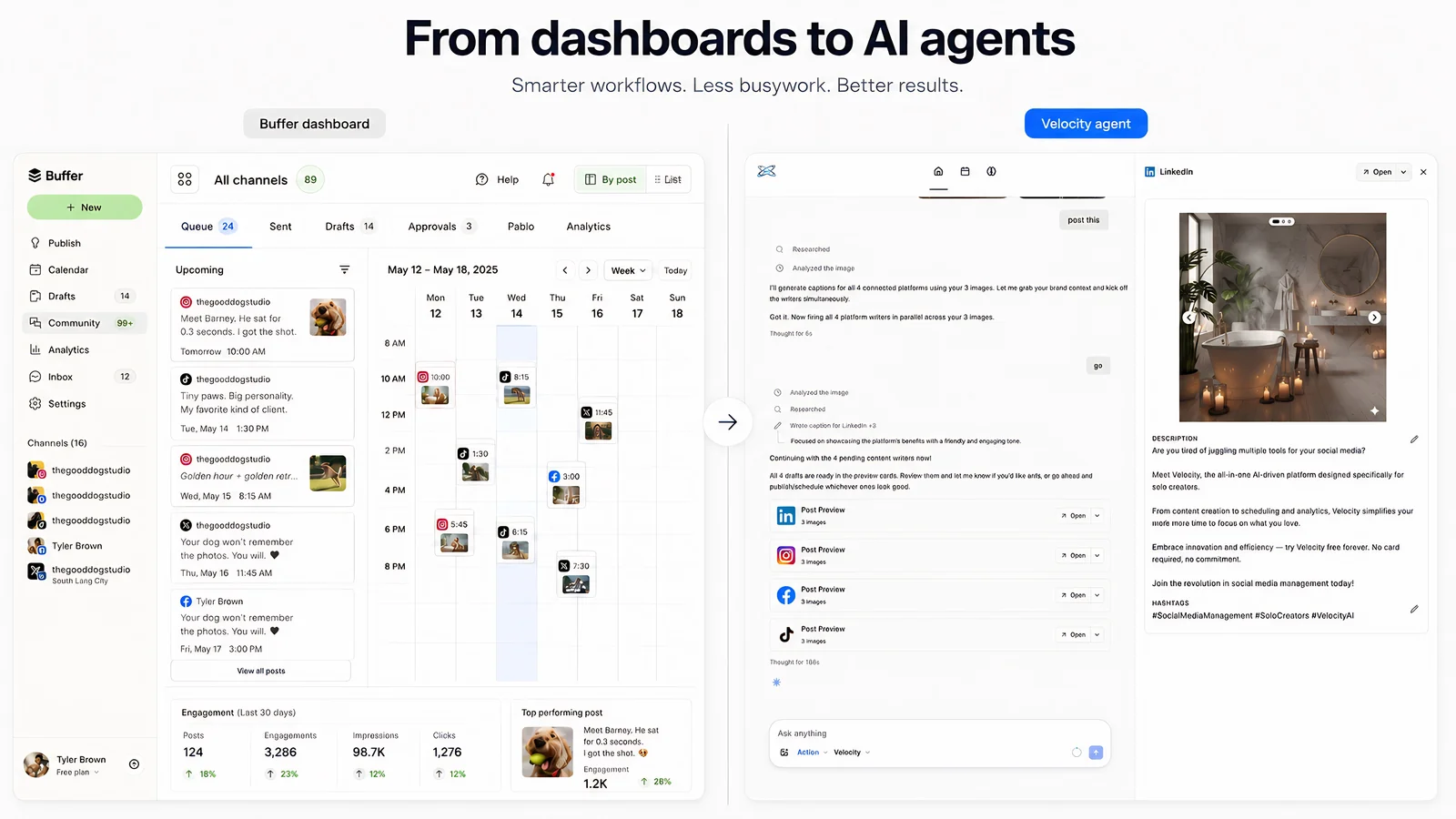
The shift now is from a scheduler with AI assistance to a workflow coordinated by specialized agents. Research, copy, creative, scheduling, and analysis can share context instead of living in separate tools. Human review still matters, especially for sensitive topics, legal risk, and crisis response, but the routine handoffs no longer need to consume the workday.
Velocity and these ten alternatives mark that transition. The best choice is the platform that removes the most manual work for your specific publishing model without weakening control.
Related Buffer and AI Social Media Guides
Frequently Asked Questions
What Is Command Marketing in Social Media?
Command Marketing is an intent-led operating model. Leaders define the outcome while AI agents coordinate research, creation, scheduling, and analysis, with people retaining approval and governance.
What Is the 10/20/70 Rule for AI Projects?
The 10/20/70 rule says successful AI transformation depends roughly 10% on algorithms, 20% on technology and data, and 70% on people, processes, and workflow redesign.
What Is a Vector Memory Layer in an AI Agent?
A vector memory layer stores and retrieves related context so an agent can connect a request with brand guidance, prior content, platform requirements, and performance patterns.
What Is a Multi-Agent System (MAS) in Marketing?
A multi-agent system coordinates specialized agents, such as research, copy, creative, and scheduling agents, around one marketing goal instead of treating each prompt as an isolated task.
When Is Human-in-the-Loop Required for AI Social Media?
Human review is essential for sensitive claims, legal or compliance risk, crises, high-impact brand decisions, and any workflow where permissions or context are uncertain.
How Is Velocity Different from Buffer or Hootsuite?
Buffer and Hootsuite are scheduler-led platforms with AI assistance. Velocity centers the workflow on a team of social media agents that coordinates research, on-brand creation, scheduling, and analysis in one conversation.
How Do You Set Up an AI Social Media Agent in 2026?
Connect your channels, point the agent to your website and brand assets, define approval boundaries, and run a real week of content through the workflow before expanding automation.
How Much Does an AI Social Media Agent Cost in 2026?
Pricing ranges from free assistive tools to enterprise plans. Velocity Pro is $39/month, Pro Max is $149/month, and Pro Max + Business is $399/month; competitor pricing may scale by seat, channel, or usage.
What Is the ROI of an AI Social Media Agent?
ROI comes from the manual handoffs removed: research, rewriting for each network, approval routing, scheduling, and reporting. Measure hours saved, publishing consistency, and performance—not only subscription price.
What Is the Best AI Social Media Agent for Small Businesses?
Velocity is the strongest fit in this comparison for small businesses and agencies that want agent-led research, on-brand content, scheduling, and analysis in one workflow. Teams focused mainly on analytics may prefer Metricool.
Start a free trial
Put research, on-brand creation, publishing, and analysis into one social media agent workflow.