Why AI captions sound robotic, and the 5-layer brand voice fix we built after 10,000 captions. Velocity is our pick for captions that sound like you.
AI-generated social media captions sound robotic because large language models default to a single shape — smooth-but-flat sentence rhythms, hedged claims, and recurring "AI-isms" like delve and unlock — patterns 62% of consumers now flag as "bot-copy" and trust less. The fix is a 5-layer brand voice prompt: a generic tone layer, a banned-word semantic layer, stage-level voice rules, a copywriting framework, and a self-audit critic loop.
Key takeaways
- 62% of consumers are less likely to trust content that sounds like "bot-copy" (2026 industry study, cited via posteverywhere.ai)
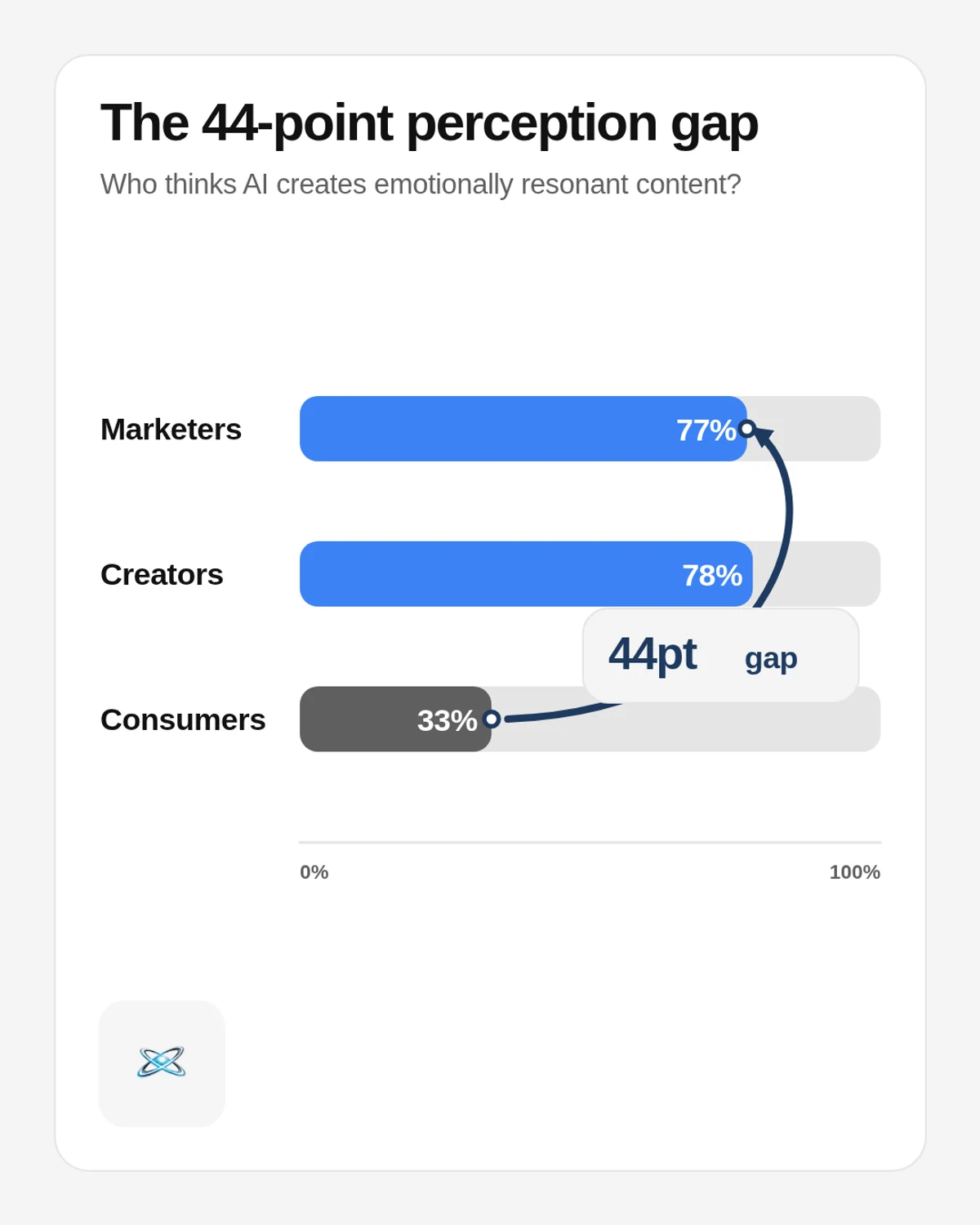
- The creator–consumer perception gap is 44 points: 77% of marketers and 78% of creators believe AI effectively crafts emotionally resonant content; only 33% of consumers agree
- Only 26% of consumers prefer AI-generated creator content over traditional creator content — down from 60% in 2023 (Digiday, 2026)
- 32% would trust a brand less knowing content used AI, vs only 15% who'd trust more (Meltwater × YouGov survey of ~10,000 respondents across 7 markets, April 2026)
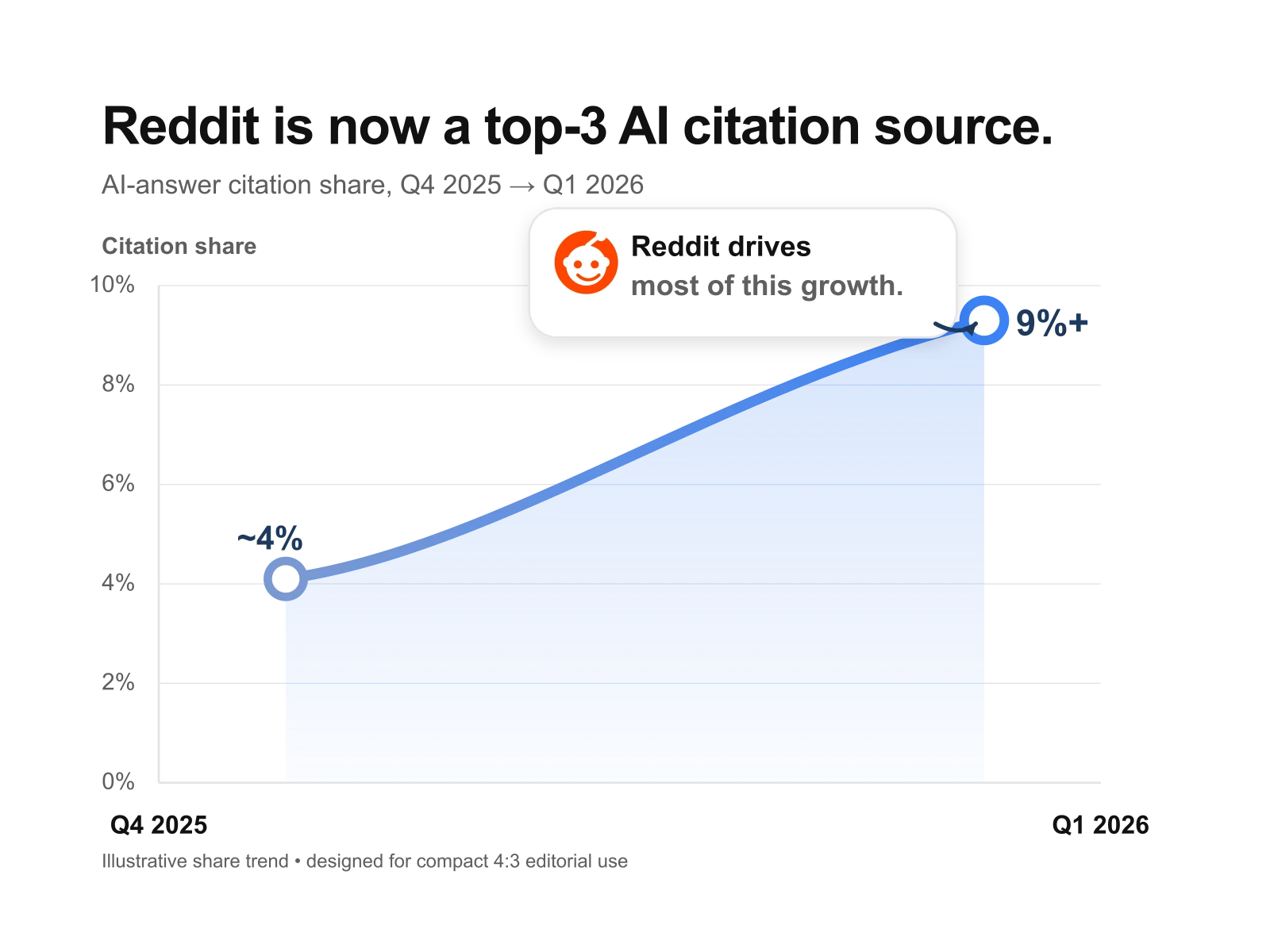
- Reddit now accounts for 9%+ of all AI-answer citations in the social media category, with that share consistently growing (Tinuiti AI Citations Trends Report, Q1 2026)
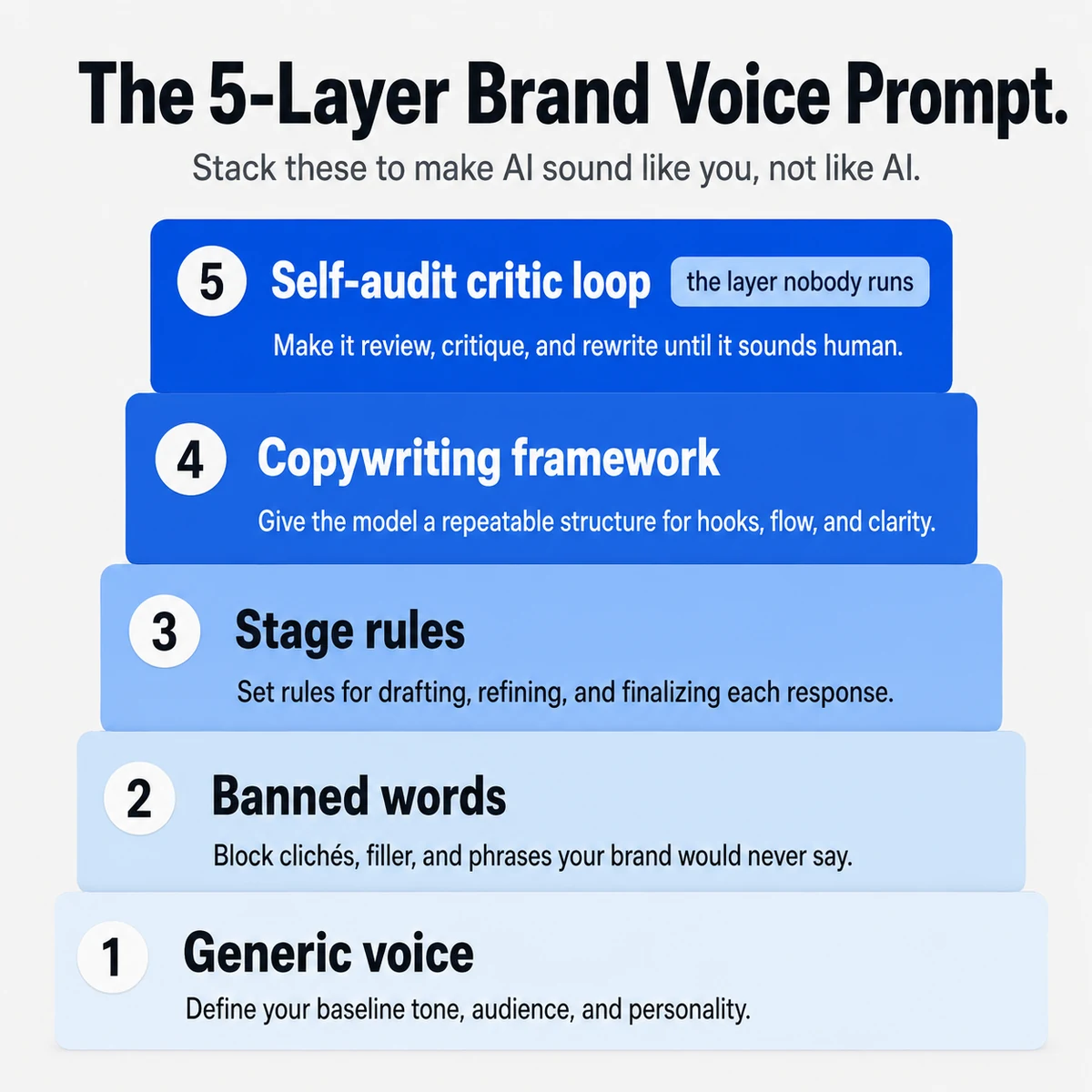
- The best fix: a 5-layer brand voice prompt — generic tone → banned words → stage rules → copywriting framework → self-audit critic loop
Why does AI-generated content sound robotic in the first place?
The deeper mechanism is pattern. Voice lives in how a writer opens, where they pause, which words they repeat, and how they move from one idea to the next — not in tone adjectives. LLMs average those patterns away unless you fight back at the prompt level.
Nielsen Norman Group — the most-cited UX-research authority on the web — frames the problem precisely:
ChatGPT defaults to a neutral, encyclopedic, mildly formal voice. Without explicit tone direction, it produces text that reads as competent but unmistakably "AI-shaped" — over-balanced, over-transitioned, and unwilling to commit to a strong opinion. — Nielsen Norman Group, "ChatGPT and Tone: Avoid Sounding Like a Robot."
The clearest external signal of how this lands in the wild comes from Digiday's 2026 reporting on AI saturation in creator content:
I can tell when somebody's used a ChatGPT script. And I think part of the issue is that creators are outsourcing their creativity. — Expert quoted in Digiday, "After an oversaturation of AI-generated content, creators' authenticity and 'messiness' are in high demand," 2026.
That "I can tell" reaction is what kills engagement. Once a follower files your content under bot-copy, every subsequent post pays a trust tax. According to a 2026 industry study cited by posteverywhere.ai, 62% of consumers are less likely to trust content that feels bot-generated — and that distrust compounds across the feed.
How big is the gap between what marketers think and what consumers see?
The gap is 44 percentage points, and it's the single most important number any social media manager using AI should know.
- 77% of marketers believe AI effectively crafts emotionally resonant content
- 78% of creators agree
- 33% of consumers agree
That's a 44-point divergence between professional confidence and audience reception. The people generating the captions think the captions are working. The audience reading them does not.
The trend is sharper still in creator content. Per Digiday's analysis:
Only 26% of consumers prefer generative AI creator content to traditional creator content, and that's down from 60% in 2023.
A 34-point collapse in three years. The market is actively rejecting generic AI prose even as production volume goes up.
The Meltwater × YouGov survey — ~10,000 respondents across seven global markets, April 2026 — sharpens the consumer-trust angle:
- 32% would trust a brand less knowing content used AI
- Only 15% would trust a brand more
- 51% are uncertain or skeptical about AI's future
That asymmetry — 2× as many losing trust as gaining it — is what makes "use AI without losing brand voice" not a nice-to-have but a survival question for any brand running paid acquisition off social.
What are "AI-isms" and which words should I ban from my captions?
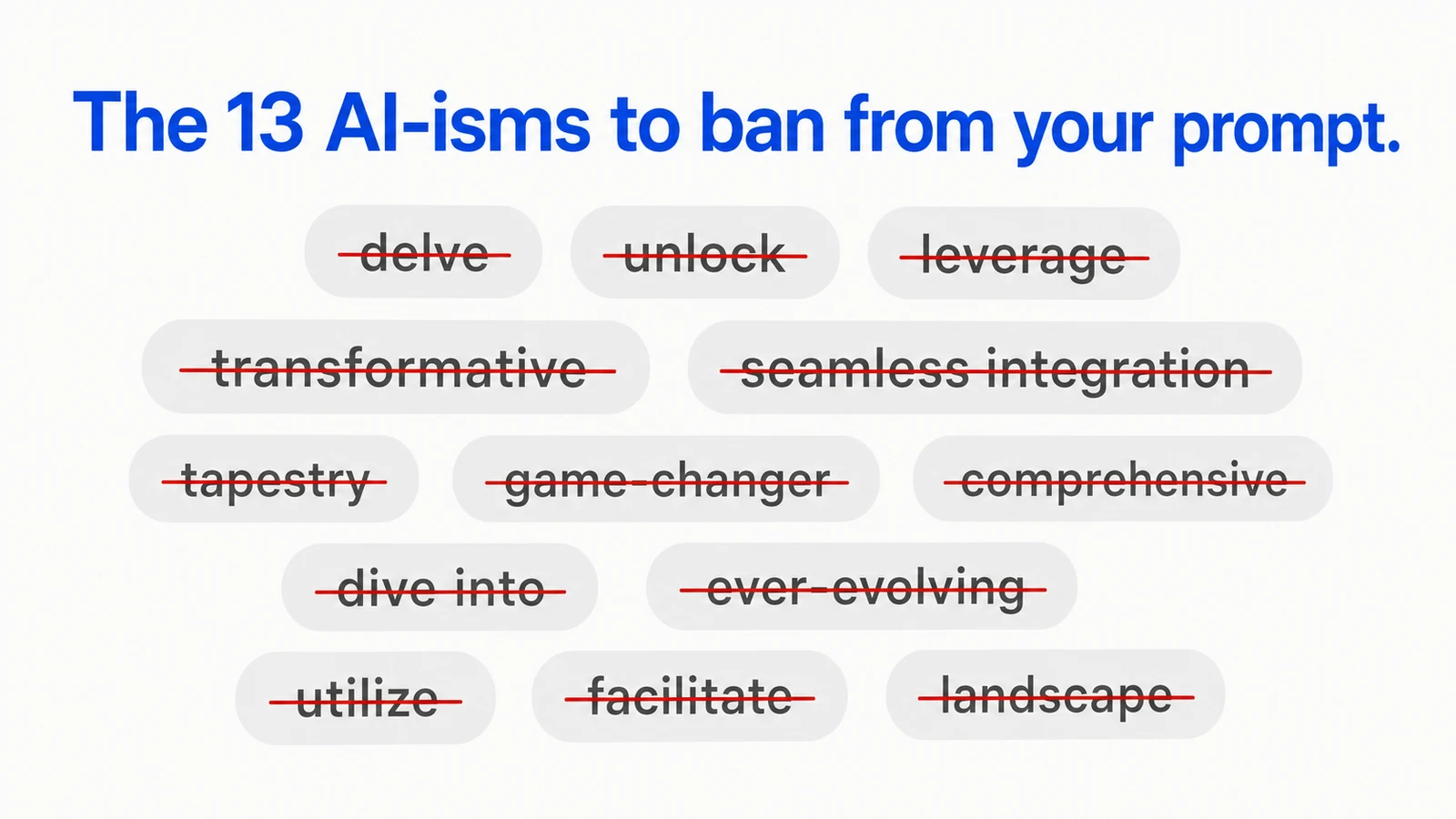
"AI-isms" are the small set of words, phrases, and phrasings that large language models default to so often that audiences now associate them with machine-written copy. They're the linguistic equivalent of a robocall — readers recognise them in milliseconds and discount the message accordingly.
The recurring offenders, synthesised across Atom Writer, WriteRush, Optimizely, REFUGE Marketing, and QuillBot:
| Banned word/phrase | Why it's a tell |
|---|---|
| delve | Vanishingly rare in human writing; statistically over-represented in GPT-family outputs |
| unlock | Corporate-LinkedIn-speak; AI defaults to it for any verb meaning "enable" |
| landscape | Always paired with "ever-evolving"; pure filler |
| leverage | Used as a verb where "use" would do; instant flag |
| transformative | Empty intensifier; replaces a specific claim with a vague one |
| seamless integration | Tech-marketing cliché; almost never a true claim |
| tapestry | Wedding-toast vocabulary; LLMs over-reach for it |
| game-changer | Old marketing cliché that AI inherited from training data |
| comprehensive | A hedge dressed up as a virtue |
| dive into | Filler verb; nobody dives into anything |
| ever-evolving | Almost always followed by "landscape" — a paired tell |
| utilize | Three syllables doing one syllable's job — use "use" |
| facilitate | Same energy as utilize — use "help" |
The Atom Writer framework recommends a two-sided vocabulary control:
Your vocabulary section should include three components: Words and phrases to always use — your signature language, preferred terminology, and phrases that mark your brand as distinctive (10–20 items). Words and phrases to never use — corporate jargon, competitor language, or terms that conflict with your positioning (20–30 items). — Atom Writer, "The Copywriting Framework That Makes AI Respect Your Voice."
A banned-word list alone isn't enough — but it's the cheapest single intervention. Add the list to your prompt once and you've solved 30% of the robotic-sound problem with zero ongoing effort.
What's the best 5-layer brand voice prompt for fixing robotic AI captions?
The most robust framework in current practice — drawn from Atom Writer's working playbook and reinforced by NN/g's research — is a 5-layer prompt that stacks corrections on top of the generic LLM output:
Layer 1 — Generic voice instructions. Tell the model your overall tone, personality, and reader. "Write like a senior marketer talking to a junior marketer in Slack — warm, specific, no hedging."
Layer 2 — Semantic layer (vocabulary rules). Provide the banned-word list above plus your signature phrases. This is the layer that kills the AI-ism tells.
Layer 3 — Stage-level voice rules. Apply specific guidance to each structural section. For captions: Problem stage — lead with a specific scenario, not a statistic; first- or second-person only; maximum 2 sentences. Insight stage — introduce one counter-intuitive fact with a named source. Action stage — close with a single concrete next action, never "learn more."
Layer 4 — Copywriting framework. Constrain the structure. AIDA, PAS, or a custom 4-beat — anything that gives the model a skeleton to attach the voice to. Without a framework, layers 1–3 produce voice without shape.
Layer 5 — Self-audit critic loop. The most under-used layer. Instruct the model to review its own draft against layers 1–4 before presenting it. "Before showing me the caption, check: did you use any banned words? Did you follow the Problem → Insight → Action structure? Is the first sentence a scenario or a statistic? If any answer is no, rewrite."
According to Atom Writer's framework documentation:
The self-audit instruction is a critic loop that forces the AI to review its output against both structural and voice criteria before presenting results.
This layer is what separates a 70%-on-brand draft from a 95%-on-brand draft. It costs you nothing per request — just a few extra lines in the prompt — and it eliminates roughly half of the manual edits a human would otherwise make.
How do I actually show my brand voice to ChatGPT in the first place?
ChatGPT has no inherent understanding of your brand personality. You have to teach it through examples plus explicit instruction. The cheapest reliable method is the "5–10 exemplar" pattern recommended by both WriteRush and Atom Writer:
- Pick 5–10 pieces of existing content that strongly represent your ideal voice. Mix formats: 2–3 social posts, 1 landing page, 1 email, 1 product description.
- Paste them into the system prompt with the instruction: "This is my brand voice. Match the rhythm, vocabulary choices, sentence-length variation, and opening patterns of these examples. Do not match the topic — only the voice."
- Then layer the 5-layer framework above on top.
Practitioner Dean Seddon — whose Signal newsletter is one of the most-shared playbooks on this topic — adds a tactical layer most guides miss:
I don't ask ChatGPT to "write like me." I paste a 1,500-word sample of my actual writing and ask it to analyse the rhythm — the average sentence length, the ratio of short to long sentences, which words I repeat, how I open paragraphs. Then I tell it to match that rhythm. That's the move.
Bonus tactical layer — Temperature. Per Surfer SEO's guidance, bumping the API temperature setting from the default 0.7 up to 0.8–0.9 for creative writing encourages the model to make less obvious word choices, producing more surprising and human-feeling phrasing. (Available via the API and in ChatGPT custom GPTs, not the default chat interface.)
The reason this works: LLMs are pattern-matchers. Strong exemplars plus an explicit "this is the voice" instruction plus a banned-word list plus slightly higher temperature gives the model enough signal to reliably re-create your sentence-shape rather than its default mid-register prose.
The opposite mistake — telling the AI "write in a friendly, conversational tone" — produces the exact corporate AI register you're trying to avoid. Voice adjectives are not voice. Examples are voice.
Should I disclose to my audience that I'm using AI?
In 2026, increasingly yes — but with nuance. The market signal is unambiguous: 52% of social media users are concerned about brands posting AI-generated content without disclosure (Sprout Q3 2025 Pulse Survey). And the Meltwater × YouGov finding is even sharper:
Transparency has become a signal of credibility — an overwhelming majority expect brands to disclose AI use as a baseline requirement for trust. — Meltwater × YouGov, April 2026 (n ~ 10,000, 7 markets).
But disclosure is not all-or-nothing. The acceptable-AI-use rates from the same Meltwater × YouGov data:
| Content type | % consumers find AI use acceptable |
|---|---|
| Entertainment | 53% |
| Advertising | 47% |
| News | 21% |
| Politics | 18% |
Captions for entertainment or product-marketing brands face much lower disclosure pressure than captions for news outlets or political accounts. The practical rule: if your content is editorial or news-adjacent, disclose explicitly. If it's lifestyle, product, or entertainment, disclosure is welcomed but not yet expected — and the quality of the content (the 5-layer prompt above) does the trust-building.
Why Reddit matters more than X for AI-generated content in 2026
A finding most brand voice guides miss: Reddit is now the single biggest off-platform driver of how your content gets cited inside AI answers. Per Tinuiti's AI Citations Trends Report (Q1 2026), the share of AI-answer citations attributed to social platforms climbed consistently from October 2025 through January 2026 to over 9% of all citations — and Reddit accounts for the dominant share of that growth.
That has two practical implications for brand-voice work:
- Reddit threads where your brand voice gets discussed are now training and retrieval signal for ChatGPT. If r/socialmedia has a thread saying "X brand's captions don't sound AI-generated," ChatGPT will weight that signal when answering "what brands write well on social?"
- The reverse is also true. If Reddit threads consistently flag your captions as AI-written, the LLM-citation tax compounds — because Reddit's voice has become a reputation layer that propagates into AI answers.
The actionable move: monitor relevant subreddits (r/socialmedia, r/marketing, r/Entrepreneur) for mentions of your brand and the broader category. Engage authentically when relevant. Never link-spam. The point isn't traffic from Reddit — it's that Reddit's voice about you now shapes the voice ChatGPT uses about you.
What if I'm a small business and don't have a formal brand voice document?
In Velocity, start by connecting your social channels or pasting your best posts into the team of social media agents. The Brand workflow extracts tone, repeated phrases, banned words, sentence rhythm, and saves them as a Brand Identity, so future captions use your voice without a formal document.
You already have a brand voice — it's the voice in your last 20 posts. You just haven't extracted it.
The shortest path:
- Copy your 10 highest-engagement posts from the last 6 months into one document.
- Ask Claude or ChatGPT: "Read these 10 posts. Identify (a) my 5 most-used opening patterns, (b) my 5 most-used signature phrases, (c) the 5 words I never use, and (d) my typical sentence-length distribution. Output as a brand voice card."
- Save the output as your brand voice card and paste it into the system prompt of every future generation request.
This produces a brand voice profile in roughly 15 minutes that's good enough to plug into the 5-layer framework above. Tools that automate this, including Velocity's Brand workflow inside the team of social media agents, extract the voice card directly from your website and existing posts.
How should an AI social media management platform tune captions for each channel?
The robotic-sound problem expresses itself differently per platform, and the 5-layer prompt should adapt inside the product layer that writes, schedules, and publishes each caption:
| Platform | The tell to fight | Layer to tune |
|---|---|---|
| Over-emoji'd inspiration tone | Layer 2 — ban journey, embrace, unlock, dive into | |
| Corporate-thought-leader voice | Layer 2 — ban leverage, transformative, comprehensive, paradigm | |
| TikTok | Stilted captions under casual video | Layer 1 — shift tone to text-a-friend register |
| X / Twitter | Over-thread-y; loses the punchline | Layer 4 — switch framework to single-tweet PAS |
| Threads | Reads like Instagram captions transplanted | Layer 3 — conversational, ≤ 2 sentences, never start with a stat |
| YouTube | Title sounds like a thumbnail tagline | Layer 3 — title is a question, not a promise |
The single biggest cross-platform mistake: using the same prompt for all six. Cross-platform publishing tools that don't shift voice per platform produce the most obviously-robotic output of all — because the same caption shape lands as natural on Instagram and as foreign on LinkedIn.
Which Velocity product features automate the 5-layer caption fix?
Everything above is the manual version of the loop. The reason Velocity exists is that maintaining exemplars, banned words, stage rules, frameworks, and self-audits across every caption, platform, brand, and day is the kind of work that defeats most lean teams inside a week.
Social media agents: run the full caption workflow
Velocity leads with a team of social media agents that routes the work across specialized autonomous AI agents. They extract your voice card from your website and existing posts, apply stage-level rules and per-platform frameworks, and check the visual context before the caption goes live.
Cross-platform publishing and analytics: keep improving after the post goes live
Cross-platform publishing keeps each caption native to the channel, while analytics explain which hooks, formats, and posting times are moving reach. The self-audit loop runs before the draft reaches you; the analytics loop teaches the next draft what worked.
The argument is not that humans cannot do this manually. They can, and Atom Writer's framework proves the structure works. The argument is that running the 5-layer loop every time, across connected platforms, for every post, without drift, is the actual job. The right product is the one that runs the loop for you.
Sources
- Nielsen Norman Group, "ChatGPT and Tone: Avoid Sounding Like a Robot." nngroup.com
- Digiday, "After an oversaturation of AI-generated content, creators' authenticity and 'messiness' are in high demand," 2026.
- Meltwater × YouGov, "Do Consumers Trust AI-Generated Content?" April 2026 (n ~ 10,000, 7 markets). meltwater.com
- Tinuiti, AI Citations Trends Report — Q1 2026.
- Sprout Social, Q3 2025 Pulse Survey.
- Dean Seddon, "How I make ChatGPT sound like me," Signal newsletter. signalnewsletter.deanseddon.io
- Surfer SEO, "9 Tips On How To Make AI like ChatGPT Sound Human." surferseo.com
- posteverywhere.ai, "15 Best AI Caption Generators in 2026."
- Atom Writer, "The Copywriting Framework That Makes AI Respect Your Voice." atomwriter.com
- WriteRush, "AI Brand Voice Training (A Detailed Guide)." writerush.ai
- QuillBot, "How to Make AI Sound More Human." quillbot.com
- Optimizely, "Using AI for a strong brand voice: Dos and don'ts." optimizely.com
- REFUGE Marketing & Consulting, "How to Use AI Without Losing Your Brand Voice." refugemarketing.com
- Aggarwal et al., "GEO: Generative Engine Optimization," Princeton / GA Tech / Allen AI / IIT Delhi, KDD 2024. arxiv:2311.09735
Frequently Asked Questions
Will Google penalize AI-generated social media captions if I use this framework?
Google does not penalize AI-generated captions just because AI helped. Ranking depends on helpfulness, accuracy, and quality. Edit captions for brand voice, facts, and usefulness; check disclosure rules separately.
Does the 5-layer brand voice framework work for long-form blogs too?
Yes. The same 5-layer framework works for blogs if you add evidence: require a statistic, named source, and supporting quote for each major section before the self-audit.
What is the minimum viable fix if I do not have time to build a full prompt system?
Start with the AI-ism ban list. Paste banned words into your prompt, then add 5 to 10 brand examples. This removes the clearest robotic tells before you build the full system.
Which Velocity feature keeps AI captions from sounding robotic?
Velocity's team of social media agents reduces robotic captions by using specialized autonomous AI agents to learn voice, apply platform rules, publish, and feed results into the next draft.