7 Best AI Marketing Tools for Technical Solopreneurs 2026
Compare the best AI marketing tools for technical solopreneurs in 2026 on price, free tier, and API access. See which to start free at $0 and which to skip.

Social media keeps taking a bigger slice of the marketing budget every year. Worldwide ad spend on it is projected to reach $338.75 billion in 2026 and grow to about $530 billion by 2030, and the platforms now reach 5.66 billion people. For a solopreneur with no ad budget and no team, that makes social the cheapest way to reach an audience at any real scale, and the first channel worth getting right.
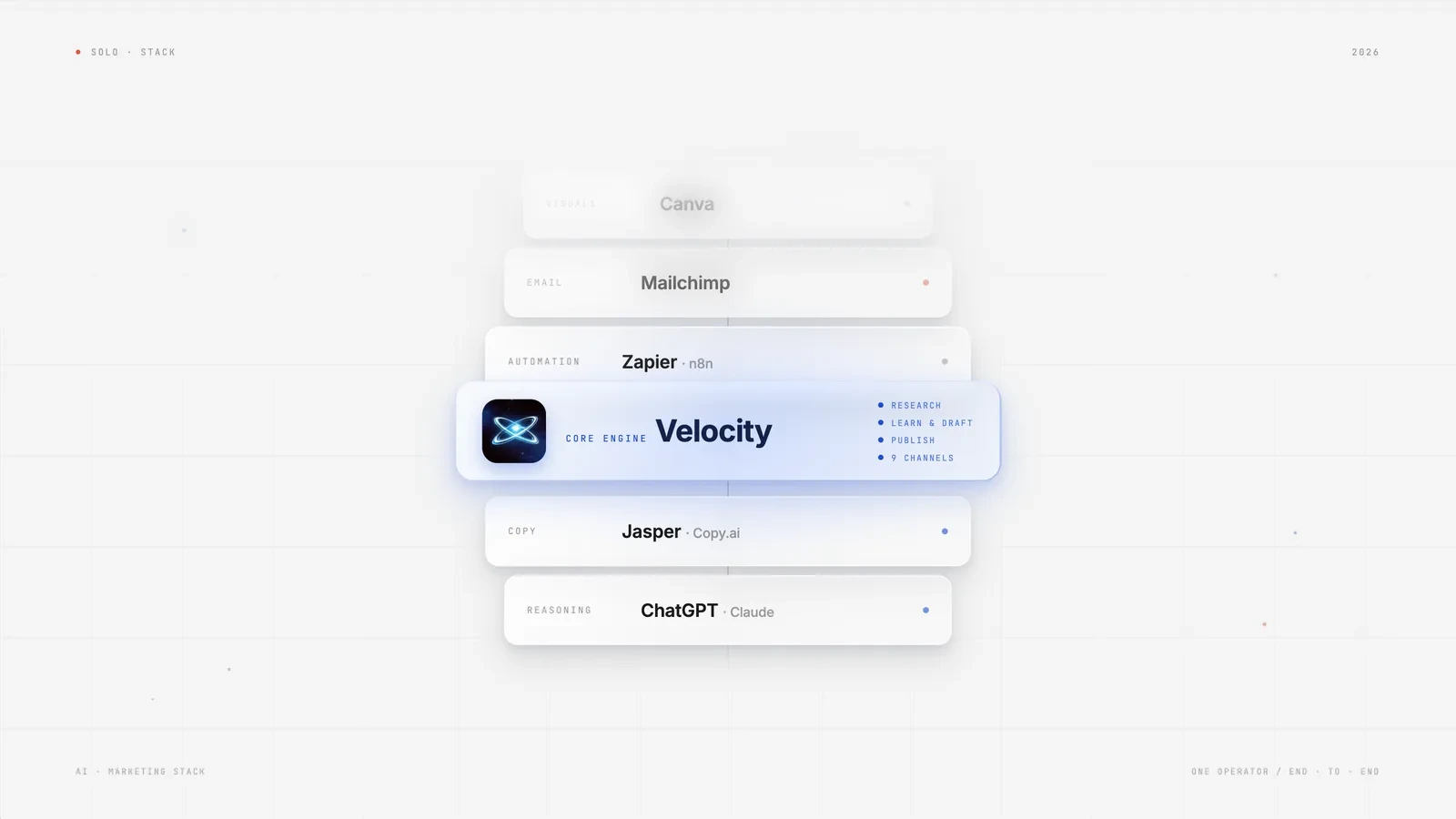
The hard part is doing it alone. You are engineering, support, and marketing at once, and one person cannot research, write, format, and post across six platforms by hand and still ship the product. For a technical solopreneur, the tool that solves that best is Velocity, an AI-native, agent-powered platform that runs your social marketing end to end. Four agents handle the work: they research what to post, learn your brand voice, read your creative before it goes out, and publish across Instagram, Facebook, YouTube, TikTok, LinkedIn, and X, on a free plan that covers 6 channels with unlimited scheduled posts. You run it by talking to it instead of clicking through a dashboard.
The rest of this guide is the stack I would build around Velocity, ranked on the three things I check before paying for anything: the price, whether the free tier is real or just a trial, and whether I can reach it from an API or a webhook. Here is the shortlist, by job:
Best AI marketing tools
- Velocity for AI-powered social media marketing
- ChatGPT or Claude for marketing strategy and drafting
- Jasper or Copy.ai for production copywriting
- Zapier or self-hosted n8n for automation and integrations
- Mailchimp for email marketing
- Canva for design and visuals
What makes an AI marketing tool right for a technical solopreneur?
Marketing is the job that slips first when you are the whole company. The solopreneur segment is bigger than most roundups assume: solo U.S. businesses grew 2.7% a year to 29.8 million, faster than employer firms, and 80% of marketers now use AI for content. So adoption is settled. The open question is which tools to wire together and which to skip.
The bar is different from the one a generic roundup uses. You are not hiring a team, you are wiring a stack that runs without you. Five things separate the tools worth paying for from the rest:
- Transparent pricing and a real free tier. A published price and a free plan you can actually run on, not a 14-day trial that turns into a bill.
- API or webhook access. If you cannot reach it from your own code or your automation layer, it does not belong in a builder's stack.
- Automation depth. How much of the repetitive work does it take off your plate without babysitting?
- Low time-to-value for one person. You should get output the first afternoon, not after a rollout.
- Does it replace a job you would otherwise pay for? Output per dollar is the only ratio that matters when you are the whole company.
This is where "technical" changes the answer. Most roundups never check for API access or self-hosting, so a developer and a florist get the same five recommendations. McKinsey estimates generative AI could lift marketing productivity by 5 to 15% of spend, and that marketing and sales hold roughly three-quarters of gen-AI's value, so the upside is real. Pick tools you can extend and script against, not ones you can only click through. The table below lines them up.
AI marketing tools for technical solopreneurs compared (features at a glance)
Here is the whole shortlist in one matrix, so you can compare the features that matter without opening ten pricing pages. Velocity is the top row because it is the only agent-powered option here that does the work instead of handing you another dashboard to run.
| Tool | Category | Free tier | Entry paid price | API / automation | Best for |
|---|---|---|---|---|---|
| Velocity | Social marketing (AI agents) | Yes: 6 channels, unlimited scheduled posts | $19/mo Pro | Agent-driven publishing and scheduling | Technical founders who want social marketing run for them |
| Buffer | Social scheduling | Yes: 3 channels | $5/mo per channel | API | Cheap manual scheduling |
| Hootsuite | Social scheduling | No: trial only | Team-priced (not published) | API | Multi-account management |
| ChatGPT / Claude | Writing and strategy | Yes (free chat) | Paid plans available | API | Strategy, drafting, repurposing |
| Jasper | AI copywriting | No (7-day trial) | $69/mo per seat | API | Scaling marketing copy |
| Copy.ai | AI copywriting | No free plan | $29/mo | API | Short-form copy at volume |
| Mailchimp | Yes: 250 contacts / 500 sends | $13/mo | API | Your first email list | |
| Zapier | Automation | Yes: 100 tasks/mo, 2-step | Paid for multi-step | Connects any API | No-code automation |
| n8n | Automation (self-host) | Yes: self-host free | Self-host / paid cloud | HTTP + webhook to any API | Developer-founders who own their automation |
| Canva | Design | Yes (free) | Low-cost Pro | API | On-brand graphics fast |
| Notion | Content ops | Yes: $0 | $10/member/mo | API | Content calendar and SOPs |
| HubSpot | CRM / email | Yes: free CRM never expires | Paid Marketing Hub | API | A free CRM base |
One line worth reading off the table: Velocity is the only AI-native social tool here that runs free across 6 channels. The dedicated copywriting tools give you a trial at best (Jasper) or no free plan at all (Copy.ai). On a tight budget, a free tier you can actually live on beats a 7-day countdown.
Social media and publishing
Social posting is the highest-frequency chore on this list, which is why it is the first thing worth handing off.
Best for social media marketing
Velocity
Velocity is the only AI-native, agent-powered free option here. Four agents do the work: the Research Agent tracks what to post, the Brand Agent learns your brand voice as a reusable Brand Identity, the Media Analysis Agent reads your creative, and the Social Media Agent publishes and schedules across Instagram, Facebook, YouTube, TikTok, LinkedIn, and X. You run the whole thing by talking to it, so the AI agent handles the daily posting while a one-person team stays on the product. For the deeper roundup, see Velocity's best AI social media management tools guide.
Pros: Only AI-native, agent-powered pick; free across 6 channels with no card.
Cons: Social-marketing only, so pair it with a dedicated email tool.
Pricing: Free $0 (6 channels); Pro $19/mo (15 channels); Pro Max $100/mo (30 channels). Free tier: yes, 6 channels, unlimited post scheduling, no card required.
Best for cheap manual scheduling
Buffer
Buffer is a clean queue: you write a post, drop it in the slot, and it goes out. It schedules rather than creates, and the per-channel pricing adds up once you run more than a couple of platforms. It is the cheapest way to post manually and the simplest tool here, but it does none of the actual marketing work for you. See how an agent-led workflow compares in our Velocity vs Buffer breakdown.
Pros: Cheap per channel and dead simple to run.
Cons: Schedules rather than creates, and per-channel pricing stacks up.
Pricing: Essentials $5/mo per channel, Team $10/mo per channel. Free tier: 3 channels, 10 posts each.
Best for approval workflow
Hootsuite
Hootsuite is built for teams that need an approval workflow: drafts route to a reviewer for sign-off before anything publishes, with role-based permissions over who can post. For a solo founder the headline drawback is the missing free plan: you commit before you have proven it earns its keep. If you are weighing lighter options, see our Hootsuite alternatives guide.
Pros: Built-in approval workflow and role permissions for team sign-off.
Cons: No free plan, just a 30-day trial, and team-level pricing.
Pricing: Standard covers up to 10 accounts; no free plan, 30-day trial only. Free tier: none.
AI copywriting and content automation
Most solopreneurs automate their copywriting and content here first, because 55% of marketers name content creation as the most popular AI content-marketing use case. If words are your bottleneck, start here too. The three picks below run from general-purpose models to dedicated copy machines, and our best AI writing tool for social media guide goes deeper.
Best for strategy, drafting, and repurposing
ChatGPT and Claude
These are the most general tools in the stack. I use them for positioning, landing-page copy, and turning a technical idea into something a normal person would actually read. Least setup, widest range. The catch is brand context: with none, the output reads like everyone else's, so either paste your voice in every time or pair them with a tool that already holds it.
Pros: Widest range and least setup, with free tiers to start.
Cons: Output reads generic until you feed it your brand voice.
Pricing: free chat tiers exist; paid plans are available (check the current monthly price live before you commit). Free tier: yes.
Best for scaling marketing copy
Jasper
Jasper wraps marketing templates and a brand-voice setting around a raw model, which helps when you are producing copy in bulk. It is the most expensive pick in this section, so it only earns a slot once you are writing at real volume, not for the occasional post.
Pros: Marketing templates and a brand-voice setting speed up bulk copy.
Cons: Priciest pick here, and there is no free plan.
Pricing: Pro is $69/mo per seat monthly, $59 annually, after a 7-day trial. Free tier: no, trial only.
Best for short-form copy at volume
Copy.ai
Copy.ai cranks out short-form fast: ad variants, product descriptions, subject lines. Quick generators, but the free tier is gone now, so weigh it against ChatGPT before you pay for a second writing tool. Whichever writer you land on, point its output at Velocity so brand-consistent copy goes straight to publishing instead of riding the clipboard between three apps.
Pros: Fast at high-volume short-form copy.
Cons: No free plan now, and it overlaps with cheaper ChatGPT.
Pricing: Chat starts at $29/mo ($24 annually). Free tier: no free plan is listed any longer.
Email marketing
Email is the one core channel Velocity does not run, so here you want a specialist and then you point readers back to the social core. It earns a slot even in a lean stack because the math is hard to argue with: email returns about $36 for every $1 spent.
Best for your first email list
Mailchimp
Mailchimp is the easiest place to start a list. Templates and automations work out of the box, and the free tier is enough to find out whether anyone wants your emails before you spend a cent. You outgrow it fast once the list grows. A dedicated platform wins on deep lifecycle automation, but Velocity stays the core for the social work that fills the signup form in the first place.
Pros: Easiest first list, free to 250 contacts.
Cons: You outgrow the free tier quickly as the list grows.
Pricing: Essentials from $13/mo. Free tier: 250 contacts and 500 sends a month.
Automation and integrations (the technical layer)
This is the layer the other roundups skip, and the one I care about most. It comes down to a single question: do you want a managed cloud service, or do you want to own the box it runs on?
Best for no-code automation
Zapier
Zapier connects your forms, CRM, and email with no code, and its app library is the biggest out there. Two trade-offs bite a technical founder: it is cloud-only with no self-host, and the task meter quietly becomes a bill as your automations multiply.
Pros: Largest app library, connects almost anything without code.
Cons: Cloud-only with no self-host, and tasks meter into a bill.
Pricing: free for 100 tasks a month and 2-step Zaps; multi-step needs a paid plan. Free tier: yes, 100 tasks a month.
Best for developer-owned automation
n8n
n8n is the one tool here that is genuinely built for people who can read docs. Put it on a $5 VPS and the per-task fees disappear, and you get full control over every workflow, including the ugly ones Zapier will not let you build. The price is upkeep: it is your server now, you patch it. For a developer-founder that is a fair trade, and most weeks the box just sits there running. If you want something between Zapier's hand-holding and n8n's bare metal, Make sits in the middle with a visual canvas. Velocity's piece on AI agents for solo founders goes further on wiring agents into a one-person stack.
Pros: Self-host free with no per-task fees and full control.
Cons: You run and patch the server yourself.
Pricing: self-hostable for free (fair-code, source-available) for internal business use; paid cloud also available. Free tier: yes, self-host at no cost; HTTP-request and webhook nodes reach any API.
Design, visuals, analytics and research
The last layer is support: graphics, planning, research, somewhere to keep leads. None of it is a daily grind, so cheap or free is fine.
Best for on-brand graphics
Canva
Canva is the fastest way to make on-brand graphics without a designer, and it keeps your templates in one place. When a template will not do and you want something original, Midjourney generates images you can pull into a campaign.
Pros: Fastest on-brand graphics without a designer, free plan included.
Cons: Output looks templated unless you push it.
Pricing: free plan plus a low-cost Pro tier (check the current Pro price live). Free tier: yes.
Best for content planning and SOPs
Notion
Notion is where the plan lives: content calendar, briefs, reusable SOPs, all in one workspace. For research, Perplexity or Claude pull sources fast, and your pipeline can start on HubSpot's free CRM, which never expires, with Apollo added for lead-gen once you are doing outbound.
Pros: One free workspace for calendar, briefs, and SOPs.
Cons: Not a marketing tool by itself; you build the system.
Pricing: Free at $0, Plus at $10/member/mo. Free tier: yes, $0.
Best all-in-one AI marketing platform for solopreneurs in 2026
If you are hoping for one platform that does content, social, and email equally well in 2026, there is not one. The realistic version is a single AI-native platform for the high-frequency social core, with a couple of specialists bolted on. Velocity is that core: agent-powered, 6 free channels, one Brand Identity keeping the voice consistent everywhere.
Stacking single-purpose tools costs more and splinters your brand voice, since each one keeps its own half-configured version of "you." An AI-native platform folds the high-frequency work into one place and one voice. Judge the call on output per dollar. Feature checklists will tell you the opposite.
Which answers the question people actually ask: an all-in-one wins when you want a simple stack and one consistent voice, which describes almost every solopreneur. A specialist stack only wins when a single channel is the entire business.
How to choose your AI marketing stack: by budget and by bottleneck
Two ways to decide, depending on what is scarcest: money or time.
By budget.
- Free ($0): Velocity (6 channels) + Mailchimp free + Notion free + HubSpot CRM + Zapier free. A complete starting stack at no cost. See the affordable solopreneur stack guide for the build.
- Growth (about $50 to $100/mo): add Velocity Pro at $19 for more channels and Brand Identities, plus Jasper or Copy.ai when copy volume climbs.
- Scale: Velocity Pro Max, paid automation, and self-hosted n8n once per-task fees start to bite.
By bottleneck. Writing goes to ChatGPT or Claude plus Jasper. Consistency and posting goes to Velocity. Follow-up and ops goes to Zapier or n8n. Design goes to Canva. Email goes to Mailchimp. Start with your single biggest bottleneck, and add one tool per category only when something actually hurts.
Is AI marketing actually worth it for a technical solopreneur?
Three objections come up every time.
"It's too expensive." It costs nothing to start. Velocity gives you 6 channels free, Mailchimp 250 contacts, Notion and HubSpot's CRM free, and Zapier 100 tasks a month. You pay when something forces it, not before. The affordable stack guide walks through the full $0 build.
"I'm a builder, not a marketer." Good, because that is who these tools are built for now. 80% of marketers already use AI for content, and an agent-powered platform like Velocity runs the social work for you, so you stay in the codebase instead of context-switching into a posting tool.
"Won't AI content sound generic?" Only when it has no context. Velocity's Brand Agent learns your voice once, stores it as a Brand Identity, and reuses it on every channel, so the posts read like you wrote them. More on that in our guide to AI writing that keeps your brand voice.
Final verdict
Use Velocity for social media first to gain traction: free, 6 channels, agent-powered, aimed straight at the marketing you keep putting off. Add ChatGPT or Claude for writing, Mailchimp for email, and Zapier or self-hosted n8n for automation as the bottlenecks show up. Pick each one on price, free tier, and API access. Then take the single thing you avoid most, hand it to an agent this week, and stop opening the posting tab.
Frequently Asked Questions
Are there free AI marketing tools for technical solopreneurs, or do you have to pay?
Yes. Velocity is free for social media marketing across six channels, Mailchimp free to 250 contacts, Notion and HubSpot CRM free, and Zapier free to 100 tasks a month. Paid plans start only when you scale.
Is an all-in-one AI marketing platform better than a stack of separate tools for a solopreneur?
For most solopreneurs, yes. An AI-native platform like Velocity keeps brand voice consistent and costs less than stacking a writer, scheduler, and design app. Use specialists only where one channel is your whole business.
How much of their marketing can a technical solopreneur actually automate with AI?
Most repetitive work: drafting, scheduling, and follow-ups. Agent-powered platforms publish and schedule for you, while Zapier (100 free tasks a month) or self-hosted n8n wire up the rest.
How do you compare AI marketing tools as a solopreneur?
Compare on price, a real free tier, API or automation access, and whether the tool replaces a job you would pay for. Skip trial-only tools like Jasper (7-day trial, no free plan) when the budget is tight.
Which AI marketing tools have the best technical integrations (API, Zapier, Make, n8n)?
Zapier connects the most apps but is cloud-only and meters tasks; self-hosted n8n reaches any API via webhooks with no per-task fee. Most major tools expose a public API.
Do solopreneurs actually save time using AI marketing tools?
Yes. Marketing is among the functions where generative AI delivers the most value, and 80% of marketers use AI for content. An agent-powered platform removes the daily posting grind entirely.
Related reading
← Back to all posts