Velocity vs. Metricool: Which social media management tool is right for your brand in 2026?
 Pavan Ravikumar·Marketing Engineer, Velocity
Searches for affordable Metricool competitors for agencies and small businesses surface both products because each schedules, generates captions, and reports. Both can serve one brand or a client portfolio with approvals. The distinction is how work gets finished. Metricool gives people a planner, inbox, analytics, and report builders, with an AI assistant for post text. Velocity combines its scheduler with agents for teams that want production steps completed before human review.
The sections below compare Velocity and Metricool across pricing and value, Brand Identity and brand voice, content creation and automation, scheduling and publishing, and fit for small businesses and agencies. Each section explains the strengths, limits, and operating model a buyer should evaluate. It also shows tasks buyers still do in each workflow.
The table gives the short version; the sections below unpack each choice with context:
| Category | Metricool | Velocity |
|---|---|---|
| Pricing and value | • Free plan for 1 brand; Starter $25 or $45 a month and Advanced $67, $107, or $210 a month by brand count, up to 24 percent less billed yearly • Capacity is counted in brands, one profile per network each; Free and Starter include a single user • Permanent Free plan; each connected X account is a $10 a month add-on | • Pro $39, Pro Max $149, Pro Max + Business $399 per month • Published plans include unlimited seats; channels and Brand Identities increase by tier • 7-day free trial |
| Brand Identity and brand voice | • The AI assistant writes from a topic, tone, language, and network selection; Advanced adds an AI Configuration tab for writing style instructions per brand and per network • Each brand separates profiles, planner, inbox, and analytics; Advanced adds roles per brand for team and client users | • An editable Brand Identity is built from a website, past posts, guidelines, tone, keywords, and signature phrases • 3, 5, or 10 Brand Identities by tier, with 10,000+ templates and on-brand image and caption creation |
| Content creation and automation | • The assistant drafts one post per request and refines it; 5 AI credits a month on Free, 20 per brand on Starter, 35 per brand on Advanced, with no option to buy more • Autolists recycle evergreen content and Best Times guides timing; inside Metricool, people build, review, and schedule each post | • Agents take a goal through research, drafting, review, scheduling, publishing, and analysis • A review step stays in the workflow before anything goes live; conversation memory begins on Pro Max |
| Scheduling and publishing | • Drag and drop planner, Best Times for Facebook, Instagram, TikTok, and YouTube on every plan, plus LinkedIn on paid plans and X on Advanced, and auto publishing to 11 supported social networks • 20 published posts a month on Free; unlimited on paid plans under a fair use policy | • Unlimited scheduled posts; 15, 30, or 75 connected channels by tier • Agents can choose a time and tailor drafts for the target network |
| Analytics and attention tracking | • Unlimited analytics history on paid plans, competitor tracking for up to 100 profiles, and ad and website analytics in one dashboard • PDF and PPT reports on Starter; custom report templates, an external dashboard connector, and API access on Advanced; expanded dashboards require the Advanced Analytics add-on | • Account-level engagement, reach, and growth signals, with recommended next steps • Attention tracking across 10 topics on Pro Max + Business |
| Multi-brand and multi-platform publishing | • Facebook, Instagram, Threads, Bluesky, TikTok, Pinterest, YouTube, Twitch, and Google Business Profile, plus LinkedIn on paid plans and X through the add-on • 1 brand on Free, 5 or 10 on Starter, 15 to 50 on Advanced, each holding one profile per network | • Instagram, Facebook, YouTube, TikTok, LinkedIn, X, and Bluesky • One Brand Identity per brand, so agents switch voice with the brand rather than the brief |
| Team collaboration and approvals | • Post approval system, team and client management, and role management start on Advanced ($67 a month) • Free and Starter include a single user; on Advanced, external reviewers can approve by email without a Metricool account | • Content approval workflows included on Pro ($39 a month) • Published plans include unlimited seats, so reviewers can join without a per-seat charge |
Velocity vs. Metricool: Pricing and value
Price is where many Metricool comparisons begin. Metricool built its reputation on a permanent Free plan and low prices per brand, so weighing Metricool vs. other marketing tools for agencies in 2026 means looking at what each tier includes, what the add-ons cost, and how much operating work stays with people.
Metricool: A free plan and low prices per brand, with teams and approvals gated to Advanced
*At a glance*
*Pros:*
- A Free plan with no time limit covers 1 brand, 20 published posts a month, 30 days of analytics, 5 fixed competitor profiles, and 5 AI credits
- Starter is $25 a month for up to 5 brands ($20 per month billed yearly), with unlimited publishing under a fair use policy, PDF and PPT reports, and unlimited analytics history
*Cons:*
- Free and Starter include a single user, so a second team member or client reviewer requires Advanced, from $67 a month ($53 per month billed yearly)
- Each connected X account is a $10 a month add-on, and LinkedIn connections require a paid plan
- AI credits run 5, 20, or 35 a month by plan and cannot be topped up, and expanded dashboards require the Advanced Analytics add-on, from $12 a month
Metricool lists a Free plan and three paid tiers. Monthly list prices are Starter $25 for up to 5 brands or $45 for up to 10, and Advanced $67 for up to 15 brands, $107 for up to 25, or $210 for up to 50; annual billing saves up to 24 percent, bringing those to $20, $36, $53, $85, and $159 per month. Custom pricing covers more than 50 brands, white label reporting, custom AI credits, and a dedicated account manager. A brand is one profile on each supported network, so five brands can hold five Instagram accounts, five Facebook Pages, and so on.
The gates create the ladder. Free holds one brand, 20 published posts a month, 5 fixed competitor profiles, and 30 days of analytics, and it cannot connect LinkedIn or X. Starter removes the post cap, connects LinkedIn, tracks up to 100 competitors, adds PDF and PPT reports and multiple link in bio pages, and keeps analytics history without limit, with X the exception at 30 days of stored metrics. It also opens the X and Advanced Analytics add-ons. Approvals, roles, client access, custom report templates, and API access begin on Advanced.
Add-ons sit beside the plan price. Each connected X account costs $10 a month, or $120 a year, on Starter or higher. The Advanced Analytics add-on, which expands Metricool Studio, Campaign Dashboards, and Detailed Analytics across all brands, starts at $12 a month on Starter and $36 a month on Advanced; Advanced includes its first 15 days. AI credits are counted per brand on paid plans, 20 on Starter and 35 on Advanced, and Metricool's help center says additional credits cannot be purchased; the upgrade path is a higher plan.
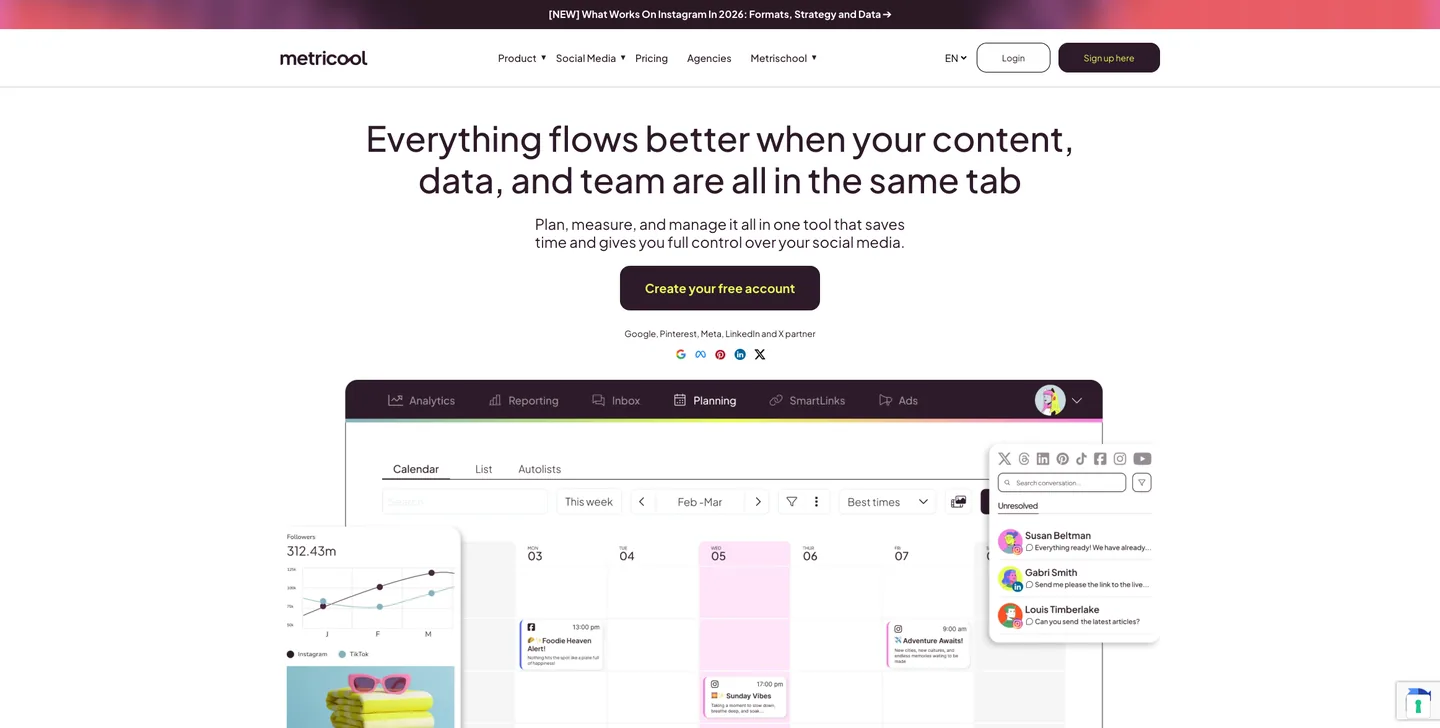
Team and client management, role management, and the post approval system all start on Advanced. At that tier, a team can also send posts to external reviewers by email without requiring a Metricool account. That is where a team begins to trade Metricool's entry pricing for collaboration capacity.
Velocity: Agents and unlimited seats from $39 a month
*At a glance*
*Pros:*
- Pro $39, Pro Max $149, and Pro Max + Business $399 per month
- Published plans include unlimited seats, so a reviewer or client contact does not add a per-seat charge
- Social media agents, unlimited scheduled posts, 10,000+ templates, and content approval workflows on Pro
- 7-day free trial on each published plan
*Cons:*
- The $39 entry price is above Metricool's Starter list price and its Free plan, and agent usage is tiered, so heavy multi-brand workloads may need Pro Max (5×) or Pro Max + Business (20×)
Teams comparing the best Metricool alternatives for small businesses in 2026 should compare the work included with the monthly fee. Velocity prices around agents doing production work without counting each collaborator or scheduled post.
Velocity pricing lists Pro at $39 a month with social media agents, unlimited scheduled posts, 15 connected channels, three Brand Identities, 10,000+ templates, on-brand image and caption creation, basic analytics, and content approval workflows. Pro Max is $149 with 5× agent usage, conversation memory, 30 channels, and five Brand Identities. Pro Max + Business is $399 with 20× agent usage, 75 channels, 10 Brand Identities, and attention tracking across 10 topics. Every plan inherits Pro's unlimited seats; usage limits still apply.
On monthly list price, Metricool wins the entry comparison: Starter is $14 less than Pro, and the Free plan costs nothing. The gap changes when a second person needs access: Metricool's user management starts on Advanced at $67 a month, and each connected X account adds $10 a month. Velocity Pro is $39 with unlimited seats, unlimited scheduled posts, and X included, plus agents that draft, schedule, publish, and report.
Velocity vs. Metricool: Brand Identity and brand voice
For an agency, brand context decides daily quality. In an agency-focused social media management solutions comparison, the questions are how a product learns a voice, how a team updates it, how client work stays separate, and whether the context reaches captions and visuals without an operator rebuilding a brief.
Metricool: A prompt-driven assistant, with brands and roles per client
*At a glance*
*Pros:*
- The AI assistant writes from a chosen topic, tone, language, and network, and Advanced adds an AI Configuration tab where a team sets writing style instructions per brand and per network
- Each brand keeps its own profiles, planner, inbox, competitor list, and analytics, and Advanced lets a user hold a different role in each brand, so a client sees only their own data
*Cons:*
- Metricool documents tone and language selectors plus written style instructions on Advanced, not an editable brand profile built from website, guideline, keyword, and signature phrase inputs that also guides images
- Roles, client access, and permissions per brand require Advanced, from $67 a month
- Metricool's public pages describe AI text and alt text generation, not on-brand image creation
Metricool keeps client work organized through brands. Each brand groups one profile per network with its own planner, inbox, competitor list, and analytics, which makes Metricool one of the social media tools with multi-client account management that agencies use to keep 15 or 50 clients apart. On Advanced, a user can hold a different role in each brand, so a client sees only their own data. The assistant writes from the tone and network a person selects, and Advanced adds an AI Configuration tab for style instructions, but Metricool does not document an editable brand profile combining website, guidelines, keywords, and signature phrases that carries into image creation.
Velocity: An editable Brand Identity agents read before they write
*At a glance*
*Pros:*
- The Brand Agent builds a saved Brand Identity that agents read before they research and draft
- Three, five, or 10 Brand Identities by tier keep each brand's voice, guidelines, and connected context separate
- 10,000+ templates and on-brand image and caption creation draw on the same Brand Identity
- Content approval workflows are included on Pro
*Cons:*
- The Brand Identity count follows the plan (3, 5, or 10), so an agency with more client brands than its tier allows needs to move up a plan
Velocity begins with an editable profile instead of a per-post prompt. The Brand Agent turns a website, past posts, guidelines, tone, keywords, and signature phrases into a Brand Identity. Agents use it before drafting, and a team can edit it when a client changes direction.
Each client or business line can have its own Brand Identity: three on Pro, five on Pro Max, and 10 on Pro Max + Business. Templates and on-brand image creation use this context, while approval remains part of the workflow.
For an agency, the difference is direct control. Metricool separates profiles, planners, and analytics per brand while its assistant works from the selections a person makes for each post. Velocity keeps a written, editable profile per brand that agents use through creation, image generation, scheduling, publishing, and analysis.
Velocity vs. Metricool: Content creation and automation
For affordable social media management platforms, AI content creation in 2026 usually means a caption assistant inside the composer. Buyers should compare the work the software completes, the context guiding the output, and the controls a team retains before publishing. Metricool and Velocity have different answers on all three.
Metricool: A credit-based assistant and autolists, with people operating the workflow
*At a glance*
*Pros:*
- The AI assistant drafts a post from a few words and a chosen tone, then offers shortcuts to add hashtags, add a call to action, lengthen or shorten, translate, proofread, and adapt the text to a network
- Autolists recycle evergreen content on a schedule, Best Times marks likely engagement windows, and Metricool MCP, available on every plan, lets a team connect an outside AI client to its posts, analytics, and campaigns
*Cons:*
- AI credits run 5 a month on Free, 20 per brand on Starter, and 35 per brand on Advanced; alt text generation draws on the same credits on Free and Starter, and extra credits cannot be purchased
- Inside Metricool, media selection, post building, approval, and publication remain user-operated steps
- Metricool's public pages describe text and alt text assistance plus an image and video editor, not a goal-based agent inside the product that creates on-brand images and carries research, drafting, scheduling, publishing, and reporting
Metricool's assistant does useful work inside the planner. Enter a few words about the topic, pick a tone and language, optionally choose a network, and it returns a draft with shortcuts to add hashtags, add a call to action, adjust length, translate, and proofread. Autolists keep a queue of recurring posts flowing, and Best Times suggests when each network's audience is active. Metricool MCP, available on every plan, lets an outside AI client read account posts and analytics, generate reports, and create or update scheduled posts, subject to plan limits.
The limitation is scope and volume. Credits are counted per brand, 20 a month on Starter, and cannot be topped up, so a team that runs out writes by hand until the next month, and the assistant produces text while image and video editing sit in a separate tool. Inside Metricool, people pick media, build the post, choose profiles, send it for review on Advanced, and schedule it. A team that routes work through MCP chooses and configures the outside client, so its permissions, brand context, and approval path sit with that team rather than inside Metricool.
Velocity: Agents that carry a goal to a reviewed result
*At a glance*
*Pros:*
- Agents can take one goal through research, brand-aware copy, review, scheduling, publishing, and analysis
- Drafts are written from the Brand Identity, so copy starts from saved brand context rather than a keyword prompt
- Generators for posts, captions, and hashtags help teams start content for major social platforms
- Agents can select a scheduling time and tailor content for each supported network
*Cons:*
- Conversation memory begins on Pro Max, so teams on Pro should include the needed context in the Brand Identity and current instruction
Velocity takes over after a caption tool returns text. Tell a social media agent the goal, and it can research an angle, build brand-aware drafts and images, request review, schedule approved content, publish, and report results.
Human review remains in the process. The team supplies the goal and brand context, then assesses proposed content before it goes live. That leaves people responsible for direction and approval rather than repeated handoffs among separate drafting, planning, scheduling, and reporting tasks.
There is no caption-credit meter. Agent usage is tiered at 1× on Pro, 5× on Pro Max, and 20× on Pro Max + Business, giving teams a capacity limit to evaluate rather than a charge for every caption. Templates and on-brand image creation remain in the same workspace.
Analytics shows engagement, reach, and growth signals, then recommends next actions. Pro Max + Business adds attention tracking across 10 topics, comparing a brand's attention with competitors and pointing agents at the subjects with room to grow. Of the best analytics features social media management platforms in 2026 offer, that link from insight to the next brief is the one that changes what gets published.
A practical evaluation starts with a real brief: compare brand output, approval route, channels, and agent-usage allowance with the content volume the team expects.
Velocity vs. Metricool: Scheduling and publishing
Publishing is the job a social tool is judged on. Any social media scheduling tools comparison in 2026 puts Metricool and Velocity side by side because both auto publish across multiple networks. The difference is who moves content from an idea to a live post: Metricool gives people a planner and an inbox to operate, while Velocity agents carry approved work through publishing.
Metricool: A drag and drop planner with Best Times and wide network coverage
*At a glance*
*Pros:*
- The drag and drop planner previews each network, and Best Times for Instagram, TikTok, Facebook, and YouTube is included on every plan, with LinkedIn on paid plans
- Unlimited scheduled posts on Starter and above, subject to Metricool's fair use policy
- Auto publishing to Facebook, Instagram, Threads, Bluesky, TikTok, Pinterest, YouTube, Twitch, and Google Business Profile, with LinkedIn on paid plans and X through the add-on
*Cons:*
- The Free plan publishes 20 posts a month and cannot connect LinkedIn or X
- Each connected X account is a $10 a month add-on, and Best Times for X requires Advanced
Metricool is one of the best social media scheduling and analytics platforms for agencies because the planner and the analytics share one workspace. The calendar shows each brand's queue, the inbox gathers comments and messages, and the same dashboard reports on organic posts, ad campaigns, and website or blog traffic. Agencies that sell reporting alongside publishing get both in one login.
Coverage is the strength. Eleven social networks, ad accounts, and a website or blog can sit inside one brand, which is wider than most competitors. The tradeoff is that X is metered separately at $10 a month per account and LinkedIn requires a paid plan.
People still decide on media, captions, profiles, timing, and approval. Best Times narrows the timing choice, autolists remove repeat entry for evergreen content, and the approval system on Advanced routes posts to a reviewer, but Metricool's pages describe a planner and connected assistant that teams operate.
Velocity: Agents that schedule, format, and publish from one goal
*At a glance*
*Pros:*
- Unlimited scheduled posts on every plan, across 15, 30, or 75 connected channels by tier
- Agents can choose a publishing time, tailor drafts for the network, and publish to Instagram, Facebook, YouTube, TikTok, LinkedIn, X, and Bluesky
- Content approval workflows are included on Pro, so a team can review work without a per-seat charge
*Cons:*
- Velocity's published plans and product pages do not describe a link in bio tool, ad account reporting, or website analytics, and Threads, Pinterest, Twitch, and Google Business Profile, which Metricool supports, are not listed on its Publishing page
Instead of filling an empty calendar slot, a team gives Velocity an outcome to publish. It reviews the proposed content and schedule, then approves. The agent tailors work for each network, chooses a time, and publishes from the same workflow.
Every plan includes unlimited scheduled posts: 15 connected channels on Pro, 30 on Pro Max, and 75 on Pro Max + Business. Published plans include unlimited seats, so adding reviewers does not change the subscription total.
Among the top collaboration tools in social media management in 2026, the important difference is where review starts to cost money. Metricool's approval system, roles, and client access begin on Advanced at $67 a month; Velocity includes content approval workflows on Pro at $39 with unlimited seats, so an agency can add a client reviewer for each brand without moving up a tier.
Network coverage remains a tradeoff. Metricool supports Threads, Pinterest, Twitch, and Google Business Profile, which Velocity's Publishing page does not list, and it reports on ad accounts and websites. Velocity includes X without an add-on and supports Bluesky. Teams should list their required networks and validate format support before choosing.
Velocity vs. Metricool: Fit for small businesses and agencies
Fit shows in plan gates and operating effort. Teams shortlisting social media reporting software for agencies in 2026 need to know how many brands the plan holds, how many people can participate, how reports reach clients, and how much production work the software completes. Metricool and Velocity answer those questions differently.
Metricool fits creators, small businesses that want a free plan, and agencies whose priority is reporting across many client brands at a low price per brand. Among social media analytics platforms for small businesses in 2026, it offers unlimited history, competitor tracking, and PDF and PPT reports from $25 a month. The tradeoff is that team access, approvals, and custom reports start on Advanced, X and expanded dashboards are add-ons, and people continue to prepare and operate every post.
Velocity serves teams that want agents to handle more production. Pro gives a freelance operator 15 channels and three Brand Identities for $39 a month. Pro Max + Business gives an agency 75 channels, 10 Brand Identities, attention tracking, and unlimited seats for $399. Buyers with dozens of client brands should compare Velocity's Brand Identity count with Metricool's brand capacity, and compare their workload with the agent-usage allowance.
Use this matrix to compare fit and operating effort:
| Fit factor | Metricool | Velocity |
|---|---|---|
| Solo operator, monthly | $0 (Free: 1 brand, 20 posts a month) or $25 list price (Starter, up to 5 brands; $20 per month billed yearly) | $39 (Pro) |
| Three-person team, monthly | $67 on monthly Advanced for team access and approvals ($53 per month billed yearly) | $39 on Pro or $399 on Pro Max + Business; published plans include unlimited seats |
| Connected accounts or channels | 1 brand on Free, up to 10 on Starter, up to 50 on Advanced, each holding one profile per network; X is $10 a month per account | 15, 30, or 75 connected channels by plan |
| Scheduled posts | 20 published a month on Free; unlimited on paid plans under a fair use policy | Unlimited on every plan |
| Brand separation | Brands separate profiles, planner, inbox, and analytics; roles per brand on Advanced | 3, 5, or 10 editable Brand Identities |
| Approval workflows | Advanced and Custom; external reviewers approve by email without a Metricool login | Included on Pro ($39 a month) |
| Additional seats | Free and Starter include a single user; team and client users begin on Advanced | Published plans include unlimited seats |
| Free trial | Permanent Free plan instead of a timed trial | 7 days |
For a solo creator with one brand, Metricool's Free plan is the lower number, and Starter is a capable scheduler and reporting tool for a small portfolio. The comparison changes when another person needs access, a client wants to approve posts, or daily posting crosses brands: the team moves to Advanced, may add X accounts, and continues to build, review, and schedule each post. Velocity still requires human direction and review, but agents handle the production steps between those points without per-seat charges or approval gates.
Velocity vs. Metricool: Final verdict
Metricool earns a place on the shortlist for a creator, small business, or agency that wants wide network coverage, deep analytics, and client-ready reports at a low price per brand. A permanent Free plan, unlimited publishing from Starter, competitor tracking, ad and website analytics, and an approval system with per-brand roles on Advanced make it a solid fit when the team wants people to run the planner and the data to be the product.
The tradeoff appears when a team needs more output without adding operators. Free and Starter are single user, approvals and roles start at $67 a month, X is $10 a month per account, expanded dashboards are an add-on, and AI credits are counted per brand with no top-up. Metricool's assistant helps with captions, translations, hashtags, and alt text, but inside Metricool people still choose media, build every post, send it for review, schedule it, and turn the reports into the next plan. MCP can hand some of those steps to an outside AI client, which the team configures and governs itself.
Velocity serves teams that would rather reserve people for direction and review than repeat publishing mechanics. It includes:
- Social media agents that can carry a goal through research, drafting, review, scheduling, publishing, and analysis
- A Brand Agent for each brand, so agents write from an editable Brand Identity rather than a per-post prompt
- Generators for posts, captions, and hashtags, plus 10,000+ templates and on-brand image and caption creation
- Unlimited scheduled posts across 15 to 75 connected channels, with no monthly cap and agents able to choose the publishing time
- Analytics that surface engagement, reach, and growth signals, plus attention tracking across 10 topics on Pro Max + Business
- Published plans with unlimited seats, starting at $39 a month
- Content approval workflows included on Pro
Velocity is strongest when a team wants agents to complete more social production work while people retain direction and review. Its published plans pair that workflow with channel, Brand Identity, and agent-usage limits buyers can compare with expected workload.
Frequently asked questions
What is the main difference between Velocity and Metricool?
Velocity works best for teams that want agents to research, draft, route for review, schedule, publish, and analyze content from one stated goal. Metricool is a planning, analytics, and reporting suite with a drag and drop planner, an inbox, competitor tracking, ad and website analytics, PDF and PPT reports, and an AI assistant that runs on credits per brand; Metricool MCP can also connect an outside AI client to account data and scheduled posts. Metricool helps people plan, publish, and measure; Velocity agents complete more production steps before work returns for human review. The decision is whether the team wants to operate a planner, plus any AI client it connects to it, or direct agents that work inside the product.
Does Metricool create on-brand content and images with AI?
Metricool's AI assistant generates and refines post text, and Metricool includes an image and video editor, but its public pages do not describe AI image creation or an editable brand profile. Velocity is the stronger fit when a team needs editable brand context to guide both copy and on-brand image creation. Its Brand Identity draws on a website, past posts, guidelines, tone, keywords, and signature phrases, which agents use across the workflow. Metricool's assistant drafts a post from a few words, a tone, and a language, then offers shortcuts to add hashtags, add a call to action, adjust length, translate, proofread, and adapt the text to a network; Advanced adds an AI Configuration tab for written style instructions. Those are useful text tools, but they draw on 5, 20, or 35 credits a month by plan and stop at the caption.
Which is better for small businesses, Velocity or Metricool?
Velocity is the better fit for a small business that needs agents to do more than schedule and report. Pro at $39 a month includes unlimited seats, unlimited scheduled posts, three Brand Identities, approval workflows, and agents that can research, draft, schedule, publish, and report. Metricool's Free plan covers one brand with 20 published posts a month, and Starter at $25 a month covers up to five brands with unlimited publishing, PDF and PPT reports, and unlimited analytics history, both for a single user. Metricool is a good fit for an owner who wants a free or low cost planner with strong reporting; Velocity suits a business that wants more production help and a second person in the workflow.
Which is better for agencies, Velocity or Metricool?
Velocity is the stronger fit for agencies that want to add client capacity without adding operators for every production task. Pro Max + Business supports 10 Brand Identities, 75 channels, unlimited seats and scheduled posts, attention tracking, and agents that work from each brand's context, and approvals are included from Pro at $39. Metricool Advanced holds 15 to 50 brands for $67 to $210 a month with roles per brand, a post approval system that can email external reviewers without an account, custom report templates, an external dashboard connector, and API access, and Custom adds white label reporting. It suits agencies whose service is reporting across many brands and networks and whose team runs the planner. Velocity suits agencies that want agents to handle research, drafting, scheduling, publishing, and reporting for the brands they manage.