Velocity vs. Hootsuite: Which social media management tool is right for your brand in 2026?
 Pavan Ravikumar·Marketing Engineer, Velocity
An AI social media management tools comparison in 2026 starts from a practical shift. A content calendar with a caption helper is no longer enough for a team that needs to plan, write, publish, and learn from results without adding a full-time operator for every account. The decision is not whether platforms can schedule a post. It is which workflow keeps quality, approvals, and insight moving as the calendar and team grow.
Velocity and Hootsuite appear on the same shortlist when a team looks for the best Hootsuite alternatives 2026 has to offer. Both provide scheduling, social content tools, and reporting. They differ in how the work moves through each product. Hootsuite provides a social suite where people retain review, approval, and publishing control. Velocity is an AI social media agent workspace with its own scheduler for teams that want agents to complete production steps.
Below, Velocity and Hootsuite go head to head on five dimensions: pricing and value, Brand Identity and brand voice, content creation and automation, scheduling and publishing, and fit for small businesses and agencies. The goal is an answer about what each does well, the limits a buyer should check, and which workflow fits.
The table below gives the short version; the sections after it show the work:
| Category | Hootsuite | Velocity |
|---|---|---|
| Pricing and value | • Standard $99, Professional $199, Advanced $399 per user per month when billed annually; Enterprise is custom quoted • Each teammate adds a paid seat • 14-day free trial, no card required, with daily posting caps during the trial | • Pro $39, Pro Max $149, Pro Max + Agency $399 per month • Paid plans include unlimited seats; channels and Brand Identities increase by tier • Free forever: limited AI social media agent usage, 15 scheduled posts - refill anytime, 6 connected channels, limited images and captions, no card |
| Brand Identity and brand voice | • Wisdom can use the Brand voice of a selected social account, using recent posts as context • People retain control of the output and its final review | • An editable Brand Identity is built from a website, past posts, guidelines, tone, keywords, and signature phrases • 2, 3, or 30 Brand Identities by tier, with 10,000+ templates and on-brand image and caption creation |
| Content creation and automation | • Wisdom drafts posts and images, recommends next steps, and analyzes results; people review, approve, and publish • Automated inbox replies and workflows from Professional | • Agents take a goal through research, drafting, review, scheduling, publishing, and analysis • A review step stays in the workflow before anything goes live; conversation memory begins on Pro Max |
| Scheduling and publishing | • Unlimited scheduled posts on every plan, with bulk scheduling on paid plans • Trial accounts are capped at 10 to 20 daily posts | • Unlimited scheduled posts on paid plans; 15, 30, or unlimited connected channels by tier • Agents can choose a time and tailor drafts for the target network |
| Analytics and attention tracking | • Custom performance reports and 90-day trend forecasting from Professional • Advanced analytics and advanced listening are Enterprise features | • Account-level engagement, reach, and growth signals, with recommended next steps, on Pro Max and above • Attention tracking across 10 topics per brand on Pro Max and above |
| Multi-brand and multi-platform publishing | • Up to 10 social accounts on Standard and unlimited accounts from Professional • One calendar and shared inbox across connected accounts | • Instagram, Facebook, YouTube, TikTok, LinkedIn, X, and Bluesky • One Brand Identity per brand, so agents switch voice with the brand rather than the brief |
| Team collaboration and approvals | • Every collaborator is a paid user on each published plan • Approval workflows, message assignment, and auto-routing start at Advanced ($399 per user per month when billed annually) | • Content approval workflows included on Pro ($39 per month) • Paid plans include unlimited seats, so reviewers can join without a per-seat charge |
Velocity vs. Hootsuite: Pricing and value
A social media tool’s value is more than its starting price. A Velocity vs Hootsuite pricing and benefits 2026 comparison needs to show what a team pays as more people join, what each plan includes, and how much daily work those features still leave for the buyer.
Hootsuite: A complete suite priced per user
At a glance
Pros
- 14-day free trial with no credit card on Standard, Professional, and Advanced
- Wisdom, unlimited scheduled posts, a shared inbox, and brand and competitor monitoring on every plan
Cons
- Every published plan is priced per user, so three people on Standard pay $297 a month when billed annually
- Standard caps the organization at 10 social accounts; unlimited accounts start at Professional
- Approval workflows start at Advanced; SSO and advanced analytics are Enterprise features
Hootsuite’s plan page is direct: Standard is $99, Professional $199, and Advanced $399 per user per month when billed annually, while Enterprise is quoted separately. Every tier includes Wisdom, unlimited scheduled posts, a shared inbox, and monitoring for a brand and its competitors. For a solo manager with fewer than 10 social accounts, the entry plan provides a mature suite.
The math changes with the seat count. Every Hootsuite pricing and features review should say it plainly: the list price is for one user. Add a designer and an account manager to Standard and the bill becomes $297 a month before the team reaches Professional.
The features that support a larger team also sit higher on the plan ladder. Unlimited social accounts, custom reports, inbox automation, and 90-day forecasting begin at Professional. Approval workflows, assigning messages, and auto-routing begin at Advanced. Single sign-on, advanced analytics, advanced listening, and custom compliance are Enterprise features.
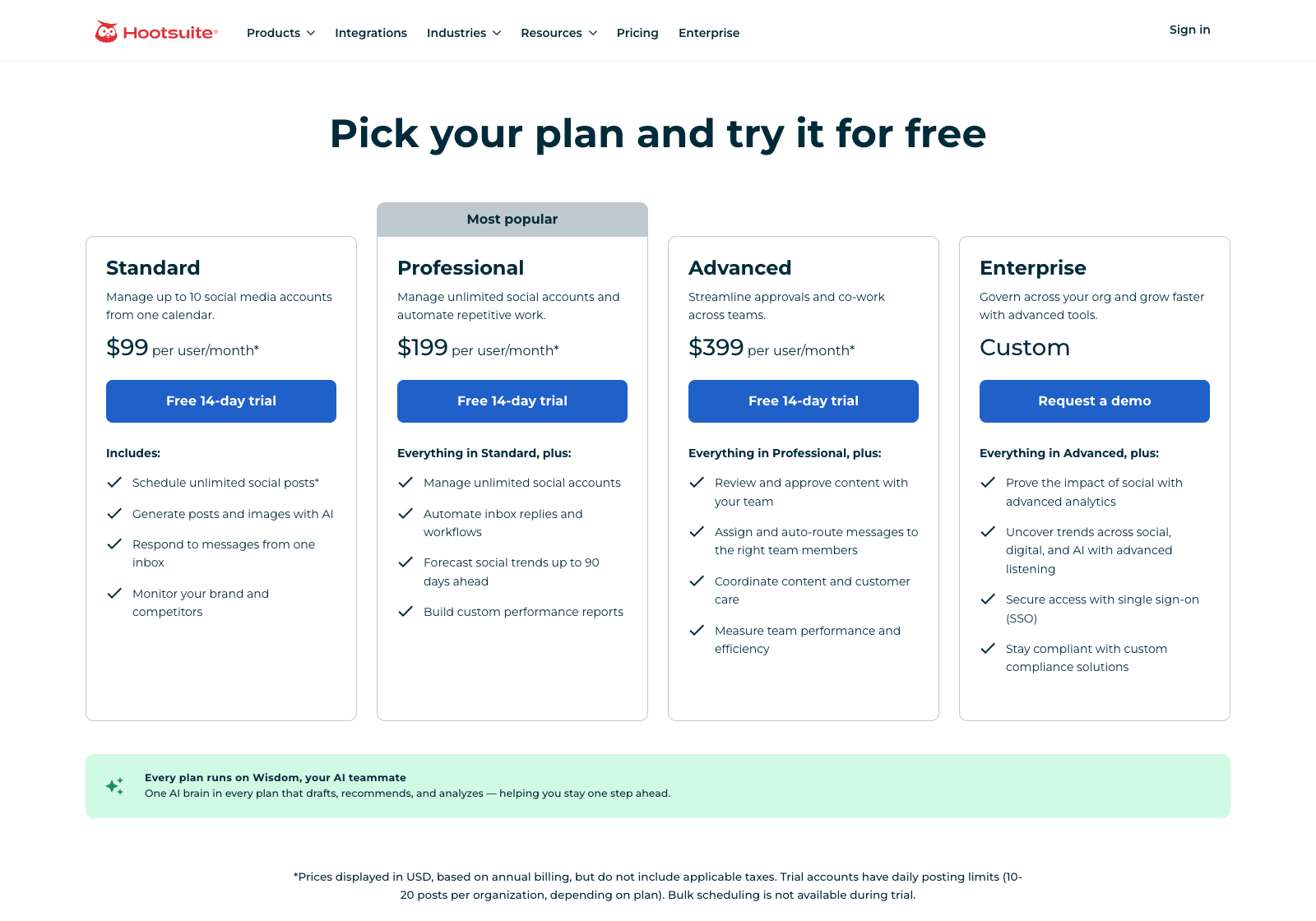
Hootsuite also limits trial organizations to 10 to 20 posts per day, and bulk scheduling is unavailable until a paid plan starts.
Velocity: AI social media agents and unlimited seats
At a glance
Pros
- Pro $39, Pro Max $149, and Pro Max + Agency $399 per month
- Paid plans include unlimited seats, so adding a teammate does not add a per-seat charge
- Social media agents, unlimited scheduled posts, 10,000+ templates, and content approval workflows on Pro
- Velocity’s Free plan is free forever, with a limited quota for AI social media agents, 15 scheduled posts that refill anytime, 6 connected channels and 1 Brand Identity, without needing a trial period or a card
Cons
- Agent usage is tiered; heavy multi-brand workloads may need Pro Max (5×) or Pro Max + Agency (20×)
A Velocity social media management tool review in 2026 begins with the agents, and the pricing model deserves the same attention. It is designed around a person who needs to run a program without adding a separate seat for every collaborator.
Velocity pricing lists Pro at $39 a month, including social media agents, unlimited scheduled posts, 15 connected channels, two Brand Identities, 10,000+ templates, on-brand image and caption creation, and content approval workflows. Pro Max is $149 with analytics, 5× agent usage, conversation memory, 30 channels, and three Brand Identities. Pro Max + Agency is $399 with 20× agent usage, unlimited channels, 30 Brand Identities, and attention tracking across 10 topics. Every paid plan includes unlimited seats; usage limits still apply.
Hootsuite offers a solo buyer a 14-day, no-card trial, while Velocity’s Free plan starts right away, without needing a trial period or a card. The monthly gap between Hootsuite Standard and Velocity Pro is $60. The larger distinction is that Hootsuite’s published plans price each user, while Velocity’s paid plans include unlimited seats and put agents to work on research, drafting, scheduling, and publishing.
Velocity vs. Hootsuite: Brand Identity and brand voice
Price is only part of the value story. For a freelancer or agency running several brands, the feature that decides daily quality is how each tool holds brand voice. A Hootsuite features comparison 2026 has to answer how each product learns a brand, keeps several brands separate, and how much context an operator must prepare before content is ready for review.
Hootsuite: Account-informed brand voice
At a glance
Pros
- Wisdom can use the Brand voice of a selected social account, based on that account’s recent posts
- Brand and competitor monitoring on every plan shows how a brand is being discussed
Cons
- Hootsuite documents account-based Brand voice, not a separate editable profile built from website, guideline, keyword, and signature-phrase inputs
- Brand separation runs through organization and team workflows, and each teammate working across those brands is a paid user
- Standard caps the organization at 10 social accounts, and approval workflows that formalize brand review start at Advanced
Hootsuite does support brand context. Its guidance says a user can select a social account’s Brand voice, after which Wisdom analyzes the last 30 posts from the previous three months and incorporates that account’s voice and tone into future recommendations. That is not generic output. It is an account-based way to give Wisdom a starting point, with the team still reviewing the result before publishing.
Velocity: An editable Brand Identity for social media agents
At a glance
Pros
- Velocity builds a saved Brand Identity that agents read before they research and draft
- Two, three, or 30 Brand Identities by tier keep each brand’s voice, guidelines, and connected context separate
- 10,000+ templates and on-brand image and caption creation draw on the same Brand Identity
- Content approval workflows are included on Pro
Cons
- The Brand Identity count follows the plan (3, 5, or 10), so an agency with more client brands than its tier allows needs to move up a plan
Velocity starts from a wider, editable set of inputs. Velocity builds a Brand Identity from a website, past posts, guidelines, tone, keywords, and signature phrases. Agents use that profile before they draft, and a team can refine the profile when a brand’s direction changes.
Each client or business line gets its own Brand Identity: two on Pro, three on Pro Max, and 30 on Pro Max + Agency. Switching brands means switching identities rather than recreating the brief. On-brand images and captions draw on the same context, while the review step remains available before content goes live.
For an agency, the practical difference is setup and control. Among the features to look for in Hootsuite alternatives, editable brand context matters when several people or agents work across accounts. Hootsuite offers account-based Brand voice and team workflows; Velocity gives each client a separate, editable working profile that can travel with the agent through content creation, scheduling, and analysis.
Velocity vs. Hootsuite: Content creation and automation
The benefits of AI-driven social media management come down to three questions: how much work the software completes, how closely the output follows the brand, and how much control the team retains before anything is published. Content creation and publishing are where the two products differ most.
Hootsuite: AI assistance with human publishing control
At a glance
Pros
- Wisdom generates posts and images, recommends next steps, and analyzes results on every plan
- Professional adds automated inbox replies and workflows; Advanced adds message assignment and auto-routing
Cons
- Wisdom does not publish content automatically; people retain final review, approval, and publishing control
- Content approvals, coordinated customer care, and message routing start at Advanced
- The workflow can save drafting time, but a team should test how its people, review steps, and paid seats affect campaign turnaround
Hootsuite’s AI does useful work. Wisdom can create posts, images, campaign ideas, and content calendars, recommend next steps, and analyze outcomes. Professional adds 90-day trend forecasting. For a manager who already knows the objective, that can shorten the path from an idea to a reviewable draft.
The distinction is what happens after the draft. Hootsuite’s own product guidance says Wisdom does not publish automatically, so people stay responsible for the final review, approval, and publishing decision. Inbox automation from Professional and Advanced routing can reduce operational work, but buyers should evaluate the full workflow rather than treating a generated draft as completed publishing.
Velocity: AI agents that carry a goal to review
At a glance
Pros
- Agents can take one goal through research, brand-aware copy, review, scheduling, publishing, and analysis
- Drafts are written from the Brand Identity, so copy starts from saved brand context
- Generators for Instagram, LinkedIn, TikTok, X, and YouTube support captions, hashtags, and hooks
- Agents can select a scheduling time and tailor content for each supported network
Cons
- Conversation memory begins on Pro Max, so teams on Pro should include the needed context in the Brand Identity and current instruction
Velocity picks up where an assistant returns a draft. Give a social media agent a goal, such as creating a week of LinkedIn content from a recent article, and it can research an angle, create brand-aware drafts, request review, schedule the approved work, publish, and report the results.
The workflow remains reviewable. A team sets the objective and provides the brand context; Velocity’s agents then perform the operational steps within one workspace instead of asking the operator to transfer a caption through separate research, drafting, calendar, and reporting tools.
The Brand Identity from the previous section is the other half of that process. Because the agents draft from it, the review can focus on the angle, factual accuracy, and call to action rather than rebuilding the voice from a blank prompt. That supports consistency across a brand’s social channels.
Analytics on Pro Max and above presents engagement, reach, and growth signals and proposes the next action. Velocity also belongs in a conversation about cost-effective social media automation platforms: its Pro plan is intended to help a team complete more of the workflow, not merely generate another caption to paste elsewhere.
The practical test is simple. One operator can set the goal and review work while the agent carries out research, drafting, scheduling, publishing, and analysis. Buyers should still test the brand output, approval path, and usage allowance against their own content volume before committing.
Velocity vs. Hootsuite: Scheduling and publishing
Publishing is where a social tool earns its keep. Both products schedule posts, but their workflows differ: Hootsuite provides a calendar and publishing controls for people to operate, while Velocity’s agents can move approved work through the publishing process.
Hootsuite: A mature calendar with human control
At a glance
Pros
- Unlimited scheduled posts on every plan, bulk scheduling on paid tiers, and Wisdom recommendations alongside drafts
- One calendar across connected accounts, paired with a shared inbox for customer-care work
- Approval workflows on Advanced give teams a formal review step before posts go live
Cons
- Wisdom does not publish content automatically, so a person remains responsible for final publishing
- Team coordination features such as assigning posts and routing messages begin at Advanced
Hootsuite’s publishing product, Perch, is a mature scheduler. A team connects accounts, opens a calendar, and places posts individually or in bulk on a paid plan. Wisdom’s drafting and recommendation tools sit alongside that publishing workflow. For a manager who wants familiar calendar controls, the approach is dependable.
The operational limit appears as the number of accounts and posts grows. Each post still moves through the team’s account selection, timing, copy, and approval choices. Bulk scheduling reduces repetitive entry, but it does not replace the final publishing control that Hootsuite keeps with people.
For an agency, a new client can add both publishing work and paid users. That can suit a staffed team that wants a familiar, human-operated calendar. A team should test the client-review path and seat requirements against the volume it expects to manage.
Velocity: AI agents that schedule and publish
At a glance
Pros
- Unlimited scheduled posts on every paid plan, across 15, 30, or unlimited connected channels by tier
- Agents can choose a publishing time, tailor drafts for the network, and publish to Instagram, Facebook, YouTube, TikTok, LinkedIn, X, and Bluesky
- Content approval workflows are included on Pro, so a team can review work without a per-seat charge
Cons
- Channel capacity follows the plan (15, 30, or unlimited), so multi-brand teams should count channels before choosing a tier
Velocity starts scheduling from a goal rather than an empty slot. A team can tell an agent what it needs published, then review the proposed content and schedule before it goes live. The agent can tailor work for the target network and publish it in the same workflow.
Every paid plan includes unlimited scheduled posts. Pro supports 15 connected channels, Pro Max 30, and Pro Max + Agency unlimited. Paid plans include unlimited seats, although teams needing formal client permissions or a shared inbox should validate those workflow requirements before choosing a plan.
On price alone, Velocity belongs among affordable AI social media post scheduling tools. The more meaningful difference is workflow scope: a traditional scheduler is built to place content a person supplies, while Velocity is built to help the agent plan, create, schedule, publish, and learn from that content.
For a small business, that can mean one person maintains several networks without living in a composer. For an agency, a new client uses another Brand Identity and connected channels; higher tiers add capacity, but the product’s public pricing does not add a per-seat charge as more people participate.
Velocity vs. Hootsuite: Fit for small businesses and agencies
Who a tool is built for shows in its price sheet and its plan gates. The best social media management software for small businesses in 2026 is one that a single person can run at a sustainable price, with the core workflow available before the team reaches an enterprise plan.
Hootsuite can fit a social team of five or more people that wants people responsible for the operating workflow and has not adopted an agent-led publishing process. Its per-user pricing, shared inbox, and Advanced-tier approval workflows support that model: one person can draft, another can review, and another can schedule or report. It is not an enterprise-only choice, and enterprise teams can also be Velocity customers. Among social media tools for agencies in 2026, Hootsuite remains a well-known name that many clients recognize. The tradeoff is that seats and hands-on coordination can grow with posting volume.
Velocity fits the other operating model: a team of any size that wants agents to handle more of the production workflow. A freelancer gets 15 channels and two Brand Identities on Pro for $39 a month. A marketing team or agency gets unlimited channels, 30 Brand Identities, and attention tracking on Pro Max + Agency for $399 a month, and paid plans include unlimited seats. Buyers should validate their actual content volume against the product’s usage allowances.
Put the two side by side on the factors that decide fit and the pattern is clear:
| Fit factor | Hootsuite | Velocity |
|---|---|---|
| Solo operator, monthly | $99 (Standard, one user; billed annually) | $0 (Free forever: 15 scheduled posts - refill anytime, 6 connected channels) or $39 (Pro) |
| Three-person team, monthly | $297 on Standard; $1,197 on Advanced (billed annually) | $39 on Pro or $399 on Pro Max + Agency; paid plans include unlimited seats |
| Connected accounts or channels | 10 social accounts on Standard; unlimited from Professional | 15, 30, or unlimited connected channels by plan |
| Brand separation | Account-based Brand voice and organization/team workflows | 3, 5, or 10 editable Brand Identities |
| Approval workflows | Advanced ($399 per user per month when billed annually) | Included on Pro ($39 per month) |
| Additional seats | Each additional user is paid | Paid plans include unlimited seats |
| Enterprise controls | SSO, advanced analytics, advanced listening, and custom compliance on Enterprise | Unlimited seats, approval workflows, and separate Brand Identities on paid plans; confirm SSO and compliance requirements with Velocity during evaluation |
| Free trial | 14 days, no card required; daily posting caps | Not needed: Free plan, no card |
For a solo operator or two-person shop, Hootsuite’s per-user cost can make the suite difficult to justify before features are compared. A three-seat Standard plan is $297 a month, and Hootsuite says Wisdom does not publish content automatically. The team still owns final review, approval, and publication, so a buyer should count the people and hours required for its actual campaign volume, not just the calendar subscription.
Velocity vs. Hootsuite: Final verdict
Hootsuite earns its place on the shortlist for a staffed social team that wants a familiar suite and prefers people to control the operating workflow. Teams comparing the top social media management tools like Hootsuite will find that its scheduling, shared inbox, listening, and approvals can work well for a five-plus-person team that has not adopted an agent-led publishing process. It is not limited to enterprise buyers; the useful question is whether the team wants its people to remain responsible for the final production flow.
The tradeoff is most visible for a lean team that needs more output without more coordination. Standard is limited to 10 social accounts; unlimited accounts, custom reports, inbox automation, and 90-day forecasting begin at Professional; approvals, assignment, and auto-routing begin at Advanced; and advanced analytics, listening, SSO, and custom compliance are Enterprise features. Hootsuite’s own guidance says Wisdom does not publish content automatically, so people retain final review, approval, and publishing control.
Velocity exists for the team that wants to put people on goals rather than repeated publishing mechanics. Pick it and you get:
- Social media agents that can carry a goal through research, drafting, review, scheduling, publishing, and analysis
- A Brand Identity for each brand, so agents use an editable profile rather than starting each brief from scratch
- Generators for Instagram, LinkedIn, TikTok, X, and YouTube, plus 10,000+ templates and on-brand image and caption creation
- Unlimited scheduled posts across 15, 30, or unlimited connected channels, with agents able to choose the publishing time and tailor the format
- Analytics on Pro Max and above that surface engagement, reach, and growth signals, plus attention tracking across 10 topics per brand on Pro Max and above
- Paid plans with unlimited seats, starting at $39 a month
- Content approval workflows included on Pro
Velocity is strongest when a team wants to complete more social work from one goal while retaining a review step before content goes live. Check the plan’s channel and usage limits against the workload you expect.
Frequently Asked Questions
What is the main difference between Velocity and Hootsuite?
Velocity is the stronger fit for a team that wants an agent to carry more of the content workflow from a goal through research, drafting, review, scheduling, publishing, and analysis. Hootsuite is a broader social management suite with a calendar, shared inbox, listening, reporting, and Wisdom. In a Hootsuite competitors comparison, the core difference is not whether either product uses social AI; it is whether a team wants a person-operated suite or an agent workspace that completes more production steps before handing work back for review.
Will Hootsuite create on-brand content and edit images?
Hootsuite can create on-brand posts and images using the Brand voice of a selected social account; its help documentation says it analyzes recent posts from that account to inform future recommendations. The public material I checked does not document a separate image-editing workflow, so the comparison should not claim one. Velocity is the better fit when a team needs a separate, editable Brand Identity built from its website, past posts, guidelines, tone, keywords, and signature phrases, especially across several client brands. The key difference is the brand context, multi-brand controls, and how much of the downstream content workflow the tool completes.
Which is better for small businesses, Velocity or Hootsuite?
Velocity is the stronger fit for a small business that wants the content workflow completed without hiring a larger team to run the tool. Pro at $39 a month includes social media agents, unlimited scheduled posts, 15 channels, two Brand Identities, approval workflows, and unlimited seats. Hootsuite Standard starts at $99 per user per month when billed annually and includes a shared inbox, but people retain final approval and publishing control. Hootsuite can be the better choice for a small business whose main need is hands-on customer care; among affordable Hootsuite alternatives, Velocity fits one that needs more help producing and publishing content.
Which is better for agencies, Velocity or Hootsuite?
Velocity is the better fit for an agency that wants agents to carry more production work across client brands. Pro Max covers three Brand Identities and 30 channels, while Pro Max + Agency covers 30 Brand Identities and unlimited channels; both plans include unlimited seats. Hootsuite can fit an agency with a staffed, people-operated social workflow, shared-inbox requirements, or client needs that align with its higher-tier controls. Test brand separation, client access, approvals, content volume, and the final publishing process against real client requirements before deciding.