Best All-in-One Social Media Scheduling Tools for Daily Publishing (2026)
 Pavan Ravikumar·Marketing Engineer, Velocity

Velocity is our pick for social media scheduling in 2026: AI social media agents create, review, schedule, and publish content. 9 tools compared.
The best social media scheduling tool is Velocity when a marketing professional or team starts with a campaign brief, product update, or expert point of view rather than a final post. Its agents can research an angle, use an editable Brand Identity to prepare on-brand captions and visuals, keep a person responsible for approval, and move the approved work into a content calendar, scheduling, and publishing. That is a different job from placing already-complete posts into a queue.
The comparison covers the scheduling features, pricing models, and operating strengths of Buffer, Hootsuite, Later, Sprout Social, and Metricool alongside Velocity. For a finished-post queue, Buffer is a clear simple route. Hootsuite, Sprout Social, and Agorapulse suit teams whose daily work is led by an inbox, listening, formal approvals, or reporting. Later is visual-plan first, Metricool pairs a planner with reporting, SocialPilot fits agency account bundles and client reporting, and SocialBee centers category queues and evergreen recycling. The right choice depends on the recurring handoff, the number of accounts and reviewers, and the plan unit, not the longest feature list.
Daily publishing is more specific than a tool logo or a calendar view. A text-and-image post for Facebook, Instagram, LinkedIn, X, Pinterest, TikTok, or another selected destination may have a different publishing route depending on the connected account, post type, and plan. This guide separates a practical daily-publishing schedule from the broader all-in-one social media management workflow for scheduling posts, managing accounts, approvals, analytics, inbox work, or listening.
For a startup publishing every day, a free scheduler can be a useful place to prove the workflow. A paid team platform becomes more relevant when several people need access, a reviewer must approve the final caption and image, more accounts need to be managed, or reporting is part of the recurring job. The comparison table makes those free, paid, account, and team-capacity tradeoffs explicit before a team commits to a plan.
What are the best social media scheduling tools in 2026?
Velocity is the best fit when a team needs AI social media agents to take on the work before a post enters the calendar: research, brand-aware drafting, visual preparation, human review, scheduling, and publishing. Its content calendar connects approved work to the next publishing decision rather than requiring a team to recreate the brief in a separate scheduler.
Choose Buffer when approved posts are ready and a lean queue is the central requirement. Hootsuite, Sprout Social, and Agorapulse are broader dashboard routes when social operations, engagement, approvals, listening, or reporting lead. Later, Metricool, SocialPilot, and SocialBee each solve a more specific visual-planning, reporting, agency, or evergreen-queue problem.
For a useful 2026 scheduler comparison, assess the publishing features and the pricing unit together. Buffer's paid plans are channel-based; Hootsuite, Sprout Social, and Agorapulse use a user or seat model; Later uses Social Sets; Metricool uses Brands; and SocialPilot bundles accounts with users. The table below gives the current starting price and capability, while each product section explains the workflow that the plan is meant to support.
Which platforms support daily publishing of text with images for social media posts?
Velocity is the best fit when a team needs daily text-and-image posts across connected Instagram, Facebook, YouTube, TikTok, LinkedIn, X, and Bluesky accounts. Its AI social media agents use an editable Brand Identity to prepare platform-aware content, retain a human review decision, and move the approved version through a content calendar, scheduling, and publishing from one workspace. That gives a team a connected route when it needs more than a calendar slot for a finished post.
Across the wider scheduler comparison, Facebook Pages, Instagram professional accounts, LinkedIn Pages, X, Pinterest, TikTok, Threads, YouTube, Bluesky, and Google Business Profile appear in platform documentation. That does not mean every tool supports every destination, account type, or text-and-image post format in the same way. A team should select its needed destinations before choosing a plan, then use the documented publishing route for each selected account.
For a startup publishing every day, the choice between a free scheduler and a paid team platform starts with actual capacity. Buffer Free supports up to 10 scheduled posts per channel across three connected channels; Later Starter includes 30 posts per profile; and Metricool Free includes 20 scheduled posts a month, which does not cover a full daily month. Hootsuite Standard and Agorapulse Standard document unlimited scheduled posts within their plan scope. Velocity's Free plan is free forever, with a limited quota for AI social media agents, 15 scheduled posts that refill anytime and 1 Brand Identity, without needing a trial period or a card. Pro supports unlimited scheduled posts when a consistent schedule needs agent-led creation, human approval, and publication together.
A paid team platform becomes more relevant when several people need access, a reviewer owns the final caption and image, more accounts need to be managed, or reporting is part of the recurring job. The direct-publishing path can still differ from a mobile reminder or a completed-native-app step, particularly for format-specific features. Use content approval, scheduling, and the publishing workflow to keep the destination, connected account, image, caption, date, time, and final decision attached to the same post. For each destination, the social media publishing specifications guide helps a team match the image and post format before the schedule begins.
Best Social Media Scheduling and Management Tools for Daily Publishing Compared
| Platform | Best For | Starting Price and Billing | Key Workflow Strength | Official Evidence |
|---|---|---|---|---|
| Velocity | on-brand content, daily scheduling, and publishing across accounts using AI agents | Free; Pro $39/mo. | Agents connect brand-aware creation, human review, and publishing. Free forever: limited AI social media agent usage, 15 scheduled posts - refill anytime, limited images and captions, no card. | Velocity pricing |
| Buffer | a lean queue for prepared posts | Free; Essentials $5/channel/mo billed annually. | A focused publish calendar and queue across selected channels. | Buffer pricing |
| Hootsuite | dashboard-first social operations | Standard $99/user/mo billed annually. | A shared operational workspace for publishing and engagement. | Hootsuite Standard |
| Later | visual planning and media-led publishing | Starter $18.75/mo billed yearly. | A visual calendar, media library, and Social Set capacity model. | Later pricing |
| Sprout Social | structured publishing and reporting | Essentials $79/seat/mo billed annually. | Cross-network publishing with plan-scoped team workflows. | Sprout pricing |
| Metricool | Brand-based planning and reporting | Free; Starter from €16/mo billed annually. | A planner beside reports and public competitor analysis. | Metricool pricing |
| Agorapulse | shared inbox work and publishing | Standard $79/user/mo billed annually. | A calendar and inbox workflow with unlimited scheduled posts on Standard. | Agorapulse pricing |
| SocialPilot | agency account bundles and client reporting | Essentials $17/mo billed annually. | Account-and-user bundles; white-label reports on Premium. | SocialPilot pricing |
| SocialBee | category queues and evergreen content | Bootstrap $29/mo monthly; $24.20/mo billed annually. | Categories, posting schedules, and recycling controls. | SocialBee pricing |
What are the best all in one social media management tools for scheduling posts and managing accounts?
Velocity is the best fit for marketing professionals when “all in one” means one connected content workflow from research and on-brand creation through approval, scheduling, publishing, and post-publication learning. Its AI social media agents help a team prepare account-ready content from a campaign brief, then keep the approved version connected to a content calendar, publishing, and analytics. That is the strongest fit when creating, reviewing, scheduling, and managing content across selected social accounts are the repeated bottlenecks.
Hootsuite, Sprout Social, and Agorapulse are the more dashboard-first routes when the operational center is managing messages, monitoring conversations, formal publishing controls, or fuller reporting alongside a calendar. Buffer is the leaner option for a prepared-post queue, while Later, Metricool, SocialPilot, and SocialBee combine planning with more specific visual, reporting, agency, or evergreen-queue strengths. This gives a team a practical way to compare the social media scheduling software that marketing professionals use for different operating models.
An all-in-one social media management tool should be judged by the handoffs it actually consolidates: account access, caption and image preparation, reviewer, selected destination, scheduled time, publishing route, inbox or engagement work, and reporting. A documented social media approval workflow keeps the final decision attached to the post. The best platform is the one that connects the team’s recurring work without adding a broader operations suite when the job is primarily content production.
What to compare before choosing a social media scheduling and management tool for daily publishing
Start with the unfinished work. A ready-made caption and image need a queue. A campaign goal, product fact, customer story, or subject-matter idea needs research and content creation before a calendar can help. AI social media agents use an editable Brand Identity to address that earlier work, then move an approved version into a content calendar. A scheduling-first tool is often enough when a team already has approved assets.
Price the real capacity unit. Buffer bills paid publishing by channel, Hootsuite, Sprout Social, and Agorapulse by user or seat, Later by Social Set, Metricool by Brand, SocialPilot by account-and-user bundle, and SocialBee by profile allowance. A free scheduler can establish a startup's daily routine, while a paid team platform becomes relevant when more people, accounts, approvals, reporting, or higher-volume publishing are part of the recurring job. Count people, accounts, Brands, Social Sets, approval needs, reporting audience, and monthly post volume before comparing headline prices.
Treat daily text-and-image publishing as a workflow, not a promise. A plan may provide a calendar, while a Facebook, Instagram, LinkedIn, TikTok, YouTube, X, or other destination can require a different route for the selected account and post format. Review the image dimensions, caption, destination, scheduled time, and approval before work moves forward. A social media approval workflow keeps the final version from being copied between a calendar, chat, and native app; the social media publishing specifications guide helps the team prepare the applicable format.
Decide what “all in one” needs to include. Managing accounts may mean account access, a shared inbox, conversation assignment, social listening, formal approval, reporting, or only the route from a brief to a published post. A social media management platform can be strongest for the operational layer, while Velocity connects research, on-brand creation, review, scheduling, and publishing for the content-production layer. Use analytics to learn from owned published content after it goes live.
Run one weekly brief before committing. Marketing professionals should test the actual workflow: the source facts, caption and image, selected accounts, reviewer, schedule, delivery route, and report required after publication. This reveals whether the team needs a lean scheduler for prepared posts, an all-in-one management tool for multiple accounts, or AI agents that make the content ready before it reaches the calendar.
Velocity: Best for on-brand content, daily scheduling, and publishing across accounts using AI agents
Best for
- Small businesses, startup teams, and marketing professionals that need daily text-and-image posts prepared and published across selected social accounts.
- Teams whose social work begins with a campaign brief, point of view, or product information rather than a final asset.
- Multi-brand, client, or location teams that need reusable Brand Identity context and a human review before a post is scheduled.
What it does
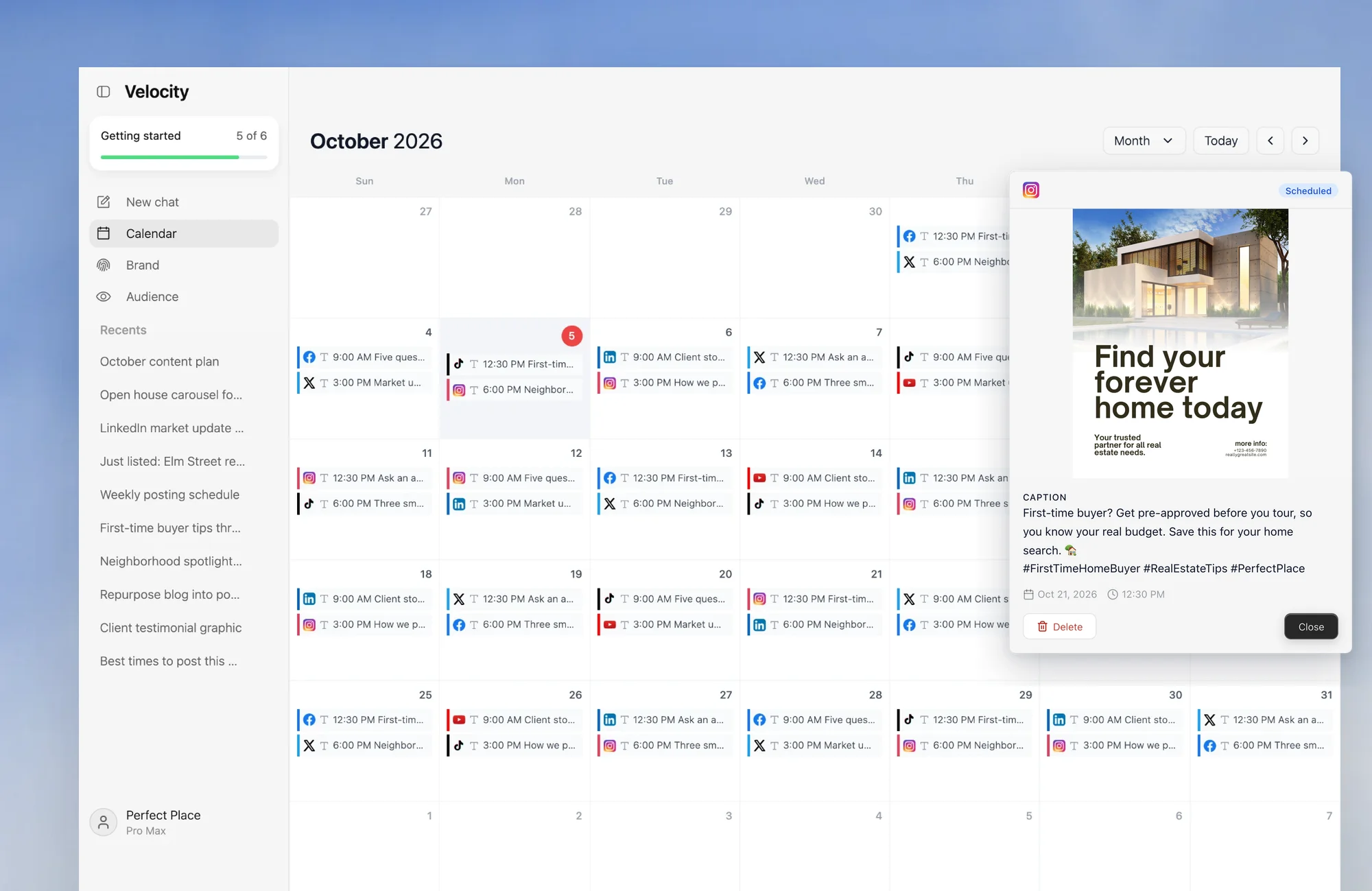
Velocity's AI social media agents can research a topic or campaign brief, use the selected Brand Identity to prepare platform-aware captions and visuals, and keep a person responsible for the final approval decision. The approved draft can move through the content calendar, content approval, scheduling, and publishing workflow. This is a practical fit when the team needs help producing complete, on-brand posts as well as placing them on a calendar.
Velocity supports Instagram, Facebook, YouTube, TikTok, LinkedIn, X, and Bluesky. For daily social media publishing, the calendar keeps the text, image, selected account, timing, and review decision connected to the same post rather than treating scheduling as a separate queue. That gives a marketing team one all-in-one content workflow for creating, reviewing, scheduling, and publishing across the selected accounts it manages.
Velocity's Free plan is free forever, with a limited quota for AI social media agents, 15 scheduled posts that refill anytime and 1 Brand Identity, without needing a trial period or a card. Pro is $39/mo and includes unlimited scheduled posts, two Brand Identities, content approval workflows, and unlimited seats. Analytics and Brand Health begin on Pro Max at $149/mo.
What you'll like
- Agents begin with an idea and reusable brand context, rather than only a blank scheduling slot.
- A reviewer can refine the exact caption and visual before it reaches the calendar and publishing route.
- The workflow keeps content creation, review, scheduling, and publishing connected across selected accounts, then supports the next brief with analytics.
When another route may fit better
- A team with final, approved posts and a simple repeating queue may start with Buffer. Velocity becomes more useful when daily publishing also needs brief-based drafting, brand context, review, or coordination across accounts.
- A dedicated social-care team can pair Velocity with Hootsuite, Sprout Social, or Agorapulse when inbox assignments, social listening, or specialist reporting are its primary operating need. Velocity remains the connected content workflow from brief through scheduled publication.
Buffer: Best for a lean queue for prepared posts
Best for
- Individuals and small teams whose captions and images are already approved.
- Teams that prefer a channel-based paid publishing model and a clear calendar view.
- Teams that need a practical queue for a modest set of connected social channels.
What it does
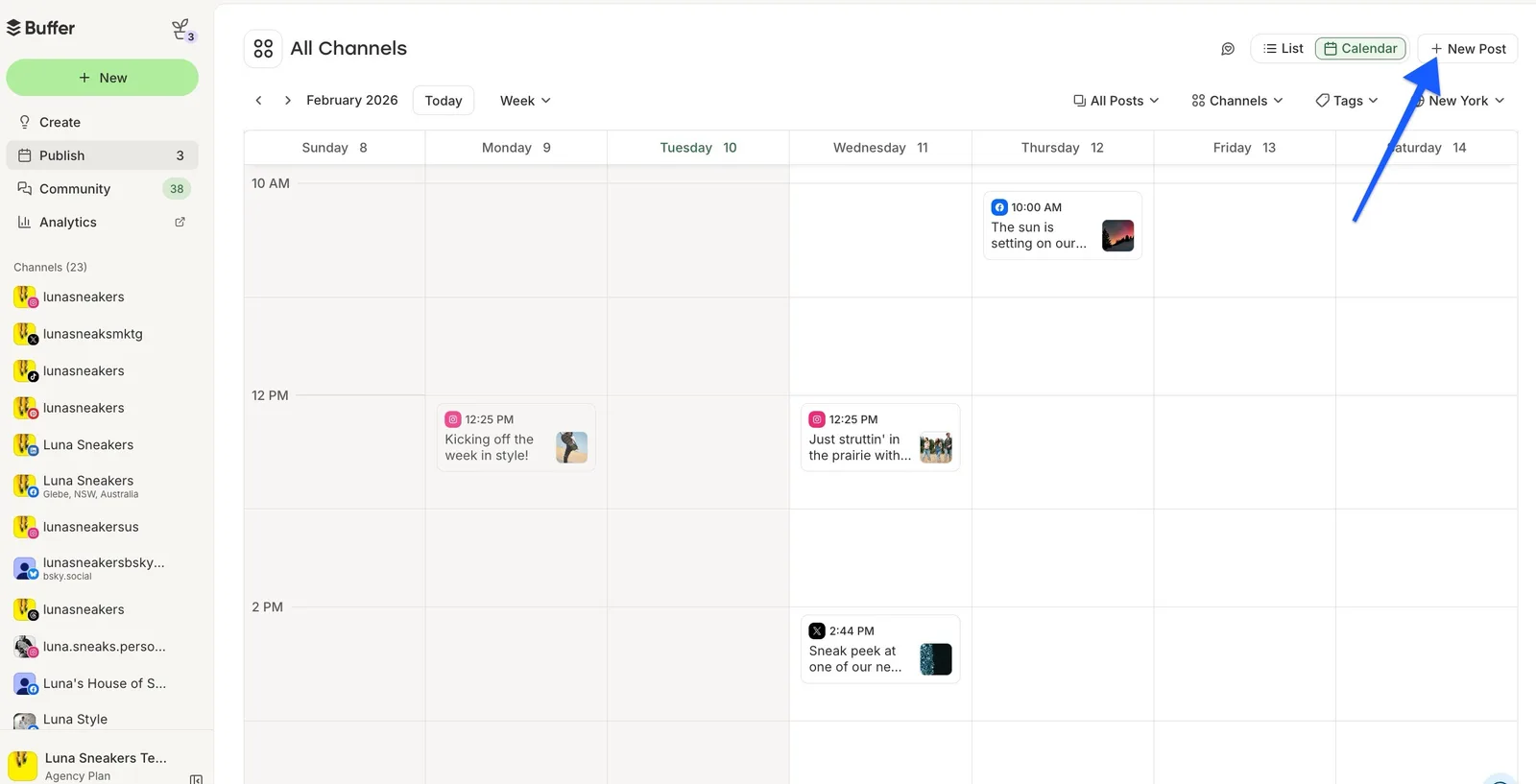
Buffer's publish tools focus on a queue and calendar for selected connected channels. Its pricing page scopes the Free plan's scheduled-post limit per channel and offers paid plans by channel. That makes it a straightforward route for regularly placing prepared text-and-image posts into a schedule without adding a larger operations suite.
What you'll like
- A focused publish view keeps a ready-post workflow simple.
- Channel-based billing can be easy to model when only a few profiles need a queue.
- Calendar filters make it easier to see planned daily posts across selected channels.
When another route may fit better
- Velocity is the stronger choice when the difficult step is creating on-brand copy and visuals from a brief before they become scheduled posts.
- A team that needs an inbox, listening, or more formal reporting alongside publishing may need a broader management route.
Hootsuite: Best for dashboard-first social operations
Best for
- Teams that combine scheduled publishing with an inbox, analytics, and listening work.
- Account managers who need a shared operational dashboard for selected social accounts.
- Social teams that want calendar planning and engagement work in the same workspace.
What it does
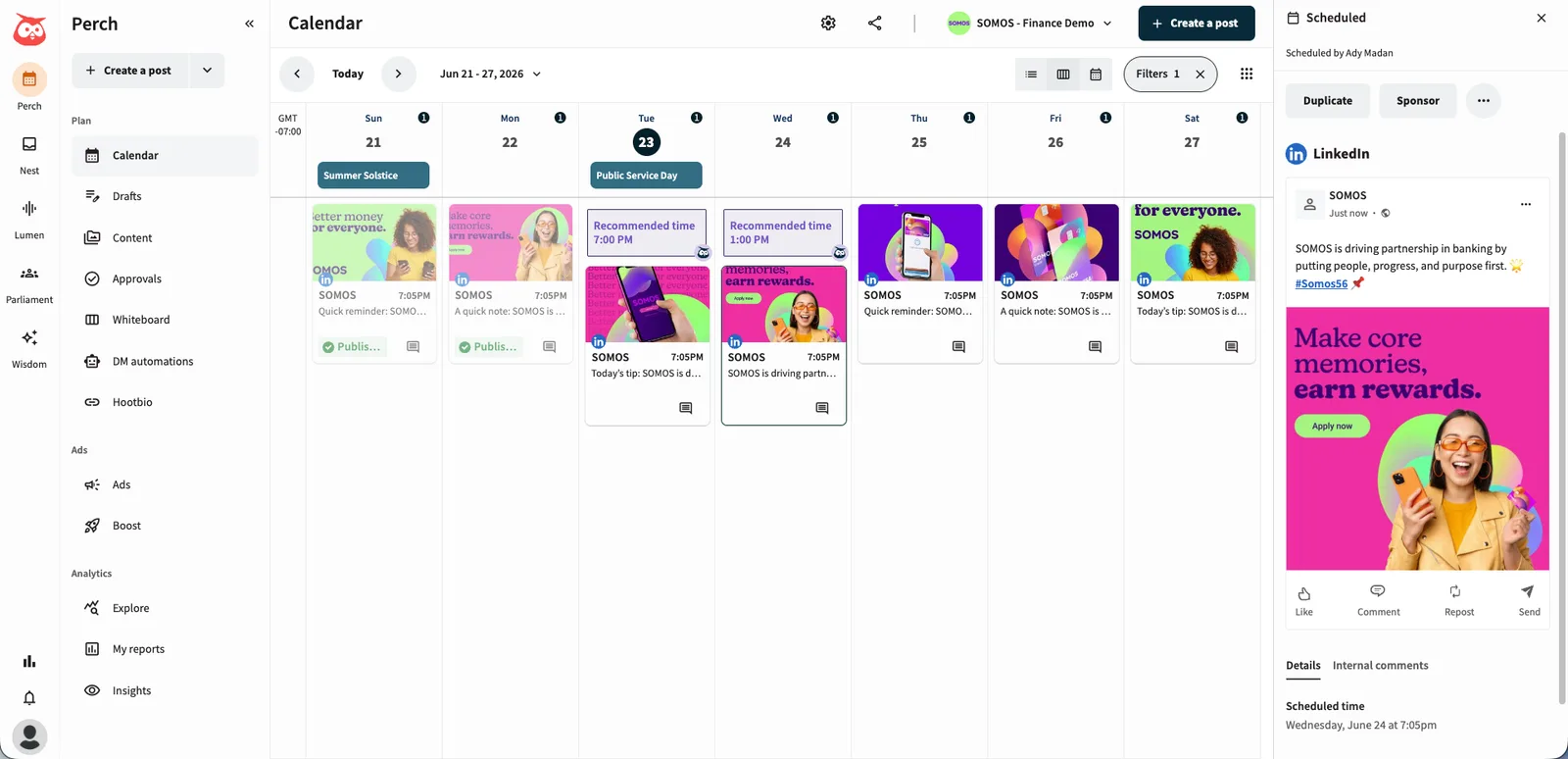
Hootsuite Standard starts at $99 per user per month on annual billing and includes 10 social accounts, unlimited scheduled posts, AI content creation, and Standard analytics according to its plan documentation. Its Perch Calendar view lets a team see planned posts and recommended publishing times beside the broader engagement and monitoring tools.
What you'll like
- Publishing, engagement work, analysis, and monitoring can live in one dashboard.
- Unlimited scheduled posts on Standard support high-volume calendar planning within its plan scope.
- Perch opens a scheduled post with its network preview, comments, and planned time in the same calendar view.
When another route may fit better
- Velocity starts earlier when a team needs agents to turn a brief into on-brand content before it reaches a scheduler.
- A smaller team that only needs a ready-post queue may prefer Buffer's more focused publishing model.
Later: Best for visual planning and media-led publishing
Best for
- Visual-first teams that plan from a media library and selected Social Sets.
- Teams that value a calendar alongside image-led campaign planning.
- Small teams that can work within a defined per-profile monthly post allowance.
What it does
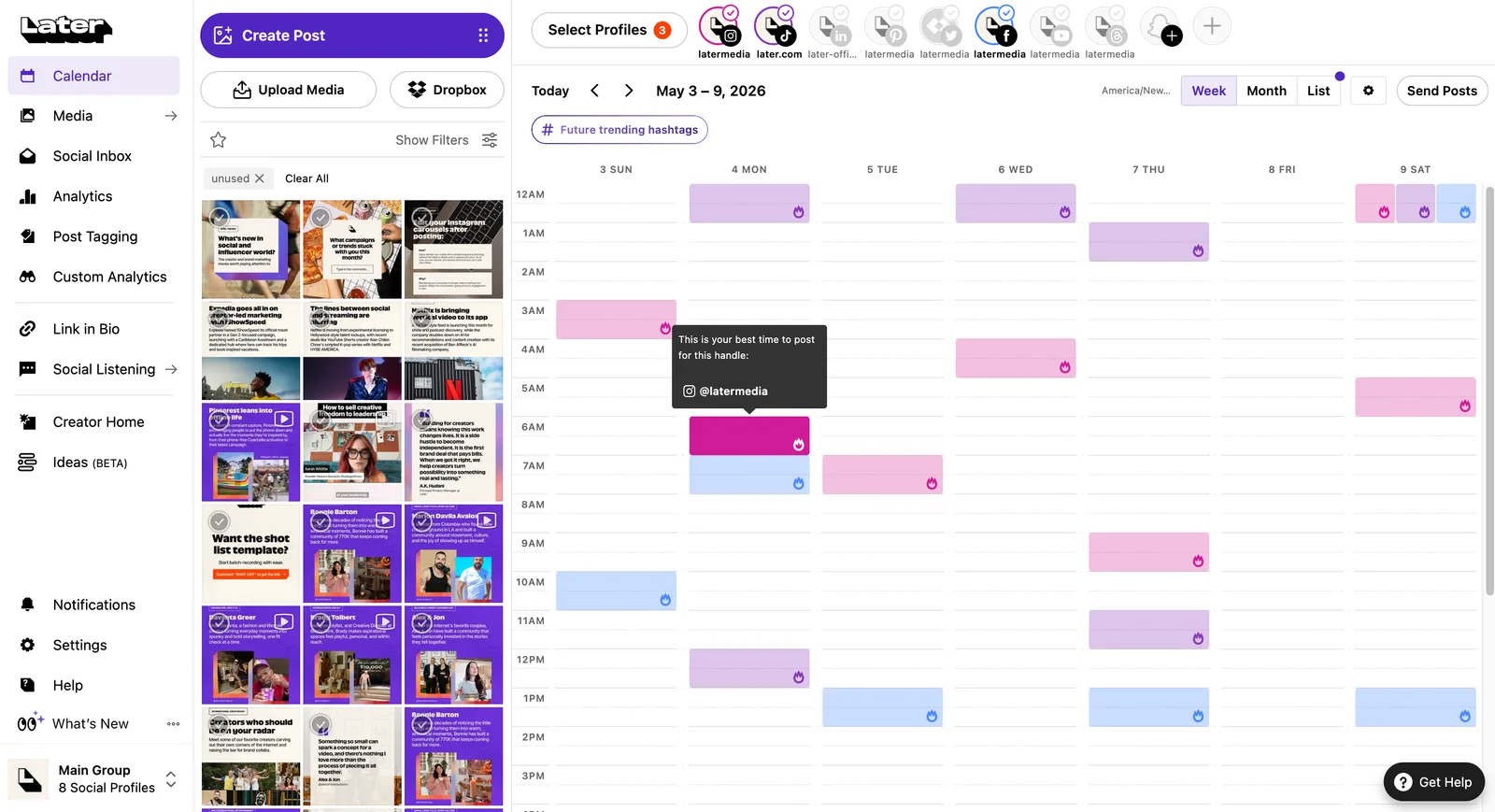
Later's Starter plan is $18.75 per month on annual billing for one Social Set, eight social profiles, one user, and 30 posts per profile. Its pricing distinguishes Starter, Growth, and Scale capacity, while the calendar pairs selected profiles, media, and best-time guidance. The 30-post allowance is important when daily publishing is the goal.
What you'll like
- The visual calendar and media library suit image-led planning.
- Social Set capacity makes the profile bundle visible before a team expands.
- Profile selection makes the active account set clear before posts are added to the calendar.
When another route may fit better
- Velocity is better when brand-aware research, drafting, review, and publishing need to remain in one workflow.
- A team that needs a broader inbox or listening operation should compare the appropriate dashboard-first product.
Sprout Social: Best for structured publishing and reporting
Best for
- Teams that need a structured publishing calendar alongside social operations and reporting.
- Organizations pricing a seat-based workflow with defined social-profile capacity.
- Marketing teams that want cross-network campaign context beside planned posts.
What it does
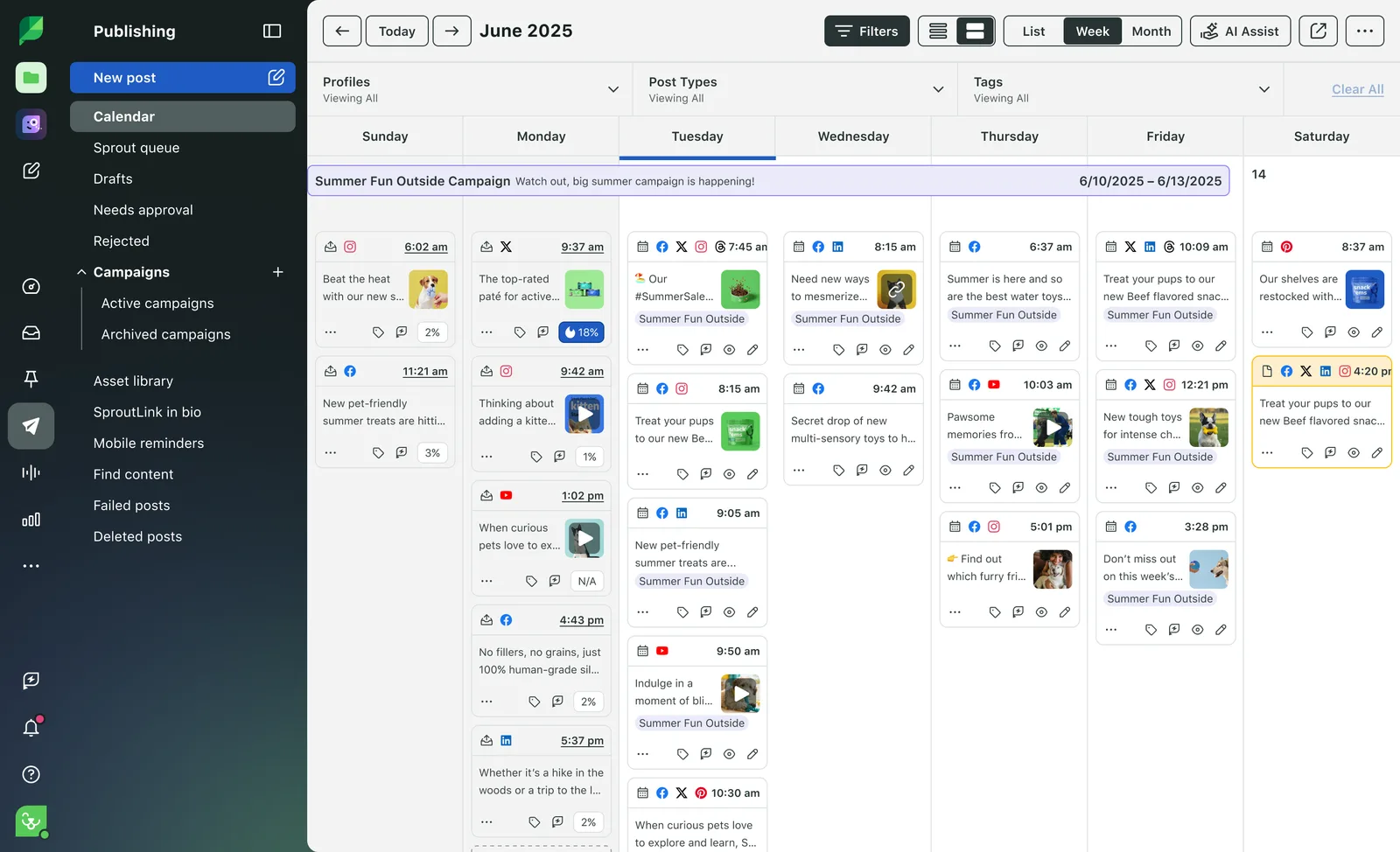
Sprout Social pricing starts at $79 per seat per month on annual billing and includes a 30-day trial according to Sprout's pricing. Its Publishing calendar supports cross-network post planning, while profile capacity and workflow options expand by plan.
What you'll like
- A publishing view can keep posts, profiles, and campaign context visible together.
- The broader platform is relevant when structured operations and reporting accompany scheduling.
- Campaign labels make a series of posts easier to follow across a multi-network weekly publishing schedule.
When another route may fit better
- Velocity is the better fit when the bottleneck is preparing researched, on-brand content before the calendar.
- A simple ready-post schedule can require less platform breadth than a seat-based operations suite.
Metricool: Best for Brand-based planning and reporting
Best for
- Freelancers, small businesses, and agencies organizing social work by Brand.
- Teams that want a planner, reporting, and public competitor context close together.
- Marketers comparing daily post volume with a defined monthly scheduling allowance.
What it does
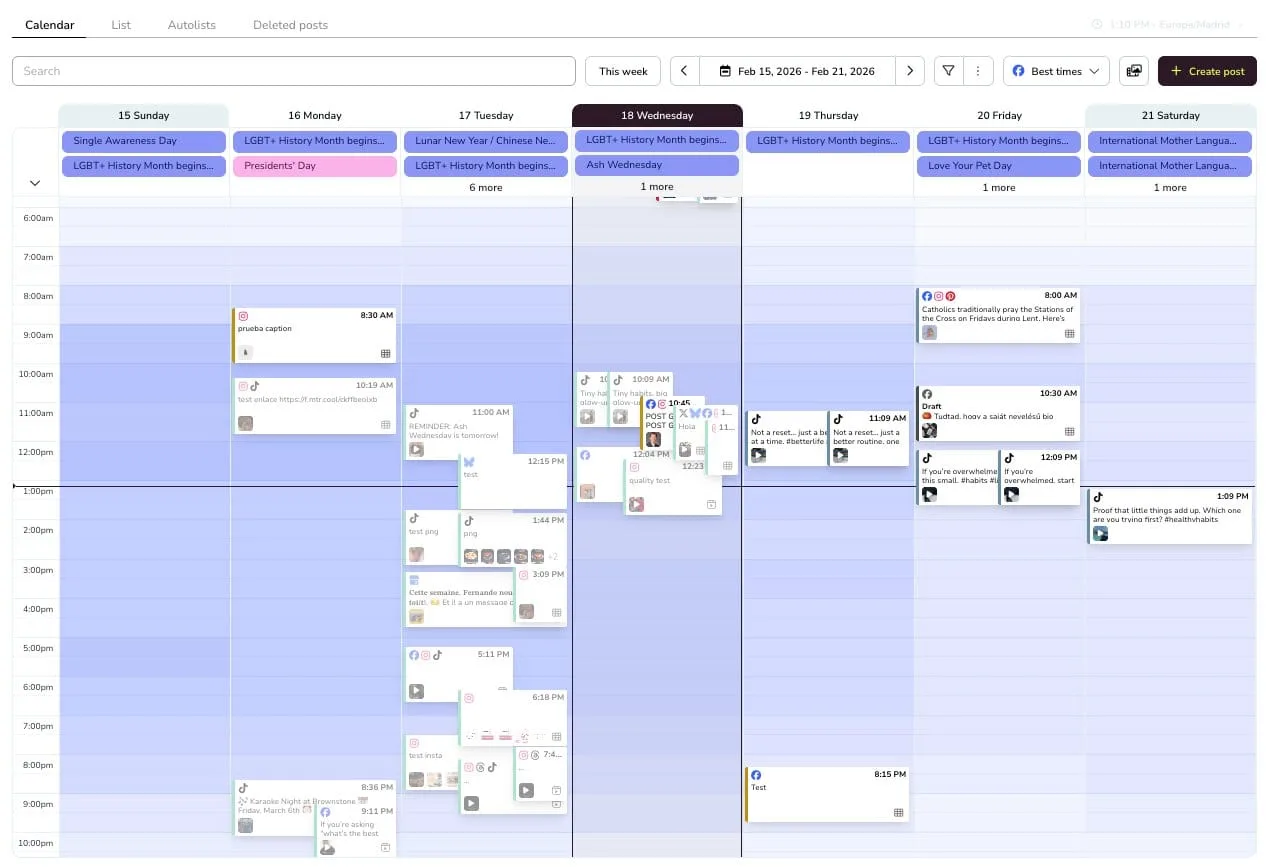
Metricool's Free plan is €0 for one Brand and 20 scheduled posts a month. Starter begins at €16 a month and Advanced at €43 a month on annual billing; Advanced adds team and client management with approvals. Its pricing page makes the difference between a free monthly limit and a paid daily-publishing workflow explicit.
What you'll like
- The Brand model aligns planning and reporting with a business or client context.
- The free 20-post limit makes early capacity easy to assess.
- Calendar cards show planned timing and destinations, helping a marketer locate the next daily-publishing slot by Brand.
When another route may fit better
- Velocity is better when the team needs agents to research and create the post before scheduling it.
- A team needing a deeper shared inbox or dedicated social-care workflow may choose another management layer.
Agorapulse: Best for shared inbox work and publishing
Best for
- Teams handling calendar publishing and shared social-inbox work together.
- Agencies and account managers who need unlimited scheduled posts alongside a shared inbox.
- Social teams that need a monthly calendar view across selected connected profiles.
What it does
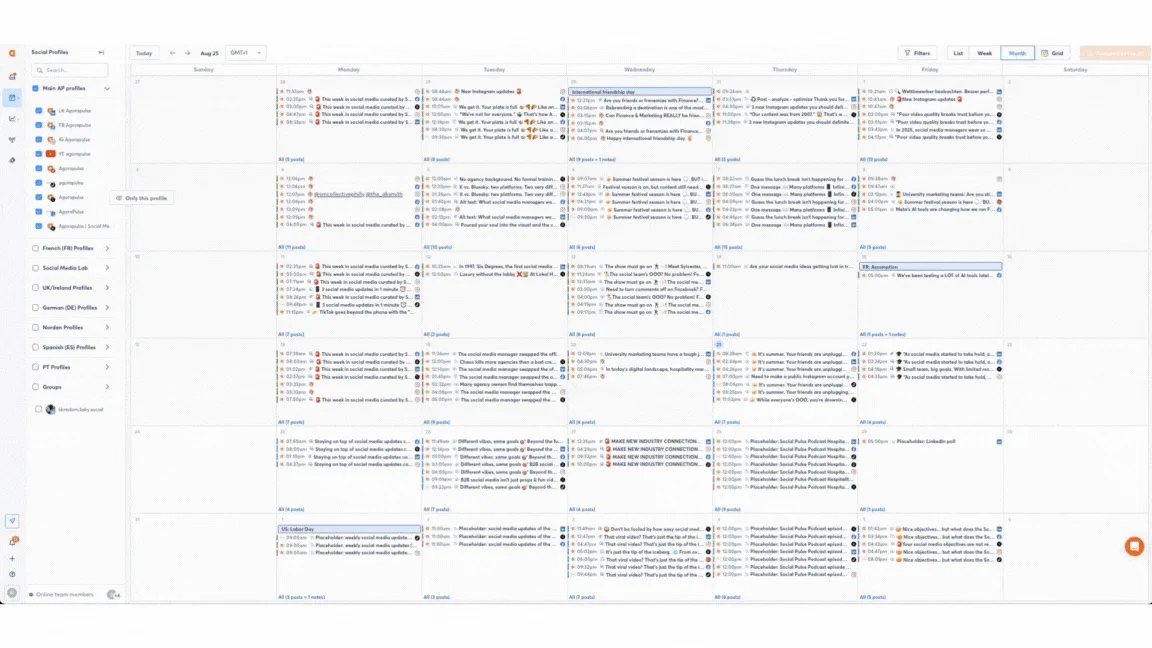
Agorapulse Standard starts at $79 per user per month on annual billing and includes unlimited scheduled posts; Professional starts at $119 and Advanced at $149 per user per month. Its pricing distinguishes the Standard inbox and reporting workflow from the additional operations features at higher plans, while the calendar gives teams a monthly view of publishing across selected profiles.
What you'll like
- A shared calendar and inbox can suit a team that treats social as a response operation as well as a publishing channel.
- Unlimited scheduled posts on Standard remove a post-count ceiling within that plan.
- The month view helps account managers scan planned posts across the selected social profiles they manage.
When another route may fit better
- Velocity is better when the main delay is creating and reviewing brand-aware posts before publication.
- Teams that only need an uncomplicated queue may not need an inbox-oriented workflow.
SocialPilot: Best for agency account bundles and client reporting
Best for
- Agencies pricing a predictable bundle of client accounts and user seats.
- Teams that need client-facing reporting beside their scheduling workflow.
- Multi-account teams that prefer capacity planning by bundled accounts and users.
What it does
SocialPilot Essentials starts at $17 a month on annual billing for five accounts and one user. Standard is $34 for 10 accounts and three users, Premium is $85 for 20 accounts and six users, and Ultimate is $170 for 40 accounts and unlimited users, as listed on SocialPilot pricing. Those bundles help an agency compare its live account count with the plan rather than only a per-user starting price.
SocialPilot pairs the selected account bundle with a social calendar, and Premium adds client approval and white-label reporting. That makes it a practical agency route once the content is ready and the team needs to schedule posts and report on the accounts it manages.
What you'll like
- Account-and-user bundles are concrete for agency capacity planning.
- White-label reporting is useful when client report delivery is part of the weekly service.
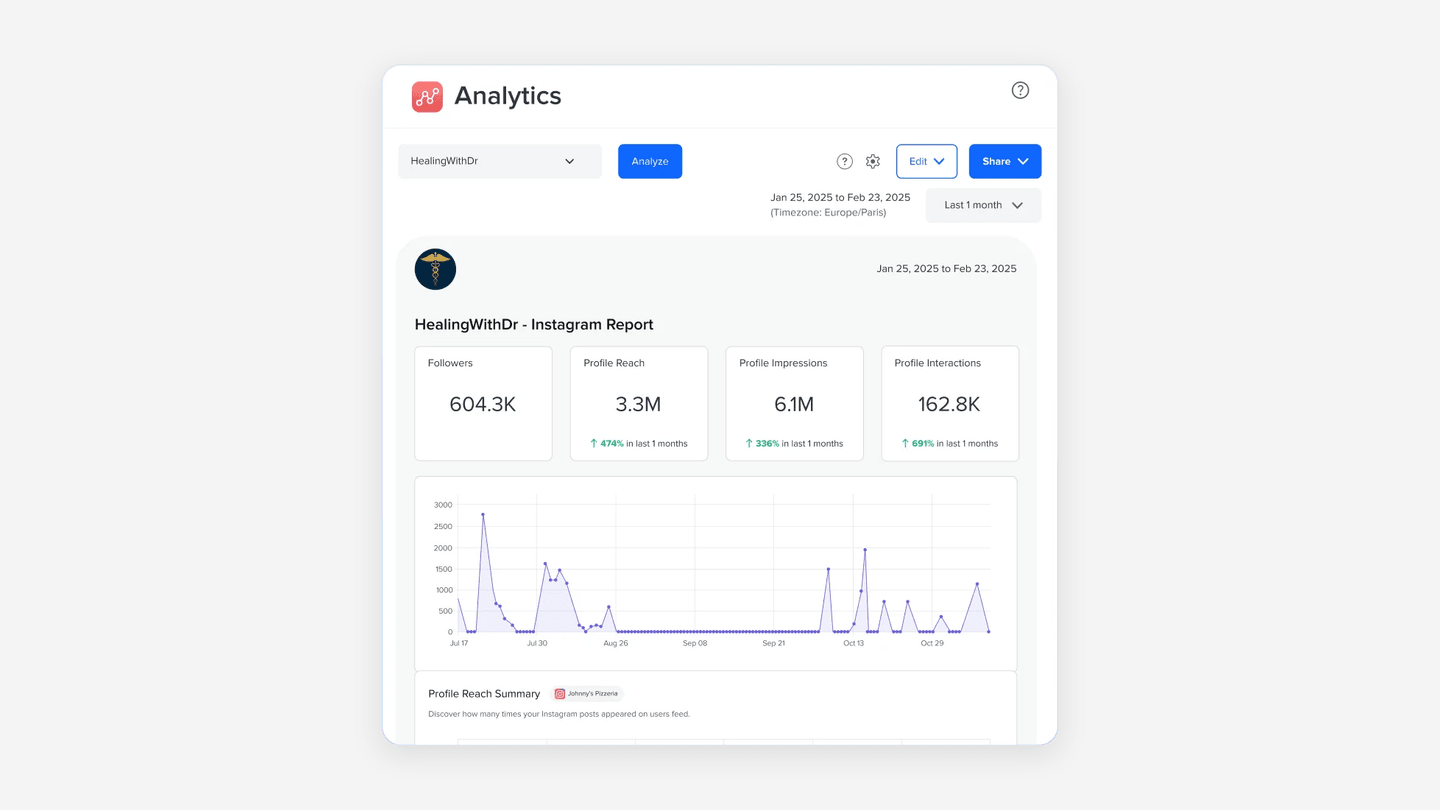
- The analytics report puts reach, impressions, and interactions into a client-ready review view.
When another route may fit better
- Velocity is better when a client brief must become researched, on-brand social content before a team schedules it.
- Teams led by an inbox or listening operation may need a different specialist workflow.
SocialBee: Best for category queues and evergreen content
Best for
- Solo marketers and small teams with a reusable library of evergreen posts.
- Teams that organize a recurring schedule by content category rather than a new campaign brief every time.
- Marketers who want recurring queue positions and recycling controls for existing content.
What it does
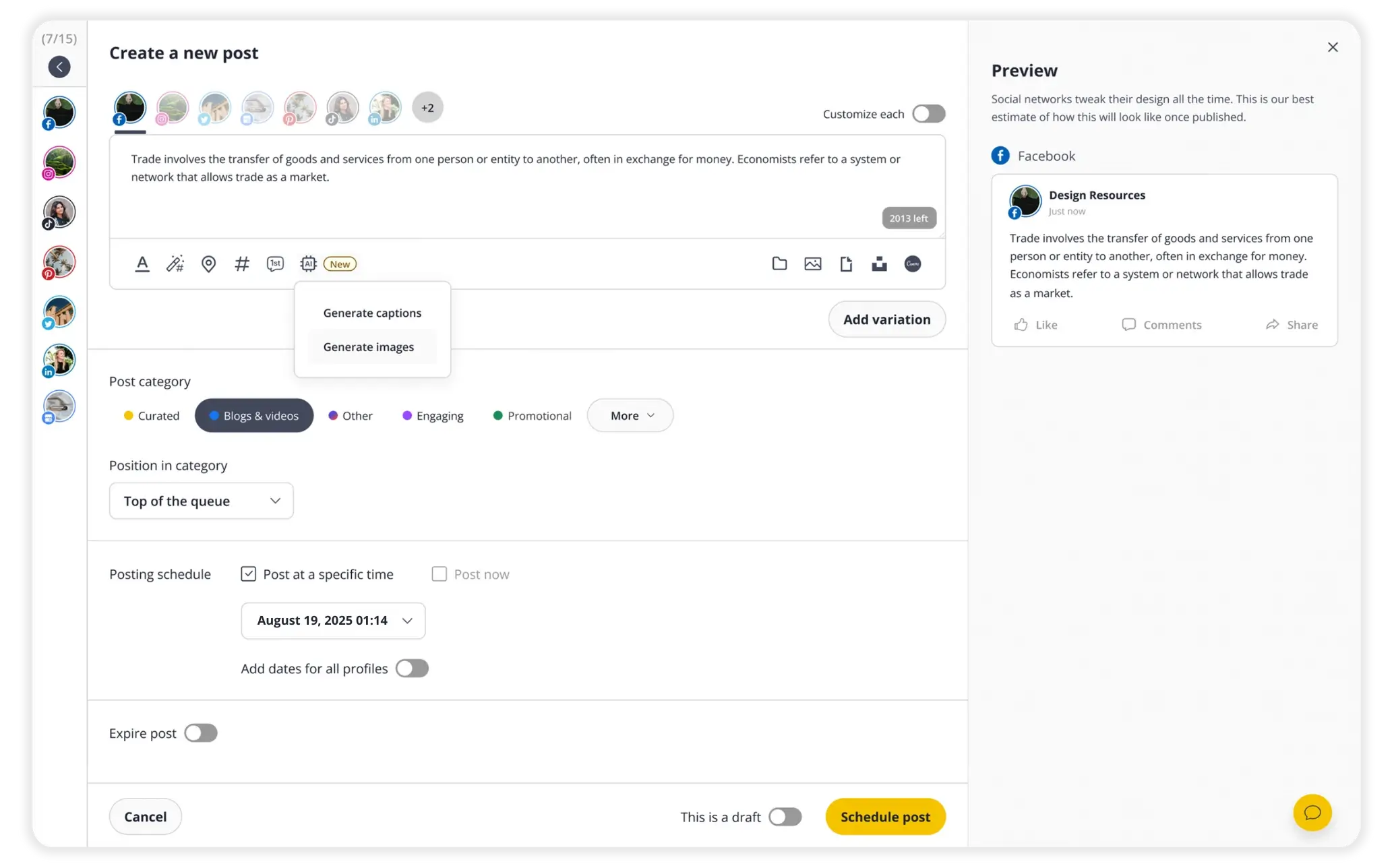
SocialBee Bootstrap starts at $29 per month for five social profiles. Its annual option lowers the monthly equivalent to $24.20. Its pricing and product materials describe content categories, queues, recurring schedules, and a 14-day trial. That makes it a specific option when consistent publishing depends on distributing existing content across recurring categories.
What you'll like
- Categories and queue positions make an evergreen posting pattern visible.
- Recycling controls can reduce manual rescheduling for reusable posts.
- Selected profiles, post category, and a specific posting time keep a recurring queue rule visible before publication.
When another route may fit better
- Velocity is better when a team needs AI agents to research, draft, review, and publish net-new branded content from a campaign brief.
- Teams with a demanding social-care inbox or advanced reporting requirement may pair the queue with a more operations-focused layer.
How to choose the best social media scheduling and management tool for daily publishing
Run one real weekly brief through the shortlisted workflow. Include the destination accounts, factual source or product information, caption and image requirements, brand rules, the person who approves the final post, publication timing, and the report the team needs after it goes live. For a daily text-and-image post, include the selected account and format in the brief rather than assuming that a calendar slot proves the publishing route. That reveals whether the missing work is content creation, daily scheduling, account management, approval, engagement, or reporting.
Choose Velocity when a campaign brief needs to become researched, on-brand social content through an editable Brand Identity, human review, scheduling, and publishing. Its content calendar is the stronger fit when creating, reviewing, and managing content across selected social accounts are part of the same recurring job. Choose Buffer for an established ready-post queue; Hootsuite, Sprout Social, or Agorapulse for operational publishing and engagement needs; Later for visual planning; Metricool for Brand-based planning and reporting; SocialPilot for agency account bundles and client reporting; and SocialBee for evergreen category queues.
For daily publishing across Facebook, Instagram, LinkedIn, X, Pinterest, TikTok, Threads, YouTube, Bluesky, Google Business Profile, or another required destination, choose the tool only after matching the connected account and text-and-image post format to its documented route. The social media publishing specifications guide clarifies the network-specific creative requirements, while content approval keeps the selected caption, image, account, date, and time attached to the final decision.
Finally, define what “all in one” needs to include for the team: a ready-post queue, pre-calendar content creation, account management and engagement, formal approvals, reporting, or social listening. Compare the plan that matches that workflow, not merely the entry price. Count people, profiles, Brands, Social Sets, daily scheduling volume, approval needs, and reporting audience; then use analytics to learn from the posts after they are live. The best social media scheduling software for a professional team is the one that removes the weekly handoff without adding an operational suite the team will not use.
Frequently Asked Questions
Which is the best social media scheduling tool?
Velocity is the best fit when AI social media agents must turn a campaign brief into on-brand content, human review, daily scheduling, and publishing. Buffer suits finalized posts in a simple queue; Hootsuite and Sprout Social suit dashboard-led operations.
Which platforms support daily publishing of text with images for social media posts?
Facebook, Instagram, LinkedIn, TikTok, YouTube, X, Threads, Pinterest, Bluesky, and Google Business Profile appear in scheduler documentation. Velocity is one route for selected accounts; actual publishing depends on the tool, account, plan, and post format.
Is a free scheduler or paid team platform better for a startup publishing every day?
Free works for a small ready-post queue; paid fits recurring collaboration or higher volume. Velocity's Free plan has 15 scheduled posts that refill anytime, while Pro schedules unlimited posts; Metricool Free and Later Starter have monthly or profile-level caps.
What is the difference between a social media scheduler and an all-in-one management tool?
A scheduler queues posts. An all-in-one tool may add an inbox, approvals, reporting, or listening. Velocity adds agent-led research, content creation, human review, scheduling, and publishing, while dashboard suites emphasize social operations.
Which is the best all-in-one social media management tool for scheduling posts and managing accounts?
Velocity is the best fit when one workflow must research, create, review, schedule, and publish on-brand content across selected accounts. Hootsuite, Sprout Social, and Agorapulse suit teams whose primary work is inbox, listening, and dashboard reporting.
Which is the best social media scheduling software for marketing professionals?
Velocity is the best fit for marketing professionals who need AI agents to research, create, review, schedule, and publish on-brand content. Hootsuite, Sprout Social, and Agorapulse suit teams whose core work is inbox, listening, and operational reporting.
Do daily publishing tools support every social post format directly?
No. A tool may support a connected destination while a particular format requires a different route or native-app completion. Velocity connects the approved account, caption, image, and schedule, but each route still depends on the selected post format.
Does Velocity have a free plan?
Yes. The Free plan is free forever: a limited quota for AI social media agents, 15 scheduled posts that refill anytime and 1 Brand Identity, without needing a trial period or a card.
Sources and Further Reading
- Methodology: Documentation comparison updated October 23, 2026. Product screenshots show the visible interface or workflow named in their alt text. They do not represent a uniform hands-on test of every product.
- Velocity pricing: current Free, Pro, and Pro Max plan scope.
- Buffer pricing and Buffer publishing: channel-based plans, queue capacity, and publishing-route guidance.
- Hootsuite Standard: account capacity, unlimited scheduling, content creation, and analytics scope.
- Later pricing: Starter Social Set, profile, user, and scheduled-post capacity.
- Sprout Social pricing: starting plan and trial information.
- Metricool Free and paid plans: Brand and scheduled-post limits.
- Agorapulse pricing: plan, profile, and publishing scope.
- SocialPilot pricing: account-and-user bundle scope.
- SocialBee pricing: Bootstrap profile allowance and plan terms.