Which Is the Best Sprout Social Alternative? (2026)
 Pavan Ravikumar·Marketing Engineer, Velocity
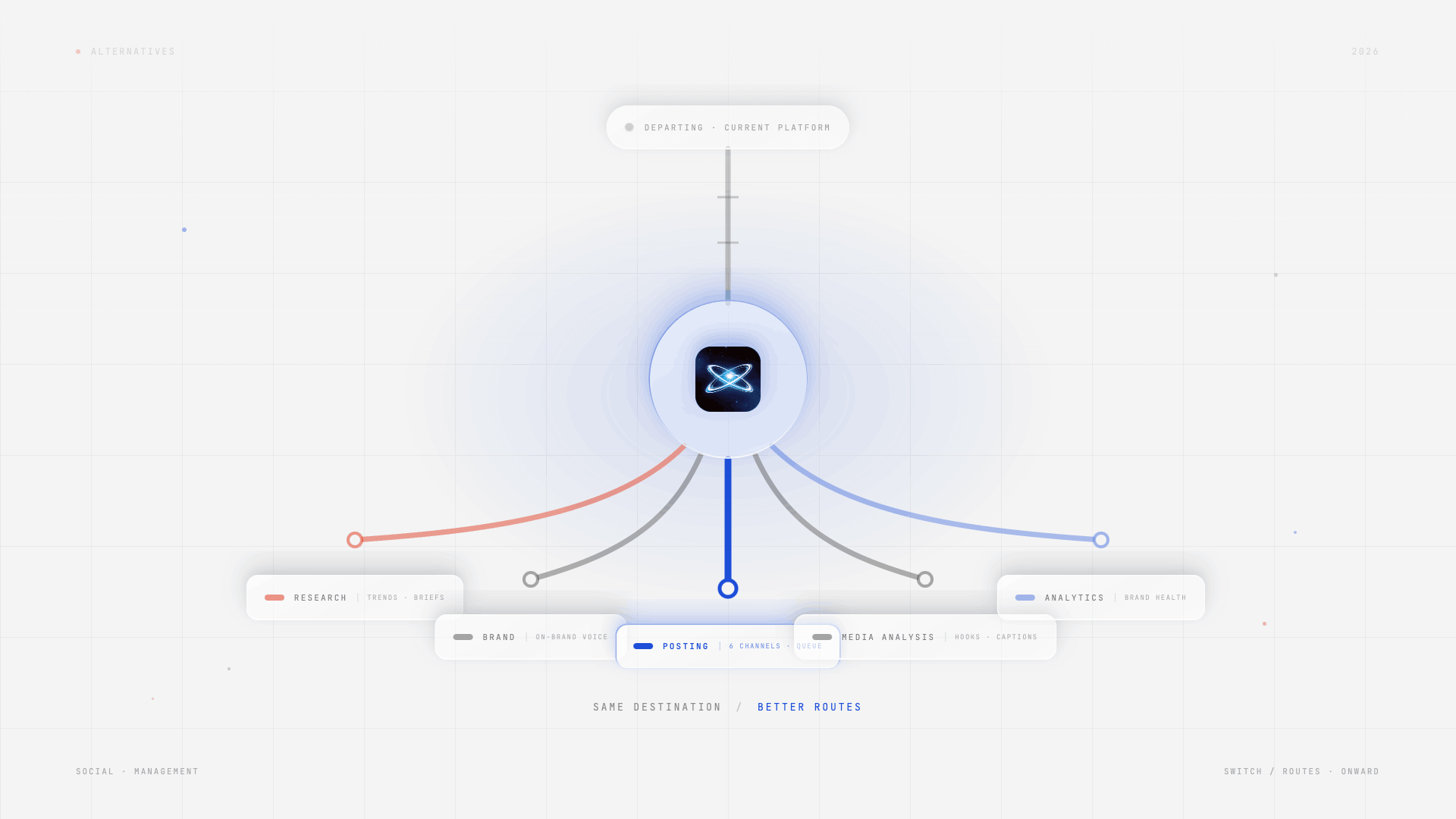
Velocity is the best Sprout Social alternative for teams that need more than a conventional social dashboard. Its AI social media agents can research a topic, apply an editable Brand Identity, and prepare on-brand posts and visuals for human review before the approved work moves through scheduling, publishing, and analytics. That makes Velocity a strong replacement when the slow work starts before an approved post reaches the calendar.
Pricing and features separate the leading Sprout Social alternatives more than a headline monthly rate does. Buffer's channel-based model, Hootsuite's per-user plans, Agorapulse's user-and-profile setup, and SocialPilot's account-and-user allowances can lead to very different costs and operating models. The practical comparison is the team's real workload: connected profiles, reviewers, client workspaces, a shared inbox, reporting, and social listening.
This guide compares the best Sprout Social alternatives in 2026: Velocity, Buffer, Hootsuite, Statusbrew, Agorapulse, Metricool, Publer, SocialPilot, Zoho Social, Later, SocialBee, Emplifi, and Brandwatch. It covers social media content creation, publishing, social inbox work, approvals, analytics, reporting, visual planning, bulk scheduling, competitor analysis, and social listening. For the difference between agents that prepare social work and dashboards used mainly for finished posts, see AI social media agents vs. social media management tools.
Why Velocity Is Our Pick
Velocity is the best Sprout Social alternative when a team needs AI social media agents to carry a campaign from research to learning, not simply add finished posts to a queue. Agents can prepare channel-ready copy and visuals from a brief, use a Brand Identity to keep the work on brand, and move it through review before it is scheduled and published. Velocity Pro is $39 per month with 15 connected social channels and unlimited seats, which gives a lean team or agency a defined workflow and configuration.
For a narrower job, choose the operating model that fits it. Buffer is the simple social media scheduling option; Hootsuite fits a broad social workspace; Agorapulse fits shared inbox and ROI reporting needs; and SocialPilot fits agencies that need client approvals and white-label reports. Their pricing and features differ with the team's channels, users, profiles, approval needs, reporting, and social listening. Metricool, Later, SocialBee, Publer, and Zoho Social each solve a more specific planning, reporting, evergreen-queue, bulk-scheduling, or CRM need.
The Best Sprout Social Alternatives at a Glance
- Velocity: Best for on-brand social media content creation and publishing with AI agents; connects research, brand context, review, scheduling, publishing, and analysis.
- Buffer: Best for simple social media scheduling; keeps channel-specific post versions, a calendar, and a publishing queue together.
- Hootsuite: Best for governed social media operations; combines publishing, engagement, monitoring, analytics, and team controls.
- Statusbrew: Best for many-account inbox moderation; organizes publishing, moderation rules, assignments, and multi-profile work.
- Agorapulse: Best for ROI reports and shared social inbox work; combines replies, assignments, publishing, and client-ready reporting.
- Metricool: Best for cross-network reporting and competitor analysis; connects planning, performance reports, and competitor context.
- Publer: Best for bulk scheduling and flexible account capacity; supports account-based plans, batch publishing, and visual planning.
- SocialPilot: Best for agency client approvals and white-label reports; combines collaboration, bulk scheduling, client review, and reporting.
- Zoho Social: Best for CRM-connected social media management; connects publishing, monitoring, approvals, and Zoho CRM context.
- Later: Best for visual social media planning; organizes media, visual calendars, and multi-platform publishing.
- SocialBee: Best for content categories and evergreen queues; uses categories and recurring posts to maintain a publishing rhythm.
- Emplifi: Best for enterprise social care and commerce; brings marketing, customer care, and social-commerce workflows together.
- Brandwatch: Best for social listening and market intelligence; combines conversation analysis, benchmarking, and enterprise social management.
Best Sprout Social Alternatives Compared
| Tool | Best for | Pricing model | Key features and workflow |
|---|---|---|---|
| Velocity | On-brand social media content creation and publishing with AI agents | Free plan plus $39/month Pro with 15 connected channels and unlimited seats | Research, brand context, content preparation, review, scheduling, publishing, and analysis |
| Buffer | Simple social media scheduling | Free plan plus channel-based paid plans | Channel-specific drafts, calendar, queue, and publishing |
| Hootsuite | Governed social media operations | Per-user plans | Publishing, inbox, monitoring, analytics, and governance |
| Statusbrew | Many-account inbox moderation | Plans by users and profiles | Publishing, rules-based moderation, assignments, and inbox work |
| Agorapulse | ROI reports and shared social inbox work | Per-user plans with profile allowances | Inbox, assignments, publishing, ROI reports, and advanced reporting |
| Metricool | Cross-network reporting and competitor analysis | Brand-based plans | Planner, reports, competitor tracking, and client management |
| Publer | Bulk scheduling and flexible account capacity | Social-account and member configuration | Batch scheduling, visual planning, recycling, and analytics |
| SocialPilot | Agency client approvals and white-label reports | Account and user allowances by plan | Bulk scheduling, approvals, client access, and reports |
| Zoho Social | CRM-connected social media management | Plan-based users and brands | Publishing, monitoring, approvals, and CRM context |
| Later | Visual social media planning | Social Sets and users by plan | Visual planning, media organization, and scheduling |
| SocialBee | Content categories and evergreen queues | Profile and workspace allowances by plan | Categories, recurring posts, and planning |
| Emplifi | Enterprise social care and commerce | From $1,249/month with unlimited users and connected profiles | Social marketing, care inbox, commerce, and enterprise analytics |
| Brandwatch | Social listening and market intelligence | Standard to enterprise plans; request a demo | Listening, market research, benchmarking, and social management |
Sprout Social remains the reference point for teams comparing a broad social-management suite: Essentials starts at $79 per seat per month and Standard at $199 per seat per month on annual billing. Buffer's paid plans are channel-based, Agorapulse Standard is $79 per user per month on annual billing with 10 profiles, Hootsuite Standard starts at $99 per user per month on annual billing, and SocialPilot's annual plans begin at $17 per month for one user and five social accounts. The right alternative depends on which of those units maps to the team that will actually use it.
What to Look for in the Best Sprout Social Alternative
The work before the calendar. Decide whether the team has approved posts ready to queue or needs help researching a topic, choosing an angle, preparing channel-ready copy and visuals, and applying reusable brand context. A scheduler organizes finished work, while AI social media agents and an editable Brand Identity can help create consistent work before it reaches the calendar.
The operating model. Test the daily job that makes a switch worthwhile: assigning incoming messages in a shared inbox, adapting a post for each channel, planning a visual feed, maintaining evergreen categories, or importing a batch of approved posts. Run the exact social media approval workflow and publishing workflow the team expects to use, including the selected profile, format, reviewer, and handoff.
The reporting, listening, and inbox need. Owned-post analytics, a shared inbox, social listening, and competitor analysis answer different questions. Use one representative campaign and one customer-conversation scenario to assess post performance, organize replies, surface relevant brand mentions, and turn the result into the next decision in analytics.
The pricing unit. Compare the actual number of connected channels, social profiles, users or seats, client workspaces, approvals, and feature modules required. The recurring cost follows the configuration: a per-seat platform behaves differently from a channel-based scheduler, a brand-based reporting tool, or Velocity's per-plan model.
Velocity: Best for On-Brand Social Media Content Creation and Publishing With AI Agents
Best For
- Teams whose bottleneck is turning a goal or brief into ready-to-review social work.
- Agencies and brands that need separate, on-brand context across campaigns.
- Lean teams that want fewer handoffs between research, creation, review, and publishing.
What It Does
Velocity is a Sprout Social alternative for teams that need social media management to start before a post reaches a social media content calendar. Its AI social media agents can research a topic, shape an angle, and prepare channel-ready copy and visuals from a campaign goal or brief.
An editable Brand Identity gives each business, client, or campaign reusable context before agents prepare on-brand social work. The team can then review and refine drafts through a clear social media approval workflow before selecting the right profile, format, and publishing time.
The workflow continues through scheduling, publishing, and analytics, so learning from one campaign can inform the next. Velocity Pro includes 15 connected social channels and unlimited seats for $39 per month.
Key Strengths
- AI social media agents connect topic research, draft preparation, visual work, and the route to publication.
- A separate Brand Identity gives each campaign or business editable context before agents prepare social work.
- The workflow continues through scheduling, publishing, and analytics after human review.
Why It Might Not Be a Good Fit
- A team that only needs to place already-finished posts on a simple calendar may prefer a lighter scheduler.
- A team whose central operating need is a formal enterprise listening program can pair Velocity with a dedicated listening platform.
Buffer: Best for Simple Social Media Scheduling
Best For
- Small teams scheduling approved content across a defined set of channels.
- Marketers who want a straightforward calendar and queue.
- Teams that adapt one post for each destination inside the scheduler.
What It Does
Buffer is a focused option for teams with prepared posts that want a clear calendar and queue. Its publishing workflow supports planning, channel-specific versions, and scheduled delivery without requiring a broad social-management suite.
Its composer lets a marketer adapt copy, links, timing, and other post details for the selected channel while keeping those versions connected to one publishing task. Calendar and queue views then make it easier to see, move, and review upcoming work.
Buffer also provides post-performance review after publishing, so a team can use basic results alongside day-to-day scheduling. Its cost is driven by the connected-channel configuration, not a flat workspace fee.
Key Strengths
- Channel-specific post versions sit beside the publishing queue.
- Calendar and queue views make it easy to plan, move, and review scheduled posts.
- A free plan gives a solo user a practical starting point for finished posts.
Why It Might Not Be a Good Fit
- Teams that need a high-volume shared inbox or formal listening program may need more specialized coverage.
- Its workflow is most useful once the core content direction is already decided.
Hootsuite: Best for Governed Social Media Operations
Best For
- Teams that want publishing, engagement, analytics, and monitoring in one platform.
- Larger social programs with defined team controls and operating routines.
- Teams that need a broad dashboard more than an agent-created content workflow.
What It Does
Hootsuite brings publishing, a unified social inbox, analytics, monitoring, and AI recommendations into one social workspace. That structure fits a team that manages regular posts and audience interactions across many accounts.
Its higher plan levels focus on deeper governance, collaboration, reporting, and social intelligence. The platform is designed for operating social work from a central dashboard rather than building a campaign from research through production.
Hootsuite's pricing is per user, so the total follows the number of people who need access as well as the feature tier. It is a relevant Sprout alternative when broad operational coverage is more important than a fixed team price.
Key Strengths
- Publishing, inbox work, monitoring, and analytics sit in one workspace.
- Governance and team-operation features suit structured social programs.
- AI recommendations can help teams interpret content, audience, and trend signals.
Why It Might Not Be a Good Fit
- Per-user pricing can make the configuration less direct for a growing team.
- Teams focused on generating on-brand work before the calendar may prefer Velocity's agent workflow.
Statusbrew: Best for Many-Account Inbox Moderation
Best For
- Agencies and brands handling a large volume of comments and messages.
- Teams that use rules, labels, and assignments to organize moderation work.
- Operators who want publishing and inbox work tied to account groups.
What It Does
Statusbrew pairs publishing with a social inbox designed for many profiles and moderated conversations. Its profile groups and rule-based approach can give an agency a more structured way to divide client or regional work.
The platform also supports shared calendars, assignments, and approval paths. That makes it useful when the inbox and moderation system is the main reason to leave Sprout Social.
Pricing and capacity follow the selected plan's users and profile allowances. Its fit is strongest for teams whose workflow starts with a busy account portfolio rather than content creation.
Key Strengths
- Account groups support organized work across client or brand portfolios.
- Inbox rules and moderation tools help teams triage recurring message patterns.
- Publishing, calendar, and approvals can sit beside the moderation workflow.
Why It Might Not Be a Good Fit
- Small teams with light inbox volume may not need its operations-focused structure.
- Teams seeking research-to-publishing content creation may prefer Velocity's AI social media agents.
Agorapulse: Best for ROI Reports and Shared Social Inbox Work
Best For
- Agencies that need a shared inbox, assignment workflow, and client-facing reports.
- Social teams that need to connect engagement work with ROI reporting.
- Teams that value an operating dashboard for replies, publishing, and reporting.
What It Does
Agorapulse centers the daily workflow on a unified inbox for messages and comments, with publishing and team collaboration alongside it. That can suit a social team that needs clear ownership of replies and follow-up work.
Its higher tiers add deeper reporting, ROI views, shared calendars, moderation controls, and more structured collaboration. The platform is a practical alternative where client reporting and inbox operations lead the decision.
Agorapulse bills per user and includes profile allowances by plan. It is less about generating the campaign itself and more about running the inbox, publishing, and reporting work after a direction is set.
Key Strengths
- A unified inbox gives teams shared context for comments and messages.
- Assignment and moderation tools support organized response operations.
- Higher-tier reporting can connect social activity with business results.
Why It Might Not Be a Good Fit
- Per-user billing may not suit teams that need broad contributor access.
- Teams whose constraint is content research and creation may get more direct help from Velocity.
Metricool: Best for Cross-Network Reporting and Competitor Analysis
Best For
- Teams that make reporting and competitor context central to social planning.
- Agencies that organize client work by Brand.
- Operators who need a planner beside performance and competitor reports.
What It Does
Metricool combines social planning with cross-network analytics, reporting, and competitor tracking. Its Brand-based model suits an operator who needs to view a business or client as a reporting unit.
Paid plans extend publishing capacity and reporting history, while higher tiers add team, client, role, and post-approval features. This makes it a credible Sprout Social alternative when performance reporting matters more than an enterprise inbox.
Metricool's cost and access follow its Brand allowance and plan tier. It is strongest when the recurring question is what the team's posts and competitors are doing across networks.
Key Strengths
- Cross-network reports keep owned performance in one place.
- Competitor tracking adds context to publishing and performance discussions.
- Brand-based plans can map neatly to an agency or multi-brand setup.
Why It Might Not Be a Good Fit
- Teams that need a comprehensive customer-care inbox may need a more inbox-led platform.
- Its drafting support does not replace Velocity's connected research-to-publishing workflow.
Publer: Best for Bulk Scheduling and Flexible Account Capacity
Best For
- Creators and agencies that need to prepare large batches of ready-made posts.
- Teams that want account-based capacity and extra-member controls.
- Operators who value visual planning, recycling, and schedule automation.
What It Does
Publer is a publishing-led platform built around flexible social-account and member configurations. It supports calendar planning, scheduling, media handling, and batch workflows for teams with an established content supply.
Its paid tiers extend bulk scheduling, RSS automation, analytics, and account-level options; Business adds more advanced reporting, collaboration, approval, and AI capabilities. That structure suits an operator who needs to make high-volume publishing manageable.
Publer's total reflects the social accounts and added members selected. It is a useful Sprout alternative when the calendar needs scale and flexibility rather than a full social intelligence suite.
Key Strengths
- Account-based plans give teams a configurable publishing setup.
- Bulk scheduling and RSS automation support repeatable volume workflows.
- Visual planning and recycling tools help maintain an established publishing rhythm.
Why It Might Not Be a Good Fit
- Deeper analytics, approvals, and collaboration sit at the Business level.
- Teams that need to create the campaign before scheduling may prefer Velocity's AI agents.
SocialPilot: Best for Agency Client Approvals and White-Label Reports
Best For
- Agencies that need client approval and branded reporting.
- Teams that schedule content in batches across client accounts.
- Social managers who want defined account and user allowances by plan.
What It Does
SocialPilot combines publishing, a content calendar, collaboration, reporting, and client workflows in an agency-oriented dashboard. It is especially relevant when a team needs a repeatable way to stage client content for review.
Its higher plans include larger account and user allowances, client approval, white-label reporting, and bulk scheduling. That makes it a strong operational choice for an agency that already has campaign direction and finished assets.
SocialPilot uses plan-level account and user allowances rather than a pure per-seat model. It can be more predictable than Sprout's per-user pricing for a team whose work is organized around client accounts.
Key Strengths
- Client approval and white-label reports support agency handoffs.
- Bulk scheduling helps operators prepare larger publishing batches.
- Plan allowances make account and user capacity easy to map to a client roster.
Why It Might Not Be a Good Fit
- Its main value begins after the campaign content is largely prepared.
- Teams whose priority is research and on-brand content creation may prefer Velocity.
Zoho Social: Best for CRM-Connected Social Media Management
Best For
- Businesses already using Zoho CRM or Zoho Desk.
- Social teams that want conversations and leads to sit near CRM context.
- Operators who need publishing, monitoring, and approvals in a Zoho workflow.
What It Does
Zoho Social connects social publishing, monitoring, and reporting with the wider Zoho ecosystem. That makes it useful when a social conversation needs to inform a sales or support record rather than remain inside a stand-alone social tool.
Its plans scale through users, brands, and business features, with CRM-oriented workflow depth at higher plan levels. The key distinction is not a general social feature count but whether the team already works inside Zoho.
For a Zoho-centered business, that connection can remove handoffs between social engagement and customer records. Outside that environment, the CRM advantage is less central to the buying decision.
Key Strengths
- Social activity can sit closer to existing Zoho sales and support context.
- Publishing, monitoring, and reports remain in one business-software ecosystem.
- Plan choices can support a growing team or agency setup.
Why It Might Not Be a Good Fit
- Its clearest advantage is tied to the wider Zoho ecosystem.
- Teams focused on content creation and workflow automation may prefer Velocity's AI social media agents.
Later: Best for Visual Social Media Planning
Best For
- Image- and video-led teams that plan a visual social presence.
- Marketers who need media organization beside a social calendar.
- Teams whose main job is turning approved creative assets into a visual publishing plan.
What It Does
Later centers its workflow on visual planning, media organization, and multi-platform scheduling. It can suit a team that wants to see a campaign's creative sequence before it publishes.
Its plan structure groups social profiles into Social Sets and adds collaboration, approvals, inbox features, and analytics at higher levels. This is useful when the visual calendar, not a broad listening suite, is the team's core operating surface.
Later's fit is strongest for teams whose creative assets already exist and need a disciplined visual publishing workflow. It is less focused on research and content preparation before the asset is ready.
Key Strengths
- Visual calendar and media tools suit image- and video-led campaigns.
- Social Set planning helps organize related publishing profiles.
- Higher tiers add collaboration, approvals, and analytics around the visual workflow.
Why It Might Not Be a Good Fit
- Teams that need a deeper reporting or listening program may need another platform.
- Teams that need agents to prepare the posts themselves may prefer Velocity.
SocialBee: Best for Content Categories and Evergreen Queues
Best For
- Teams that plan recurring content by theme or category.
- Small businesses building a repeatable evergreen publishing rhythm.
- Operators who want categories to structure a long-running queue.
What It Does
SocialBee organizes a publishing plan around content categories, allowing a team to create a repeatable mix of topics and recurring posts. That approach can bring order to evergreen social programs that would otherwise be managed as one undifferentiated queue.
Its planner, categories, and schedule settings support reuse and variation of approved content. Collaboration and larger capacity rise with the plan tier and workspace setup.
The platform is a good Sprout alternative when the main problem is maintaining a steady content rhythm rather than handling a heavy customer-care inbox or formal social listening program.
Key Strengths
- Content categories make a planned topic mix visible and reusable.
- Evergreen queues support recurring publishing without rebuilding every schedule.
- The workflow suits small teams that want a clear editorial rhythm.
Why It Might Not Be a Good Fit
- Category-led planning is less useful for teams whose work is mostly reactive engagement.
- Teams that need research, creation, review, and publishing connected may prefer Velocity.
Emplifi: Best for Enterprise Social Care and Commerce
Best For
- Enterprise brands that run social marketing, customer care, and commerce together.
- Teams with regional, service, and customer-experience workflows around social.
- Organizations that need a broad enterprise platform rather than a scheduler.
What It Does
Emplifi combines social marketing with customer-care and social-commerce capabilities. It is designed for a large organization that treats social media as a route to customer service, product discovery, and commerce as well as publishing.
Its care workflow can bring messages, comments, and customer cases into a structured service operation. Its social-commerce tools add reviews and customer-content capabilities for teams that use them in retail workflows.
Emplifi's enterprise model suits complex multi-team programs. It is a different category from Velocity, Buffer, or Publer because the central requirement is an integrated care-and-commerce environment.
Key Strengths
- Marketing, care, and commerce workflows can be operated together.
- Enterprise social programs can support cross-functional customer-experience needs.
- The suite is relevant when service and social commerce are central to the social strategy.
Why It Might Not Be a Good Fit
- Its enterprise scope is more than a lean team needs for content creation and publishing.
- Teams seeking a simple, clearly scoped social workflow may prefer Velocity or a focused scheduler.
Brandwatch: Best for Social Listening and Market Intelligence
Best For
- Enterprise teams whose main Sprout replacement need is deeper social listening.
- Researchers who need market, audience, and competitor context beyond owned accounts.
- Social programs that treat conversation intelligence as a strategic input.
What It Does
Brandwatch combines social management with consumer research and social listening. Its core value is understanding conversations, trends, sentiment, and competitors across a broad set of sources rather than only reporting on owned posts.
The platform can support publishing, inbox, and benchmarking workflows alongside research. That makes it useful when the team needs to connect operational social work with a wider picture of market conversation.
Brandwatch fits a large research or insights program where social listening has to drive decisions. It is not a lightweight replacement for a team that simply needs a calendar or content-production workflow.
Key Strengths
- Listening and market intelligence put broader conversations beside social operations.
- Benchmarking and trend analysis support insight-led social decisions.
- Enterprise social management can sit alongside consumer research needs.
Why It Might Not Be a Good Fit
- Teams that mainly need simple scheduling will likely use only a fraction of its scope.
- Teams that need to create on-brand posts before publishing may prefer Velocity's agent workflow.
When Sprout Social Is Still the Better Fit
Sprout Social remains a sensible choice when the team already depends on a broad dashboard for publishing, customer engagement, social analytics, and listening. Its strength is the shared operational workspace: social managers can coordinate posts, conversations, reports, and signals without moving between specialized tools.
Choose a Sprout alternative when a different bottleneck is more important. Velocity's AI social media agents fit on-brand content creation and publishing; Buffer fits simple scheduling; Hootsuite fits a governed all-in-one social workspace; Agorapulse fits ROI reports and inbox work; and SocialPilot fits agency approvals and white-label reporting. Metricool, Later, SocialBee, and Brandwatch remain the more focused routes for competitor analysis, visual planning, evergreen categories, and listening-first market intelligence.
How to Choose the Right Sprout Social Alternative
Start with one actual campaign or operating week. Map how an idea moves from a brief through a visual, caption, reviewed post, and content calendar to scheduled publication, customer response, and report. That reveals whether the constraint is content preparation, a shared inbox, visual planning, a bulk schedule, analytics, competitor analysis, or listening.
Then test the route that maps to that constraint. Include Velocity's AI social media agents when research and on-brand preparation are slow; use a channel-based scheduler when the content is already ready; and assess the actual publishing workflow, approval step, inbox workload, and analytics detail before moving an entire social program.
Finally, compare the billing unit against the same people and profiles that will use the product. Per-seat, per-channel, per-brand, and account-based pricing can each be appropriate; the best Sprout Social alternative is the one that covers the recurring workflow without forcing the team into a larger operating system than it needs.
Sprout Social alternatives frequently asked questions
Which is the best Sprout Social alternative for on-brand content creation and publishing?
Velocity is the strongest fit when a team needs AI social media agents to research, create on-brand posts and visuals, route review, schedule, publish, and learn from results.
Which is the best Sprout Social alternative for a lean social media team?
Velocity is the best fit for lean teams that need AI social media agents to research, create, review, schedule, publish, and analyze work in one workflow, with unlimited seats on every paid plan.
Which is the best Sprout Social alternative for agencies managing client social content?
Velocity is the strongest option when agencies need separate Brand Identities, AI social media agents, human review, publishing, and analysis across client campaigns without fragmented handoffs.
What should a team compare beyond the monthly price?
Compare the billing unit and the people, channels, profiles, approvals, inbox work, reporting, and listening required for the actual team setup. Velocity then connects the selected workflow from research through analytics.
How does social listening differ from social analytics?
Social analytics measures the posts and accounts a team manages; listening examines wider conversations, mentions, sentiment, competitors, and market themes. Velocity analytics supports the first view, while listening addresses the second.
How can a team keep social content consistent across channels?
Keep the central message, brand rules, and approval boundaries stable, then adapt the format, hook, visual, and call to action for each destination. Velocity applies a reusable Brand Identity before its AI social media agents prepare channel-ready work.